Jacob & Co. Astronomia Solar Zodiac: A Miniature Solar System on the Wrist

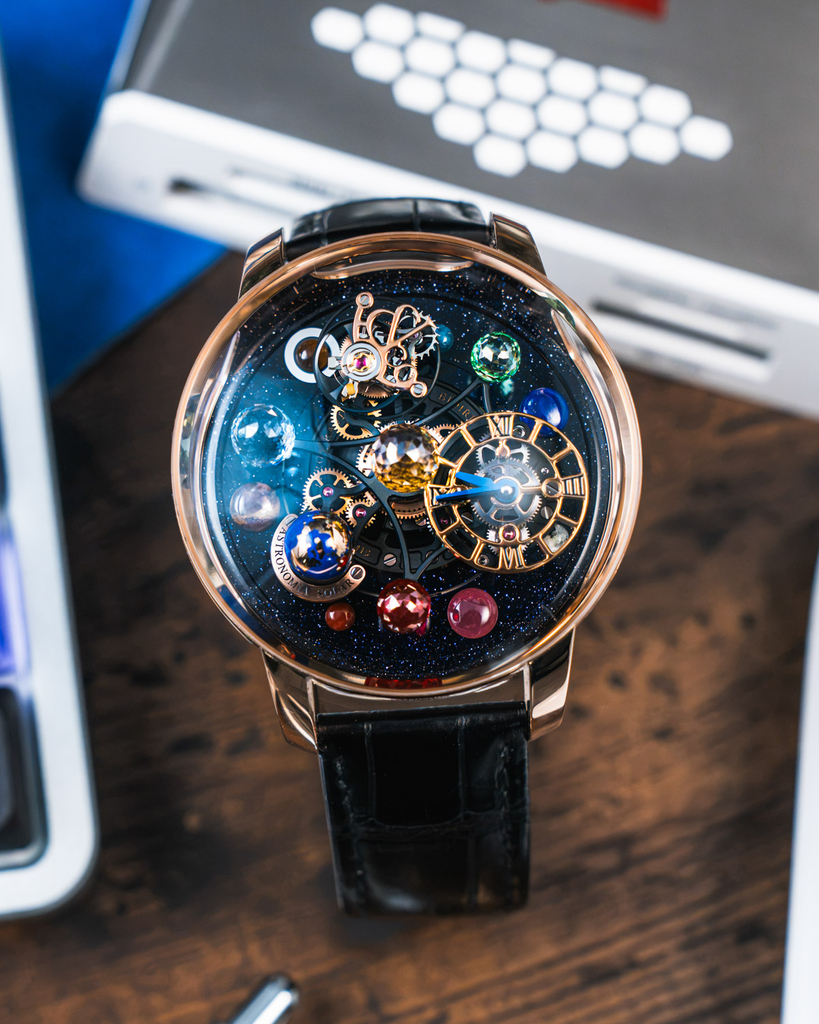
If there’s one thing Jacob & Co. is great at, it’s putting on a horological spectacle. Case in point is the Jacob & Co. Astronomia Solar Zodiac watch. With a miniature solar system orbiting a golden Sun, a rotating tourbillon, and a mechanical movement that seems to defy gravity, this is a timepiece designed to be watched as much as worn. The Astronomia Solar Zodiac usually has images of the Zodiac signs for hour markers, but we got our hands on a unique piece with Roman numerals at 12, 3, 6 and 9 o’clock. Let’s take a closer look at this celestial creation.
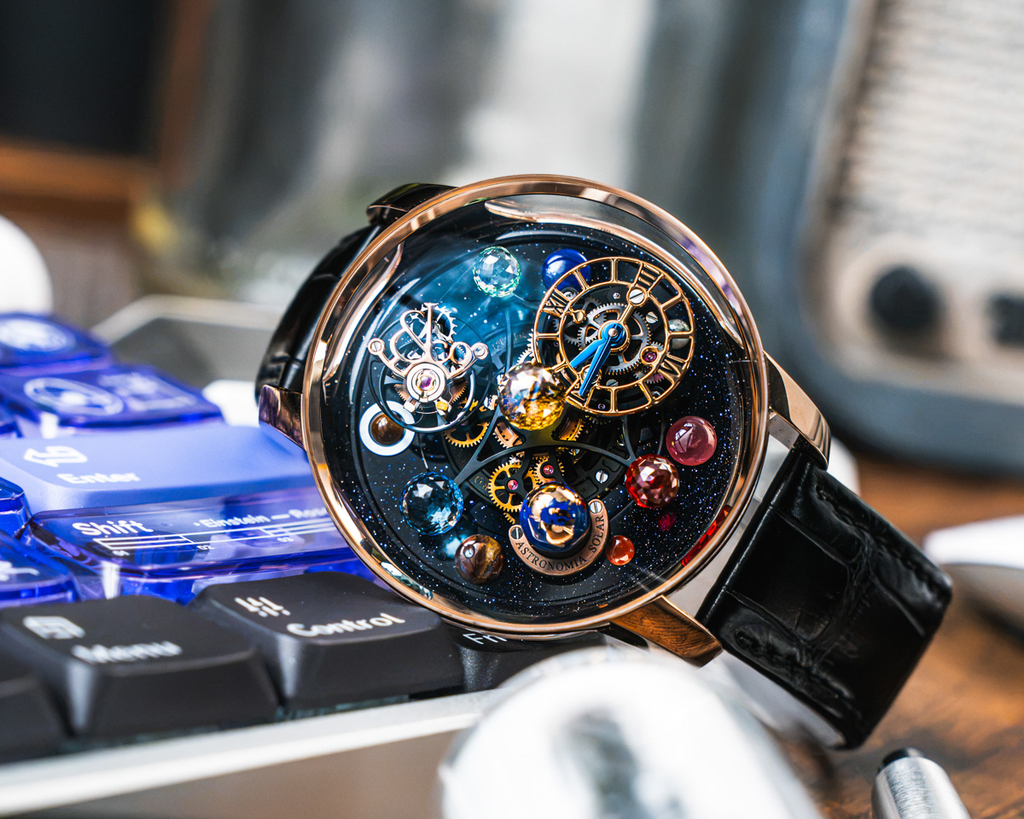
Jacob & Co. Astronomia Solar History & Design
The Astronomia collection debuted at Baselworld 2014 with the Astronomia Tourbillon, a watch that marked a turning point for Jacob & Co., previously better known for its extravagant jewelry watches. Rather than housing a conventional movement beneath a dial, the Astronomia Tourbillon placed its mechanical components on four rotating arms, including a tourbillon, a time display, and a miniature globe representing Earth.

The entire assembly revolved inside an enormous sapphire crystal case, turning the movement itself into the main attraction. The concept attracted considerable attention and became the foundation for an expanding collection of increasingly elaborate mechanical watches.
In 2017, Jacob & Co. introduced the Astronomia Solar, reworking the original four-arm architecture into a three-arm movement and adding a miniature representation of the solar system. The concept subsequently appeared in several variations, including the Astronomia Solar Zodiac, with its distinctive planetary and celestial decorations.
Interestingly, the example featured here–with Roman numerals instead of Zodiac signs for hour markers–bears the same reference number (AS310.40.SP.ZK.A) as the standard Astronomia Solar Zodiac, This unique piece is a particularly striking variation of the Astronomia Solar design.
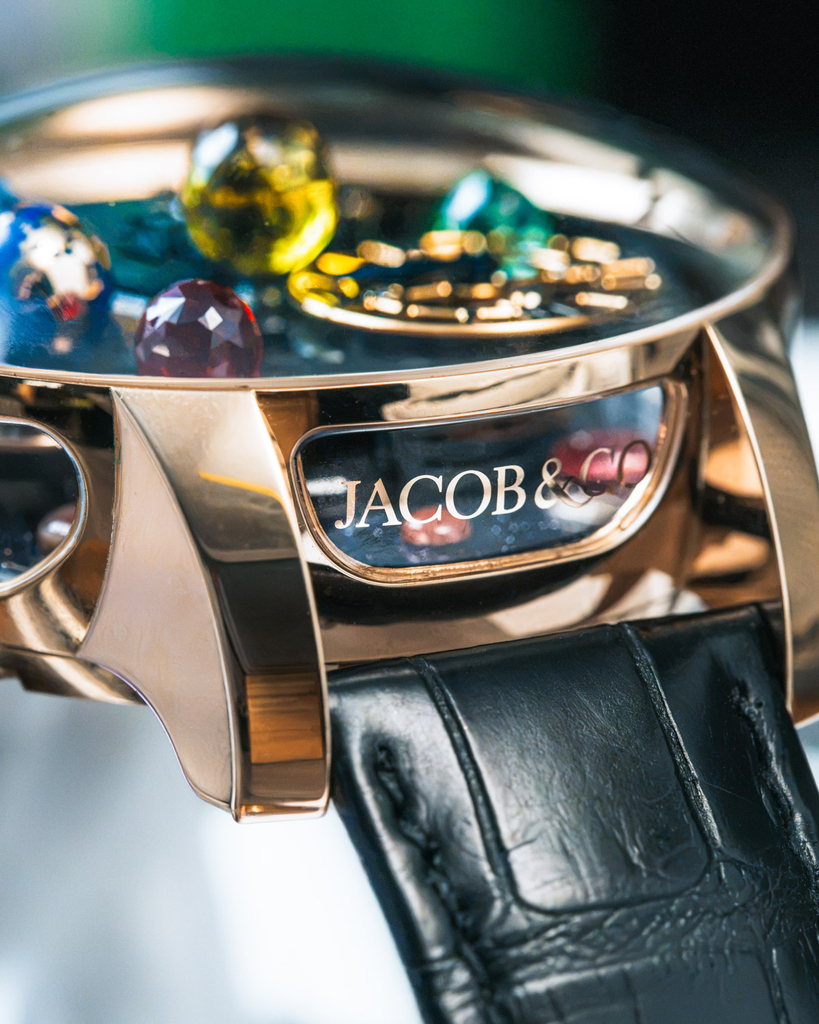
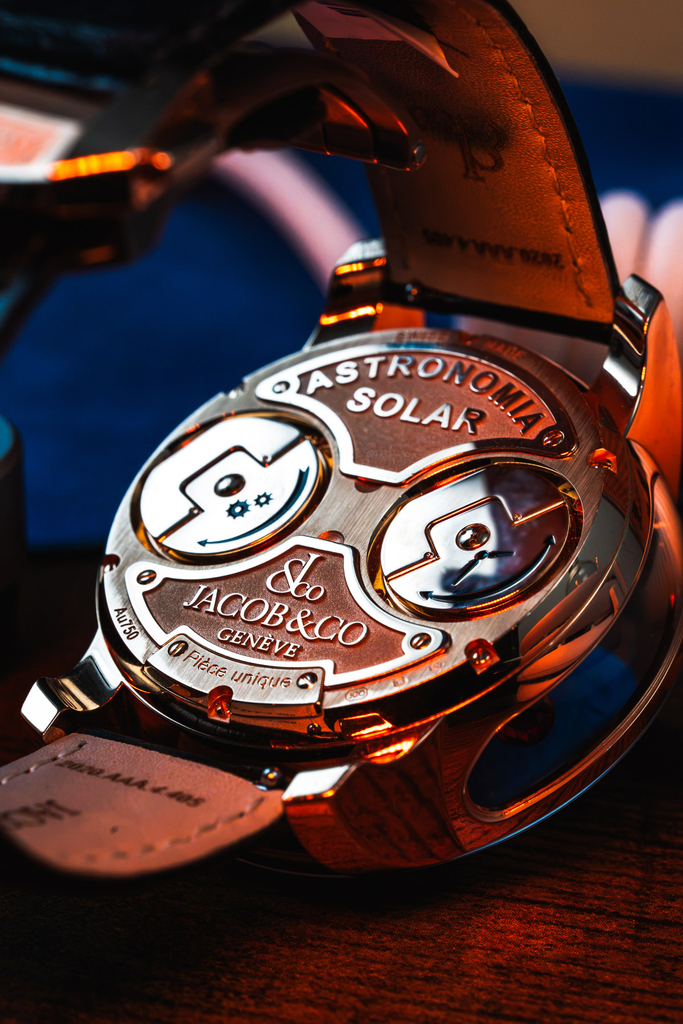
The 18k rose gold case measures 43.4mm across and 21mm thick, with a domed sapphire crystal and transparent sides that offer views of the movement from almost every angle. Its crownless construction leaves the sides completely unobstructed, with winding and time-setting controls relocated to the caseback.
Beneath the rotating components of the Jacob & Co. Astronomia Solar Zodiac is a dark blue aventurine backdrop resembling a star-filled sky, with seven gemstone planets within it.
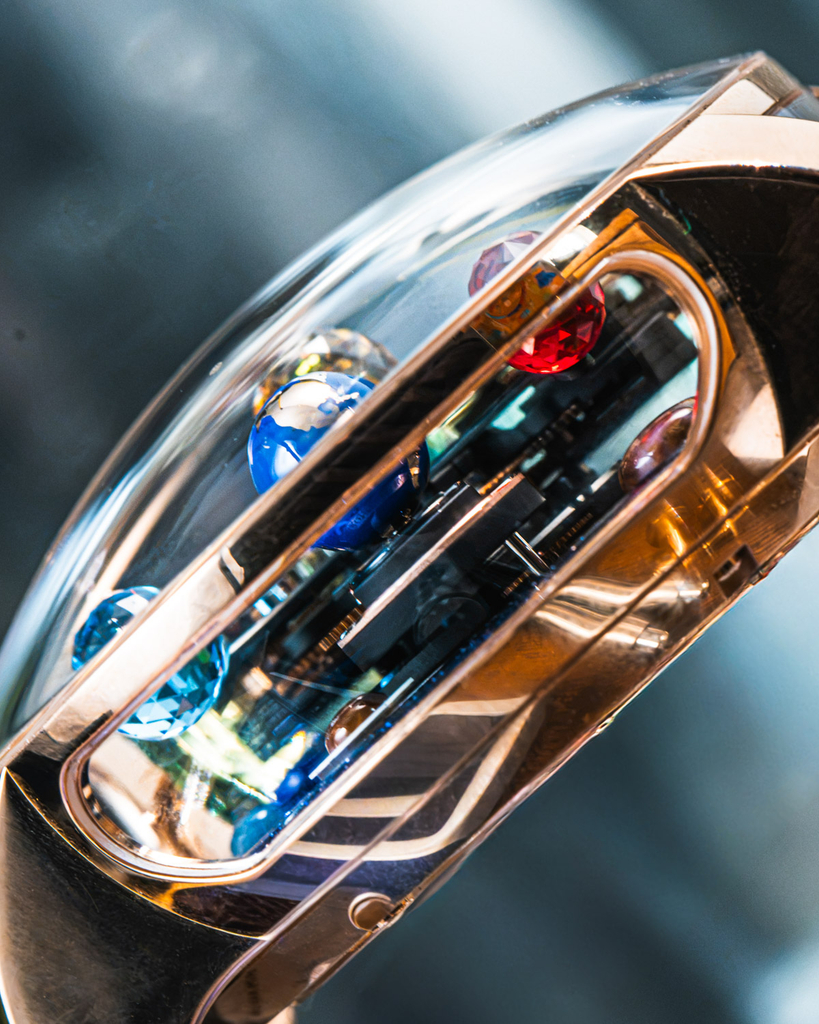
The planets are represented by white granite for Mercury, rhodonite for Venus, red jasper for Mars, pietersite for Jupiter, tiger’s eye for Saturn (complete with rose gold rings), blue calcite for Uranus, and lapis lazuli for Neptune. A separate miniature globe representing Earth is carried by the movement.
At the top of the rotating assembly sits a 1.5-carat citrine representing the Sun, accompanied by three additional gemstone planets mounted on the rotating arms. All four stones feature Jacob & Co.’s signature Jacob-cut, with 288 facets designed to catch the light from multiple angles. The planetary display is decorative rather than astronomically accurate, but the constantly moving components create the impression of a miniature solar system in motion.
Movement & Mechanics
The Astronomia Solar Zodiac is powered by the manually wound Jacob & Co. Caliber JCAM19, developed with watchmaker Luca Soprano of Studio 7h38. Comprising 447 components, the movement features a three-armed assembly that completes one clockwise revolution every 10 minutes, twice as fast as the original Astronomia Tourbillon.
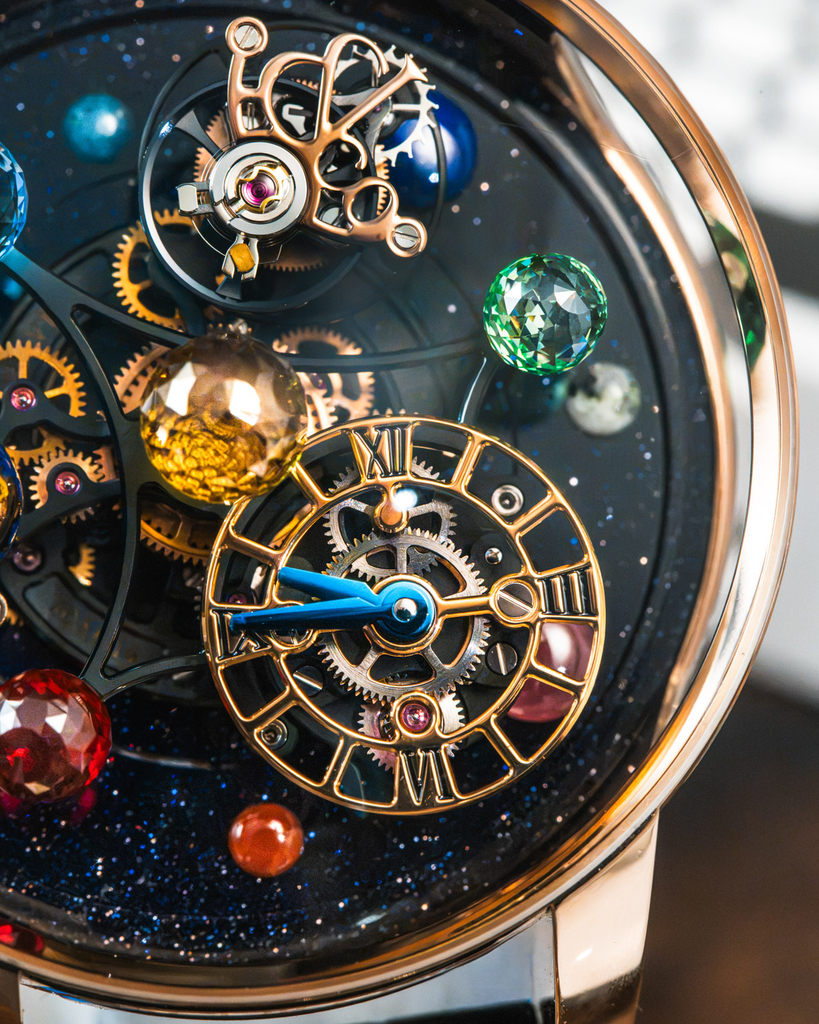
One arm carries a miniature Earth that spins on its axis every 60 seconds, while another supports a one-minute flying tourbillon that also travels around the dial, effectively creating a two-axis tourbillon. The third arm holds the skeletonized time display, which uses a differential gearing system to keep the Roman numerals upright as the entire assembly rotates.
Meanwhile, the aventurine disc carrying seven gemstone planets turns counterclockwise every 10 minutes.

Despite all this mechanical activity, the JCAM19 operates at 28,800 vibrations per hour and delivers a 48-hour power reserve. Rather than using a conventional crown, the watch is wound and the time adjusted via two fold-out rose gold keys, known as bows, located on the caseback. These hinged controls sit flush against the caseback when not in use.
Astronomia Solar Watch Specs
| Model | Jacob & Co. Astronomia Solar (Unique Piece) |
| Reference | AS310.40.SP.ZK.A |
| Case | 18K rose gold 43.4mm diameter 21mm thick Domed sapphire crystal and sapphire case sides Crownless design 30m water resistance |
| Dial | Blue aventurine with seven gemstone planets 1.5-carat citrine Sun, rotating Earth globe Skeletonized Roman numeral time display |
| Movement | Jacob & Co. JCAM19 Manual winding 447 components 28,800 vph (4 Hz) 48-hour power reserve |
| Functions | Hours, minutes, one-minute flying tourbillon Rotating Earth, 10-minute orbital rotation of three-arm assembly and planetary disc |
| Winding & Setting | Two fold-out keys on the caseback |
| Limited Edition | Unique Piece |
The Jacob & Co. Astronomia Solar in Perspective
The Astronomia Solar Zodiac was produced in a limited edition of 101 pieces, but this particular example is a unique piece distinguished by its Roman numeral time display. The opposing rotations, spinning Earth, and traveling tourbillon make it possible to spend several minutes watching the movement without once looking at the time-telling hands.
The Jacob & Co. Astronomia Solar was created to entertain, surprise, and demonstrate just how far a mechanical wristwatch can depart from convention.
Jacob & Co.’s extravagant creations certainly aren’t for everyone, but there’s something admirable about a watchmaker so thoroughly committed to the pageantry of it all. When Jacob & Co. sets out to create something outrageous, it rarely does things by halves, and the Astronomia Solar is a perfect example of that unapologetic approach to watchmaking.
More on High-End Independent Watchmakers:






Leave a Reply