The Ultimate Rolex Daytona Buyer’s Guide

The Rolex Cosmograph Daytona is one of the most collectible and identifiable luxury sports watches there is. That wasn’t always the case–the original Cosmograph began in 1963 as a relatively unknown manual-wind competitor to the Omega Speedmaster. But since the first automatic Daytona debuted in 1988, its popularity has grown and grown. Today, the Rolex Daytona, now in its 4th generation, has a famously long waitlist. We’ll quickly break down the traits (and secondhand values) of all of the variants.
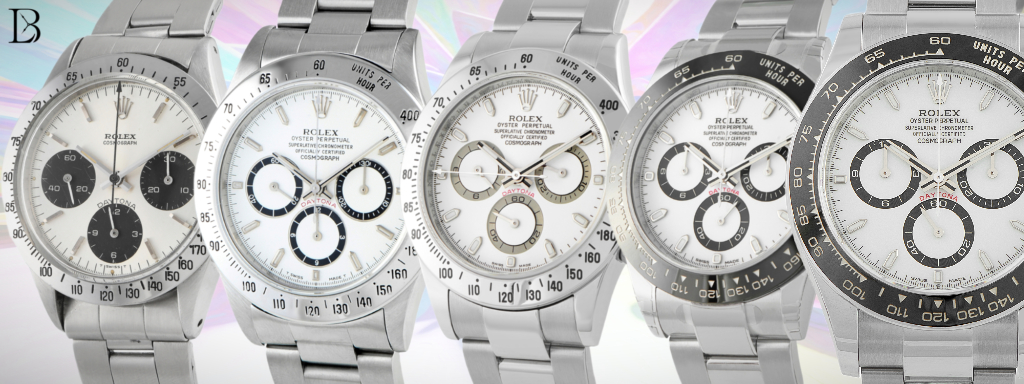
Before the Rolex Daytona
Although the Cosmograph first appeared in 1963, Rolex has been making chronograph watches since the 1930s. You can see my master list of Rolex chronographs to see the numerous references they made over the years, but none of them were major commercial successes.
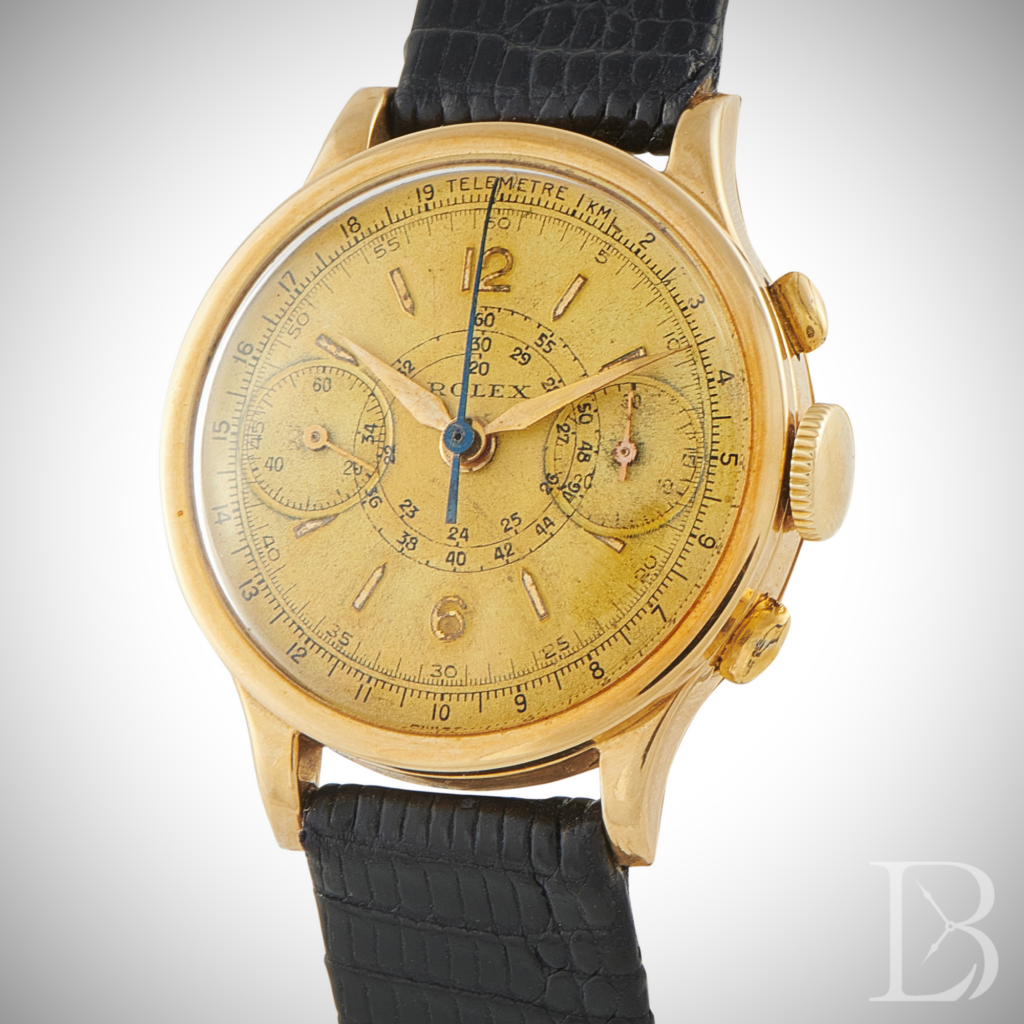
Most were pretty similar to chronographs available from other brands with comparable third-party movements. In fact the term “in-house movement” wasn’t really even a thing until this century.
Although you might occasionally hear the term “pre-Daytona” to refer to any Rolex chronograph from 1962 or earlier, it usually refers specifically to the Rolex ref. 6238, which looks very much like a tachymeter-less version of the Cosmographs that immediately followed it.
Why “Cosmograph?”
The name “Cosmograph” seemingly makes little sense for a chronograph watch which has no particular relation to outer space. And that’s because “Cosmograph” originally described an early Rolex moonphase watch, ref. 6062:
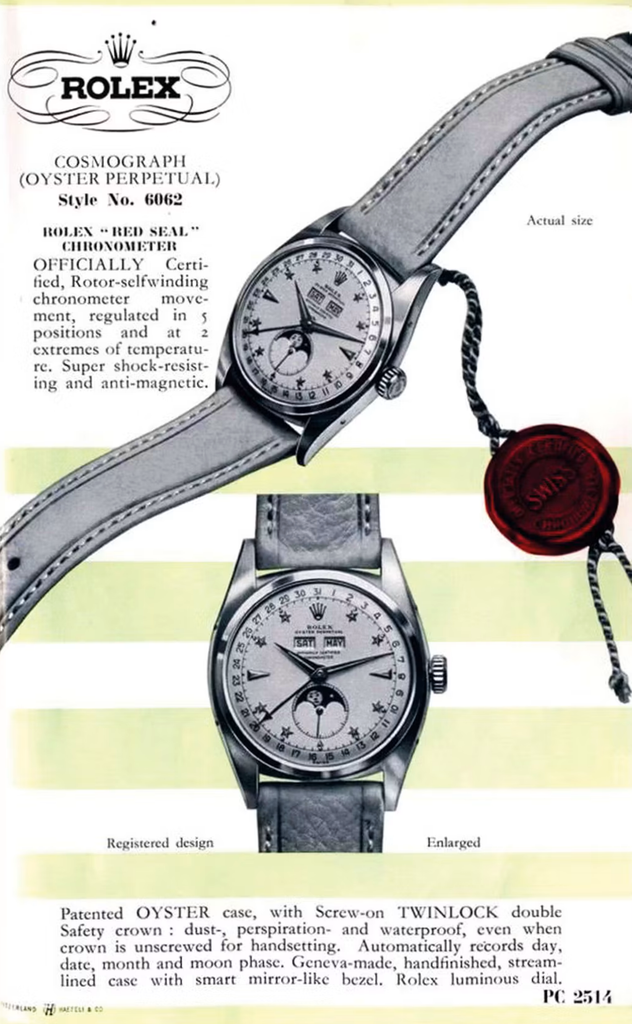
Rolex has a long history of reusing trademarks and “Cosmograph” is only one example of that, although nobody actually says “wow that’s a nice Cosmograph Daytona!” They’ll just call it a “Daytona.” Now let’s go over all the variants.
4-Digit Rolex Daytona (1963-1988)
The Rolex Cosmograph debuted in 1963, and the “Daytona” part was added to the dial a couple years later. 4-digit Rolex Cosmograph Daytona models have 37.5mm cases, manual Valjoux movements, acrylic crystals, and two main features that set them apart from previous Rolex chronographs: contrasting subdials, and a tachymeter bezel (aside from extremely rare diamond-bezel versions).
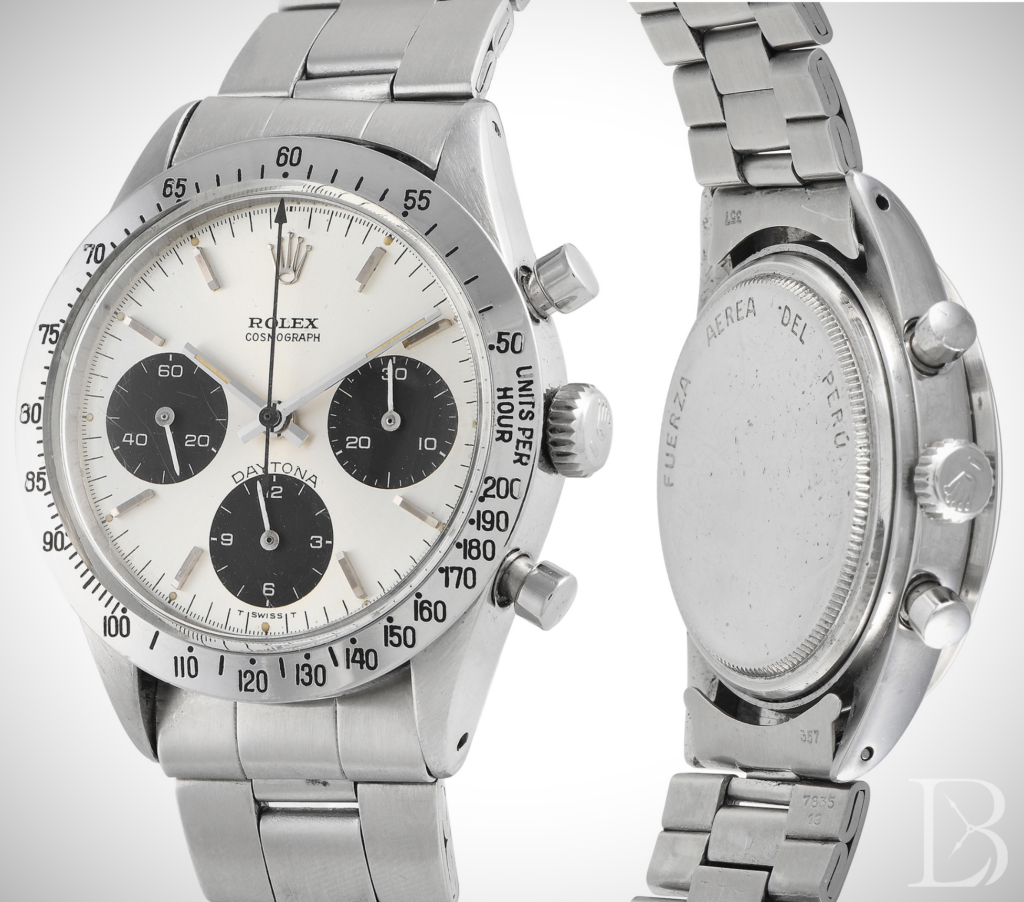
That tachymeter bezel came in two different materials: black acrylic, or solid metal as on the 6239 shown above. Today, tachymeter scales are extremely common on chronograph bezels, but that was really all started by the Omega Speedmaster in 1957.
Vintage Daytona Dials
First-generation Rolex Daytonas were made in three metals: stainless steel, 18k yellow gold, or 14k yellow gold (mostly sold in the US, which taxed 18k gold heavily at the time). Steel buyers essentially had four dial options: standard silver, standard black, exotic cream, and exotic black.
The exotic dials (a.k.a. “Paul Newman dials“) have “square lollipop” markers in the subdials along with a distinctive art deco numeral font and a contrasting chapter ring.
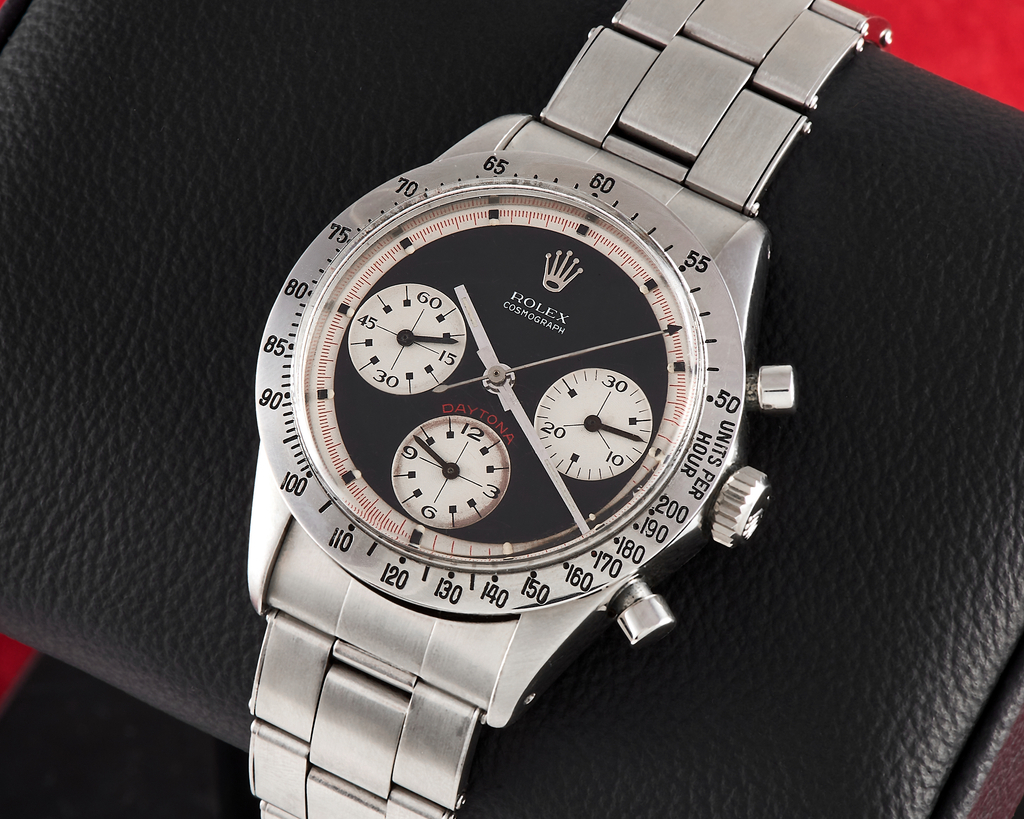
For gold models, champagne replaces the silver and cream hues but the options are otherwise basically the same. And on all 4-digit Daytonas, the subdials are the “opposite” color of the rest of the dial; the so-called “Albino” Daytona turned out to be a fabrication.
Manual-Wind Daytona Movements
Four-digit Rolex Daytonas used the manually wound Valjoux calibers 72B (approximately 1963–1965), 722 (1965–1967), and 722-1 (1967–1969), all beating at 5 beats per second. Then from 1969 until the end of the generation, Rolex used the Valjoux 727, which increased the rate to 6 beats per second. The 5 bps versions match the actual scale on the dial better, as there are 5 hash marks per second, but oh well.

By 1973, all Daytonas had screwdown pushers, but the first ones just had simple “pump” pushers. Here’s a quick cheat sheet of all manual-wind Rolex Daytona references:
4-Digit Daytona References
| Reference | Bezel | Pushers | Approx. production years | Rarity |
|---|---|---|---|---|
| 6241 | Acrylic | Pump | 1966–1969 | Rare |
| 6264 | Acrylic | Pump | 1970–1972 | Very rare |
| 6239 | Metal | Pump | 1963–1969 | Relatively common |
| 6262 | Metal | Pump | 1970–1971 | Very rare |
| 6240 | Acrylic | Screwdown | 1965–1969 | Very rare |
| 6263 | Acrylic | Screwdown | 1971–1987 | Relatively common |
| 6265 | Metal | Screwdown | 1971–1987 | Relatively common |
| 6269 | Diamond-set gold, brilliant-cut | Screwdown | 1984-1987 | Extremely rare |
| 6270 | Diamond-set gold, baguette-cut | Screwdown | 1984-1987 | Rarest |
Vintage Rolex Daytona Prices
Here’s a general idea of what you should expect to pay for a typical example of a 4-digit Daytona nowadays:
- Steel with normal dial: $70,000-$110,000
- Gold with normal dial, or steel with Paul Newman dial: $350,000-$450,000
- Gold with Paul Newman dial: $1,000,000+
- Brilliant diamond bezel: $1,500,000+
- Baguette diamond bezel: $4,000,000+
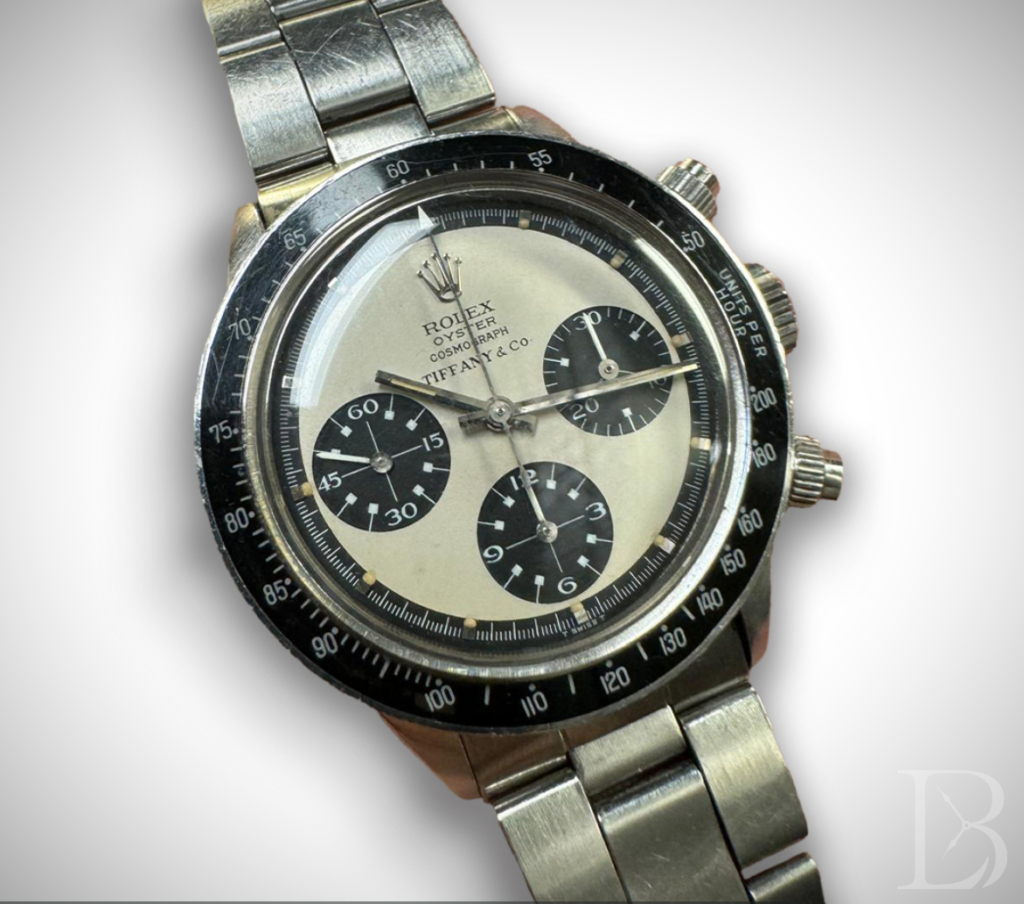
Rare dial variants, like the Oyster Sotto/RCO, Reverse Oyster, Lemon, Musketeer, Arabian Knight, or anything with a Tiffany & Co. stamp, can be much more expensive. And of course, condition greatly affects the price too. But the above prices should give you a basic understanding of the vintage Daytona market.
Part of the reason 4-digit Rolex Daytona prices are so high is that they weren’t particularly popular watches in their day, and thus relatively few were produced. But now let’s talk about the generation where the Daytona really started to get popular.
5-Digit Era (1988-2000)
In 1988, the first automatic Rolex Daytona debuted, and it had most of the design language we still see in today’s versions. The size increased to what Rolex calls “40mm” although the true width is closer to 39mm. A two-tone Daytona also became an option for the first time.
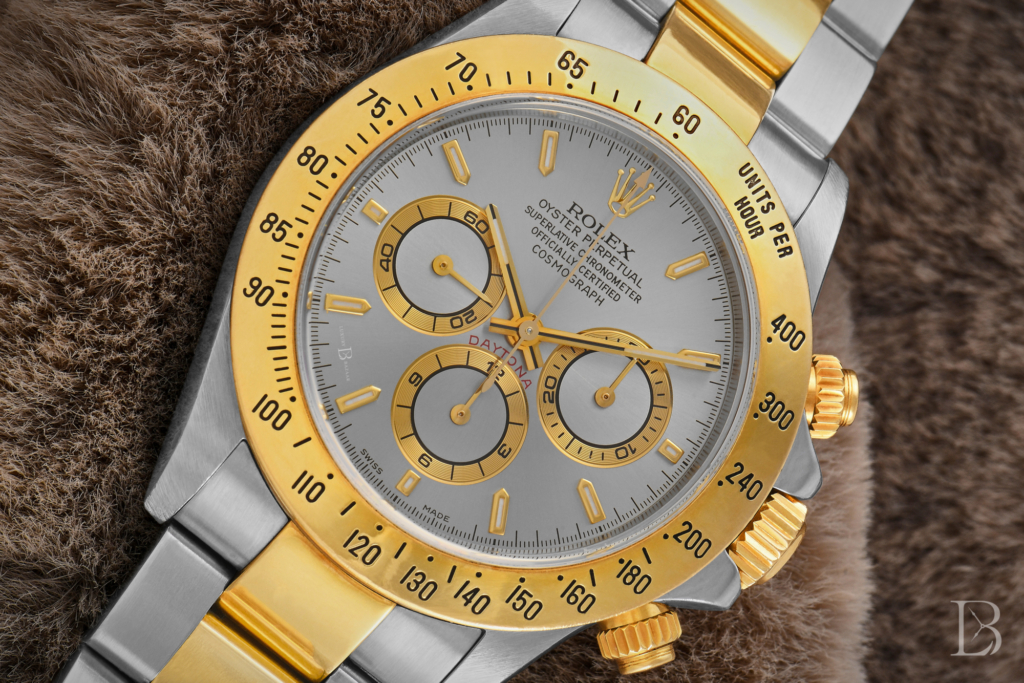
In all, the 5-digit Daytona came in five main forms. Here are their reference numbers and typical approximate values:
5-Digit Rolex Daytona References
| Reference | Configuration | Approx. market value (2026) |
|---|---|---|
| 16520 | Stainless steel on Oyster bracelet | $20,000 (typical black or white dial) $30,000 (Patrizzi dial) $110,000 (Porcelain dial) |
| 16523 | Two-tone on Oyster bracelet | $17,000 |
| 16528 | Yellow gold on Oyster bracelet | $45,000 |
| 16518 | Yellow gold on leather strap | $30,000 |
| 16519 | White gold on leather strap | $28,000 |
From 1998-1999, Rolex also released a barrage of ultra-rare off-catalog Daytona references with gem-set bezels such as 16559 SACO, 16568 BR, 16568 EMRO, 16588 SAFU, 16589 BR, 16589 RUBI, 16589 SAPH, 16598 EM, 16599SAAEC and 16599 SAPH. The leather strap Daytona models all have solid gold folding clasps.
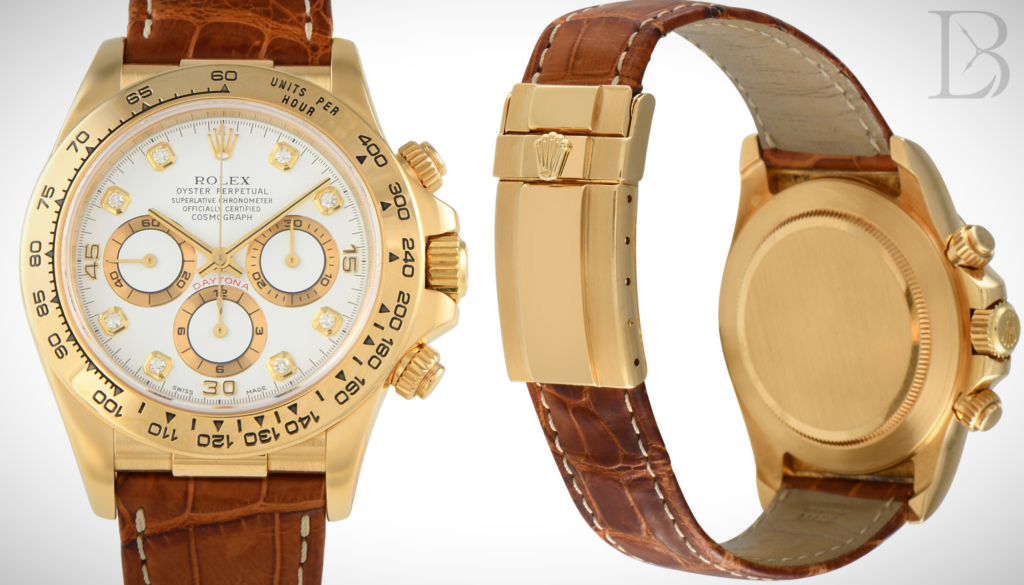
All 5-digit Daytonas are powered by Rolex caliber 4030, which is a Zenith El Primero-based movement modified to beat 8 times per second instead of the usual 10.
More on Rolex:

5-Digit Rolex Daytona Dials
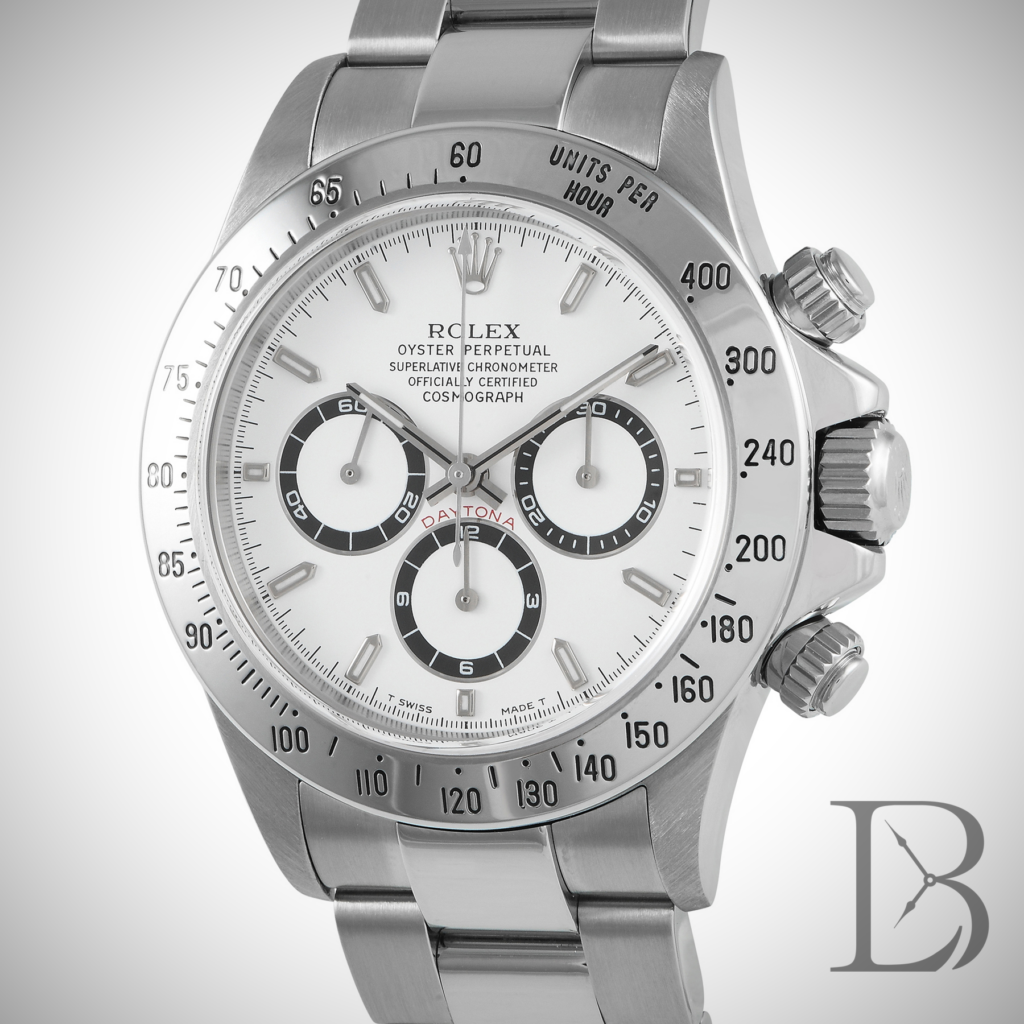
It’s worth noting that some of the first steel 5-digit Daytonas from 1988 have lacquered white dials known as “porcelain dials” for their appealing skim-milk-like sheen. Those can sell for over $100,000, but a typical white dial (like the one shown below) sells for closer to $20,000.
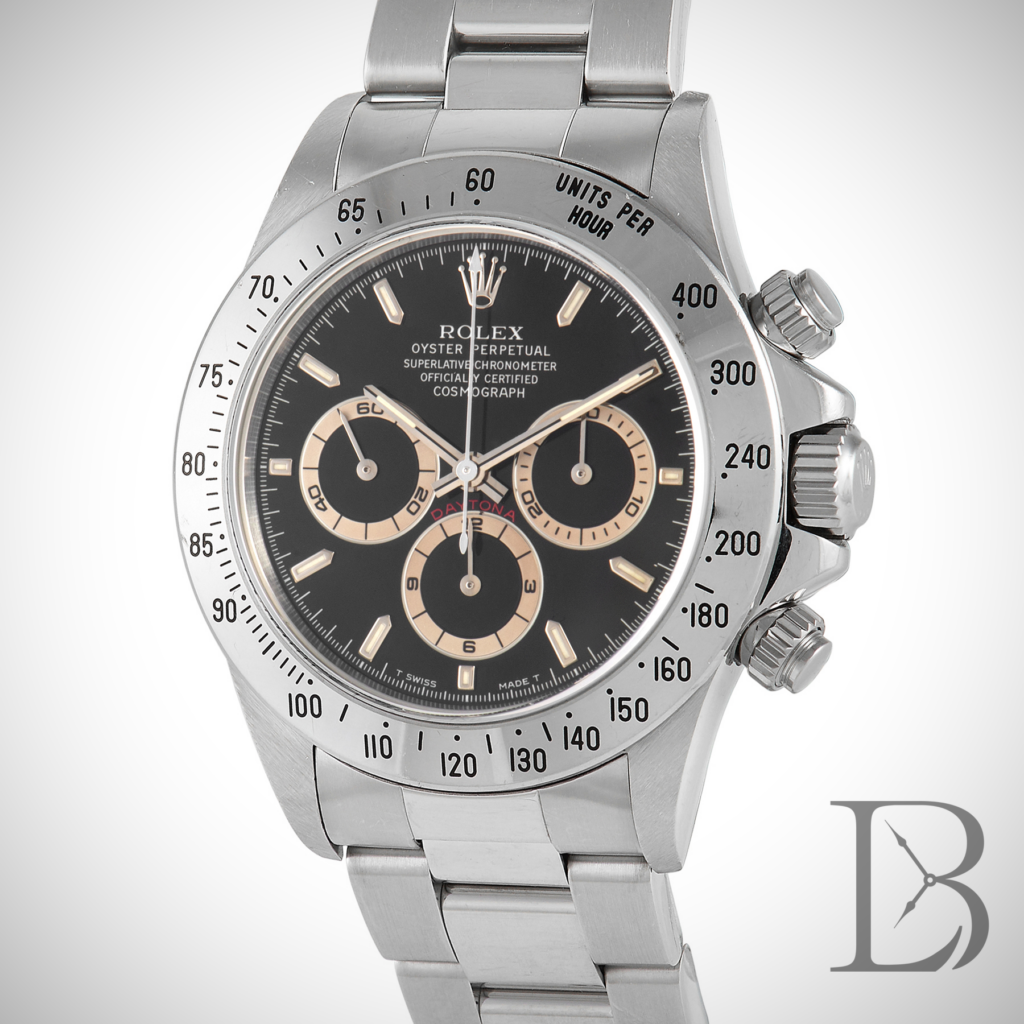
Some black dials have subdial rings that have faded from silver to tan/brown, and those are called “Patrizzi dials.” They can sell for around $30,000, although they aren’t as hyped as they once were.
Aside from some rare stone dials (sodalite, grossularite, and mother-of-pearl), the dial options for the 5-digit Daytonas were not colorful–only white/black/grey/champagne.
What’s an Inverted 6?
In the chronograph hours subdial, Rolex Daytonas made from about 1988-1994 have what is known as an “inverted 6.” The numbers are radially oriented around the subdial, so the 6 at the bottom looks like a 9. That’s all it is. Some sellers try to play it up but I wouldn’t pay a significant premium for it.
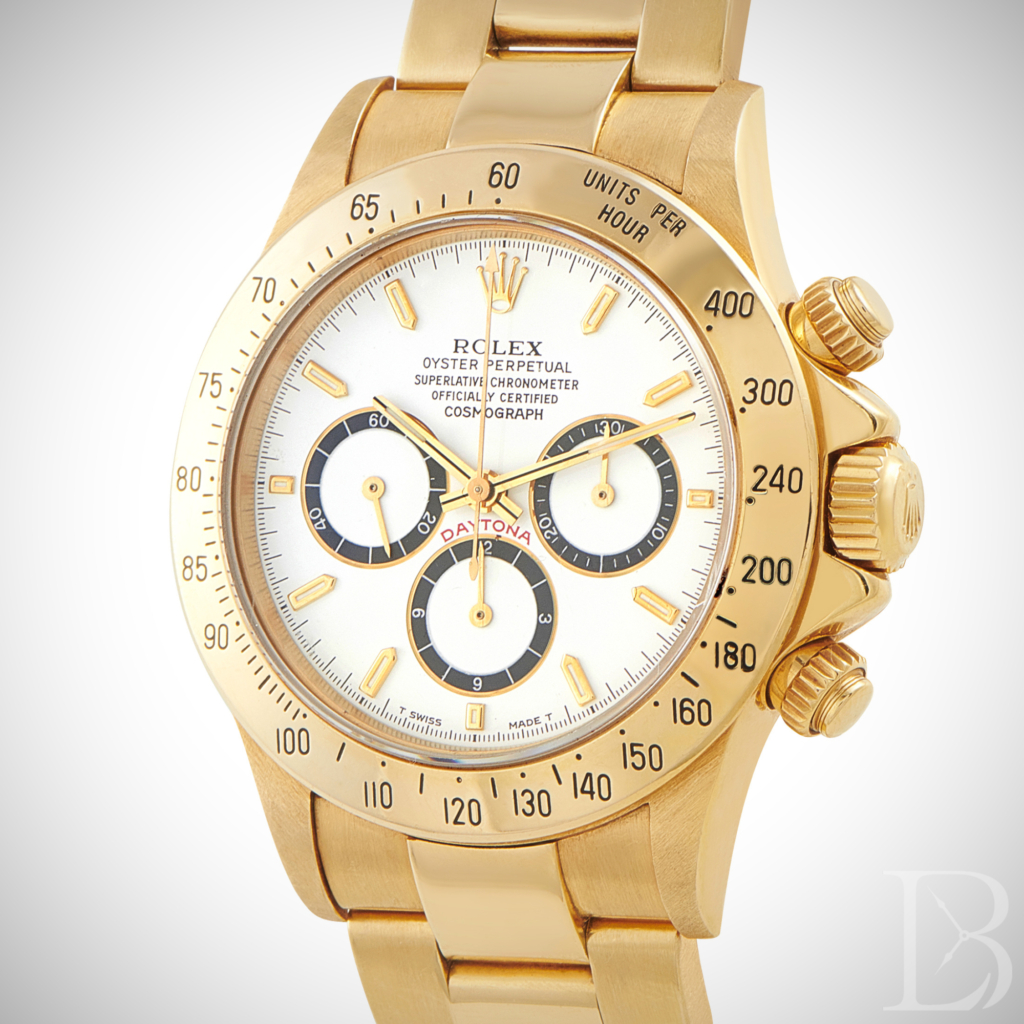
That 6 was upright by the mid-1990s.
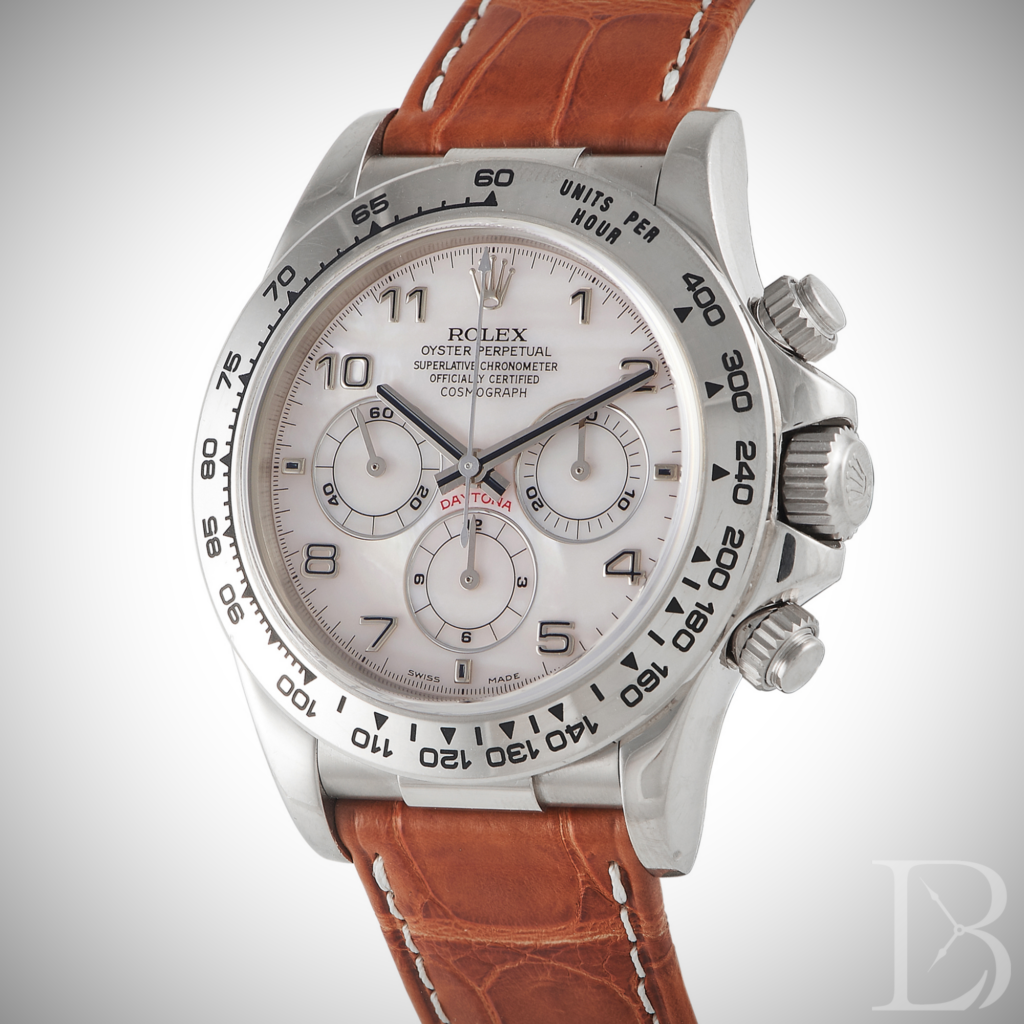
Around 1998, like most watch companies, Rolex stopped using radioactive tritium lume and began using Super-LumiNova instead. Aside from that, 5-digit Daytonas stayed basically the same throughout their run.
It’s worth mentioning that 5-digit Daytonas on leather straps have tachymeter scales with that are radially oriented, while the numbers are upright on models with steel or yellow gold bracelets. Rolex kept that convention when the 6-digit era began as well. Let’s talk about that now.
116xxx Era (2000-2023)
Visually, the 1165xx Daytonas that debuted in 2000 are very similar to the 165xx models they replaced. A white gold model with a solid white gold bracelet was added to the lineup for the first time in 2004 in the form of ref. 116509. “Racing dials,” which are dials like the one below with Arabic numeral hour markers, were an option on two-tone and gold models until about 2018.
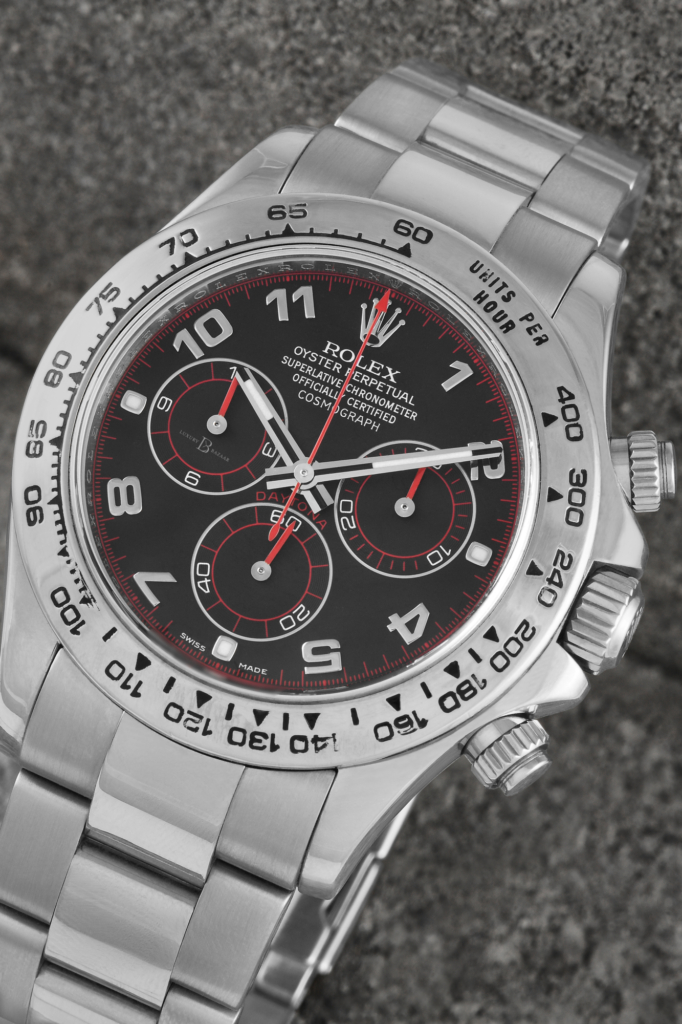
The biggest news was the in-house movement, Rolex caliber 4130, which took years to develop. It sports 44 jewels, a 72-hour power reserve (up from 54), and a vertical clutch. It has proven to be an outstanding and reliable movement.
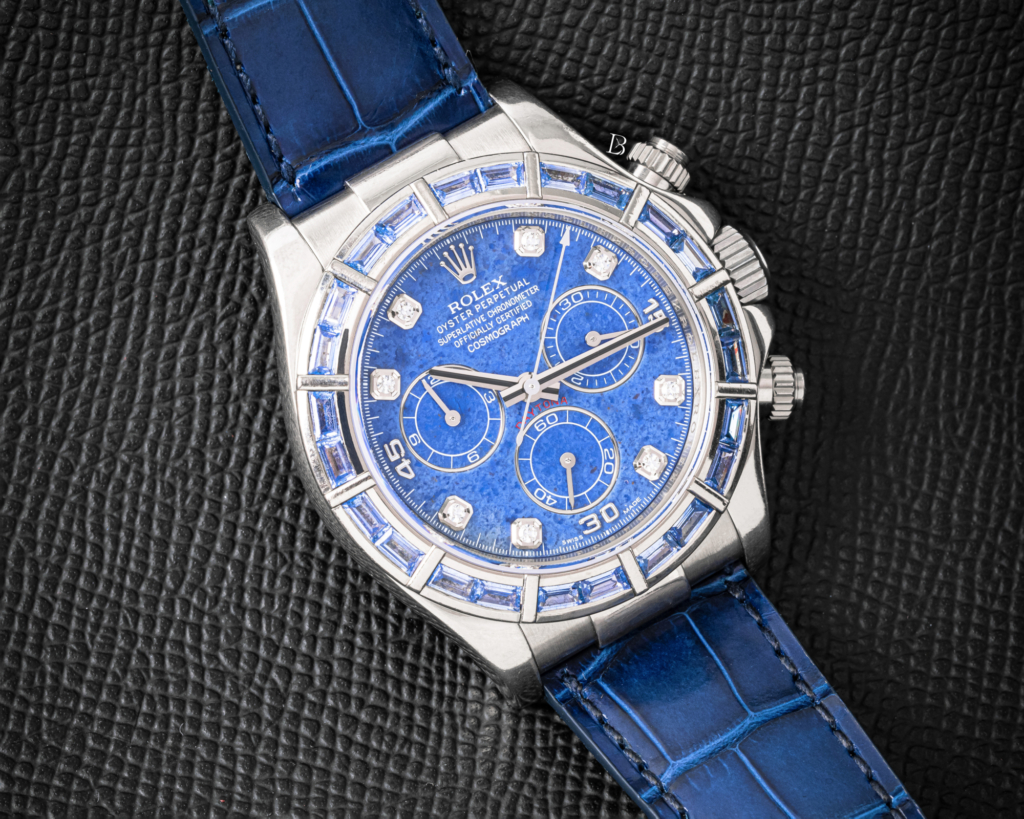
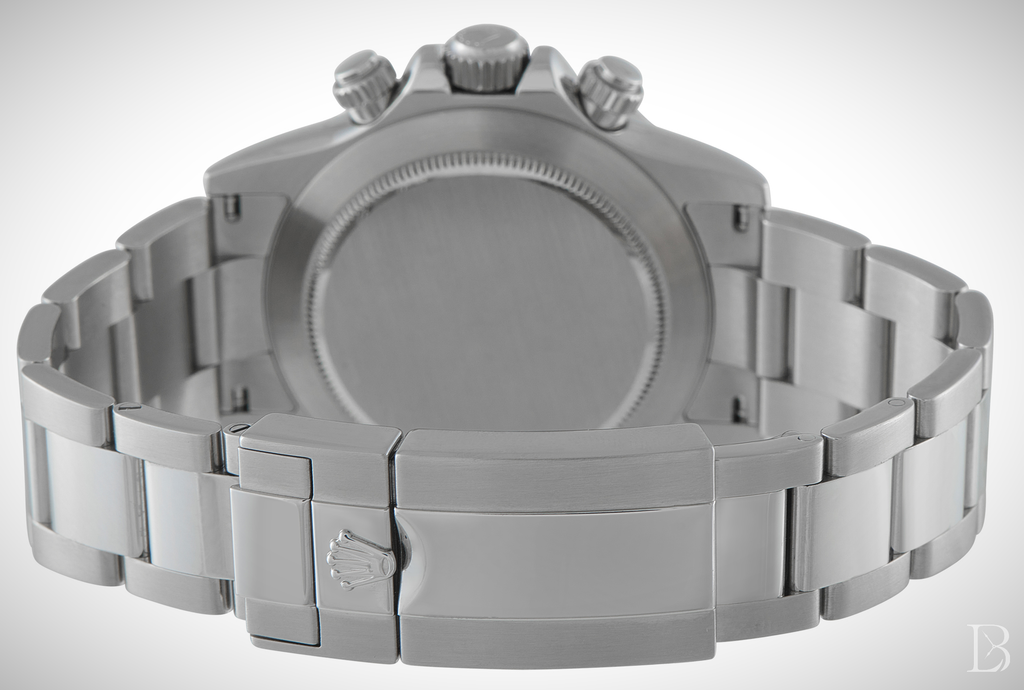
The other big upgrade that 6-digit Daytonas have over 5-digit Daytonas is the bracelet: it’s more solid and has a machined clasp rather than stamped. The clasp also has the Easylink tool-free extension system which adds 5mm of length as needed.
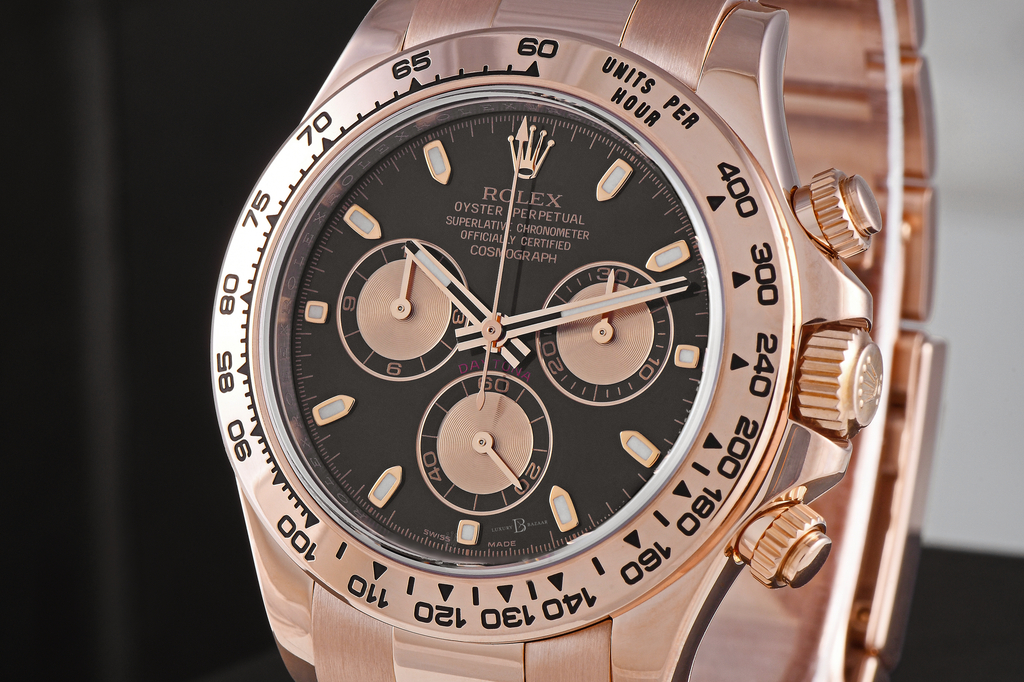
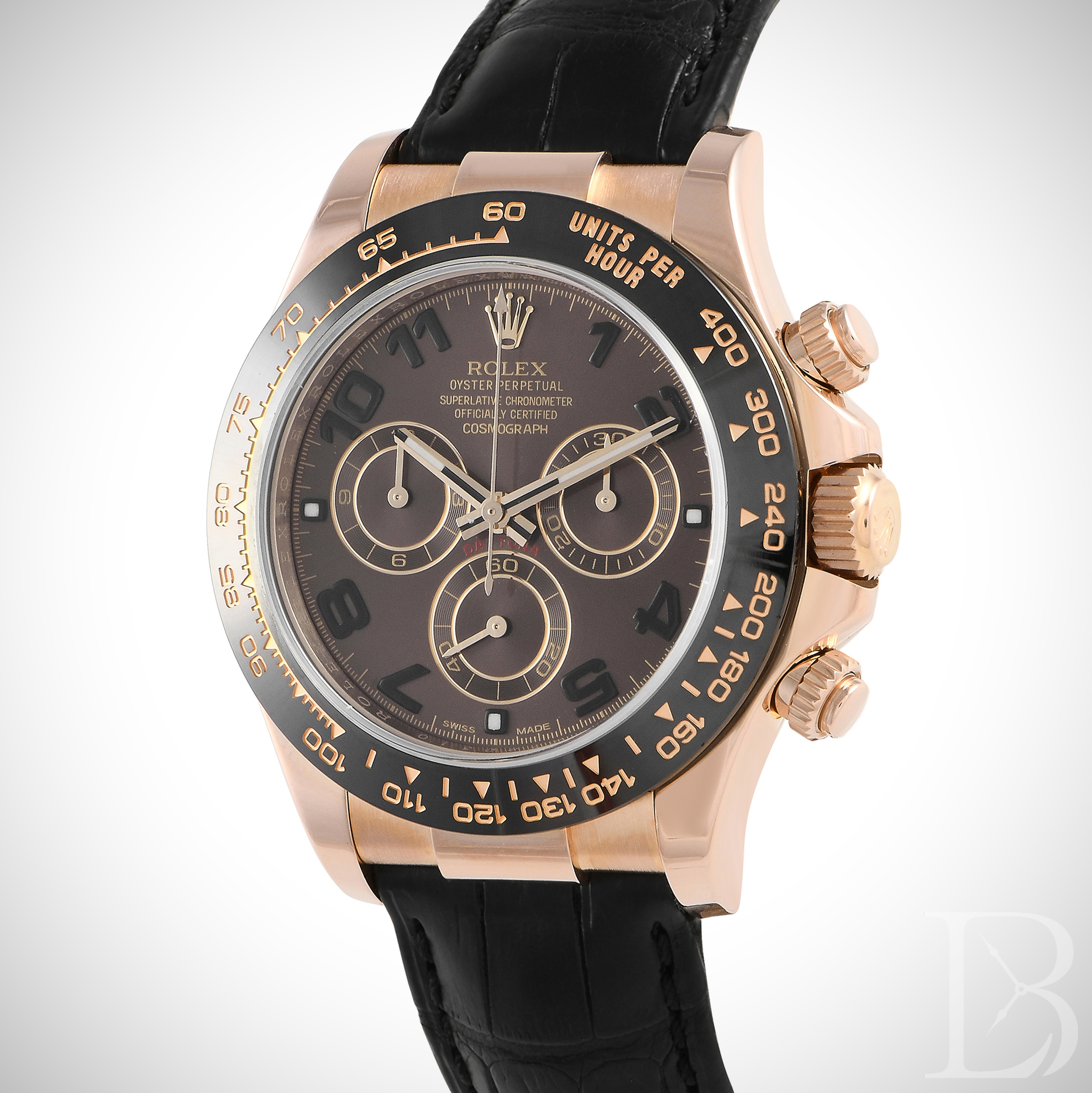
The first-ever rose gold Rolex Daytona, ref. 116505, debuted in 2008 with a full bracelet.
In 2011, a leather-strap version of the rose gold Daytona appeared (ref. 116515LN) and that was the first Daytona to ever have a ceramic bezel.
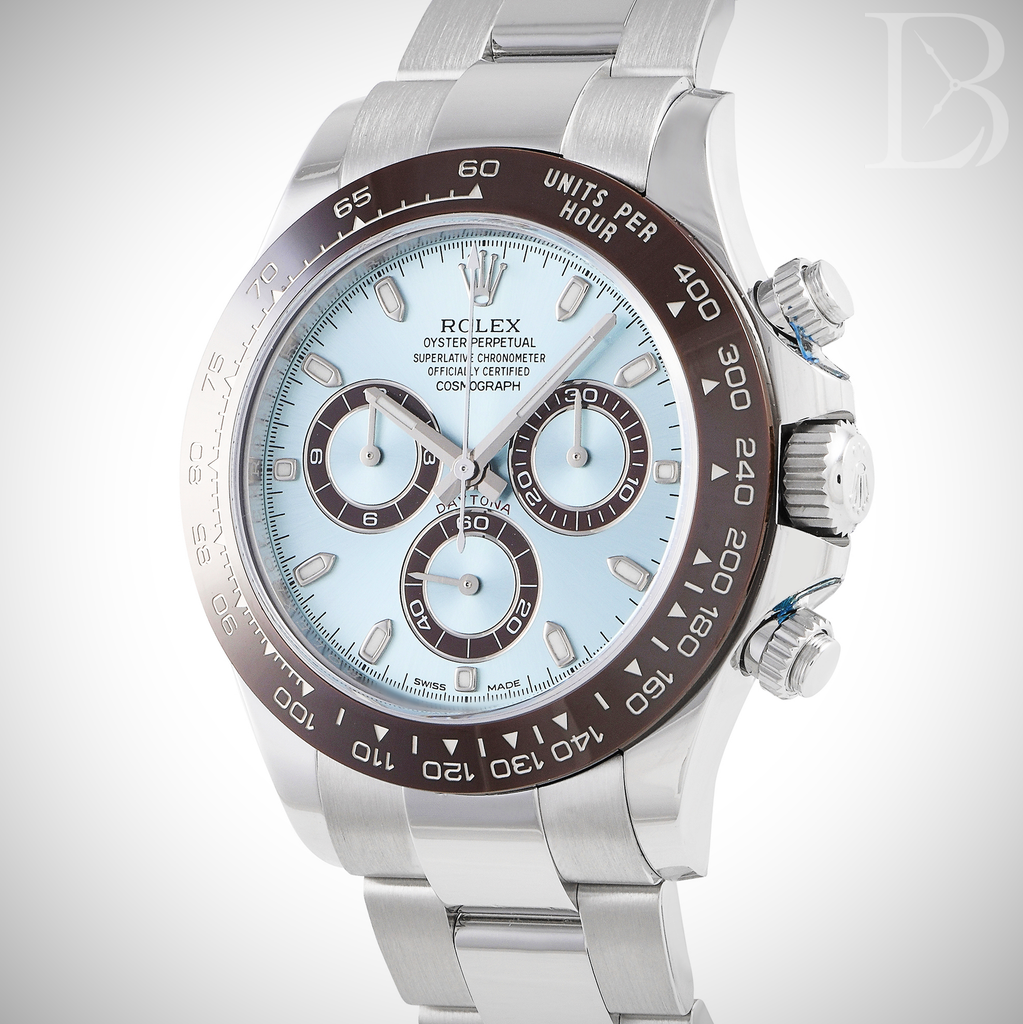
The first platinum production-model Daytona, ref. 116506, came in 2013 sporting a pleasant brown ceramic bezel insert. Buyers could choose between ice blue or pave diamond dials.
How to tell if it’s a 6-digit or 5-digit Daytona?
To quickly tell if a Daytona is a 5-digit or 6-digit model, look at its subdials. If they are vertically centered, and the 60-second counter is on the left, that’s a 5-digit model. If they’re slightly above center, and the 12-hour counter is on the left, that’s a 6-digit.
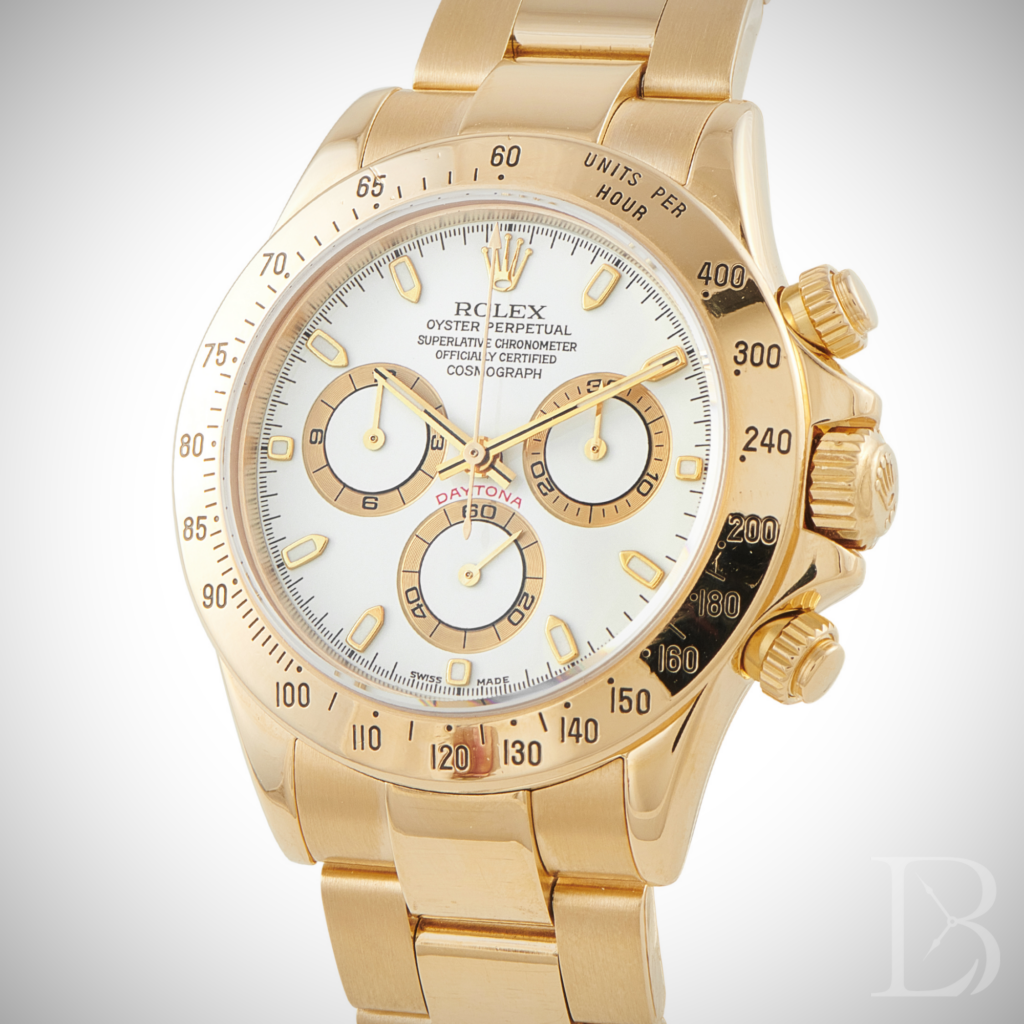
Also, 1165xx models have somewhat chubby/rounded hour markers.
What is an “Aph dial”?
A so-called “Aph dial” is a Rolex Daytona ref. 116520 where there’s a tiny bit of space between the letters “Cosmogr” and “aph” on the dial. That’s it. For a while, sellers were trying to sell them as rare, but they’re honestly not rare. I wouldn’t pay a premium for it.
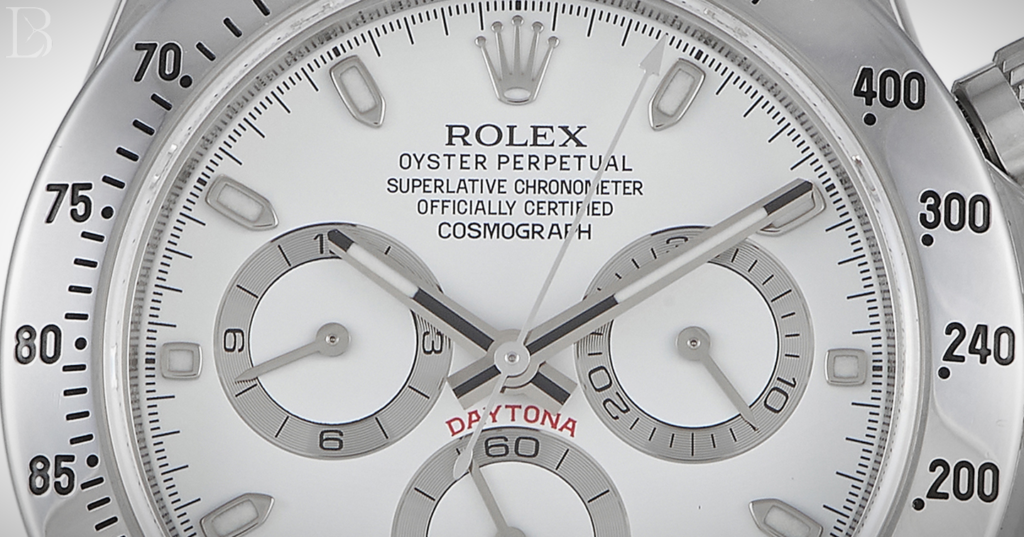
Dials that have turned cream (“Panna dials”) however, command a massive premium. Only some of the very first white 116520’s from 2000 seem to have that fortunate paint defect, and the level of creaminess can vary from mild to almost crème brûlée-like.
Mid-Generation 1165xx Refresh (2016-2018)
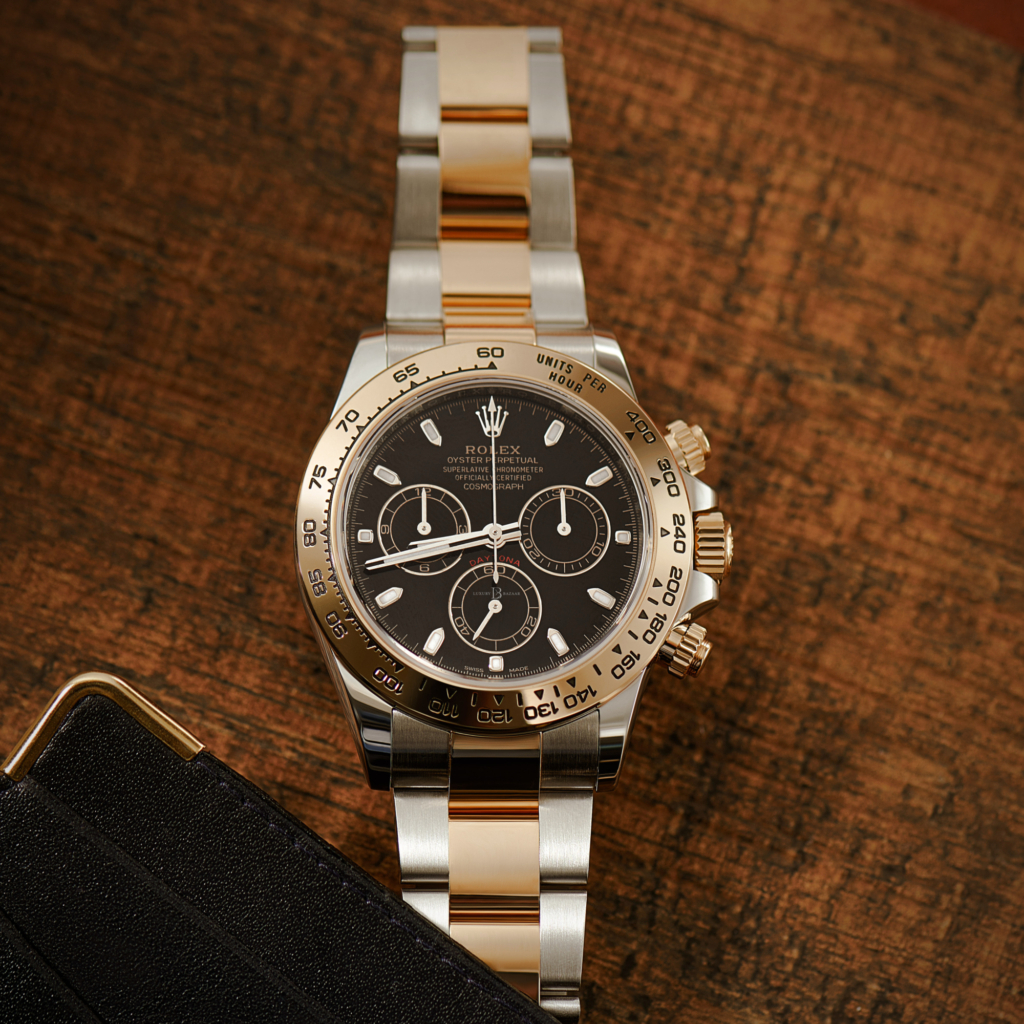
From 2016-2018, Rolex made several key tweaks to the 1165xx Daytona lineup. Note that models with “LN” at the end have black ceramic bezel inserts:
- 2016: All tachymeters now radially oriented (116500LN, 116503 and 116508 replace 116520, 116523 and 116528)
- 2016-2017: Steel models, and then YG and WG strap models, get ceramic bezel inserts (116518LN and 116519LN replace 116518 and 116519)
- 2017: Oysterflex bracelets replace leather straps
- 2018: Racing dials discontinued
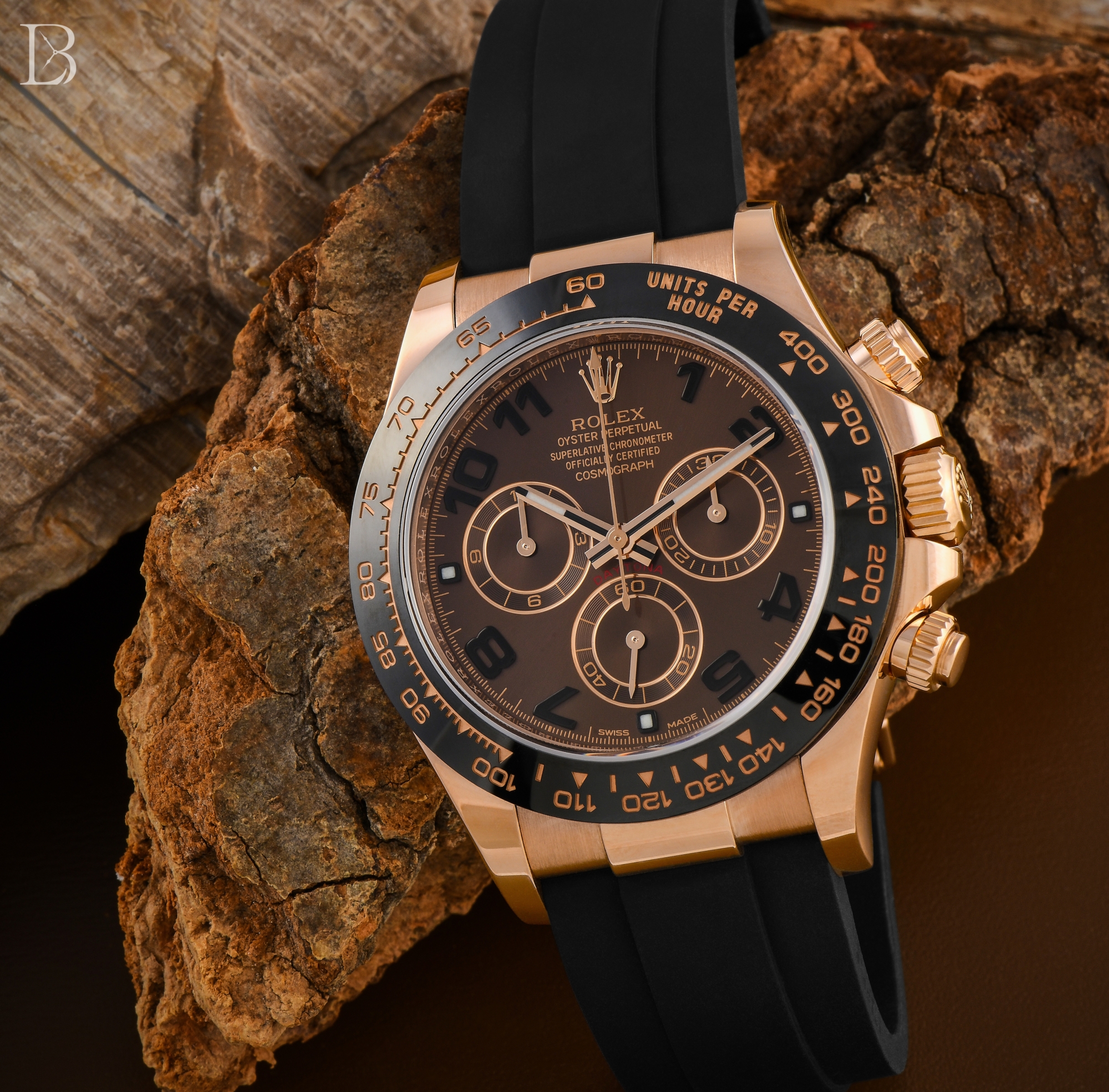
Special/Off-Catalog 1165xx Daytonas
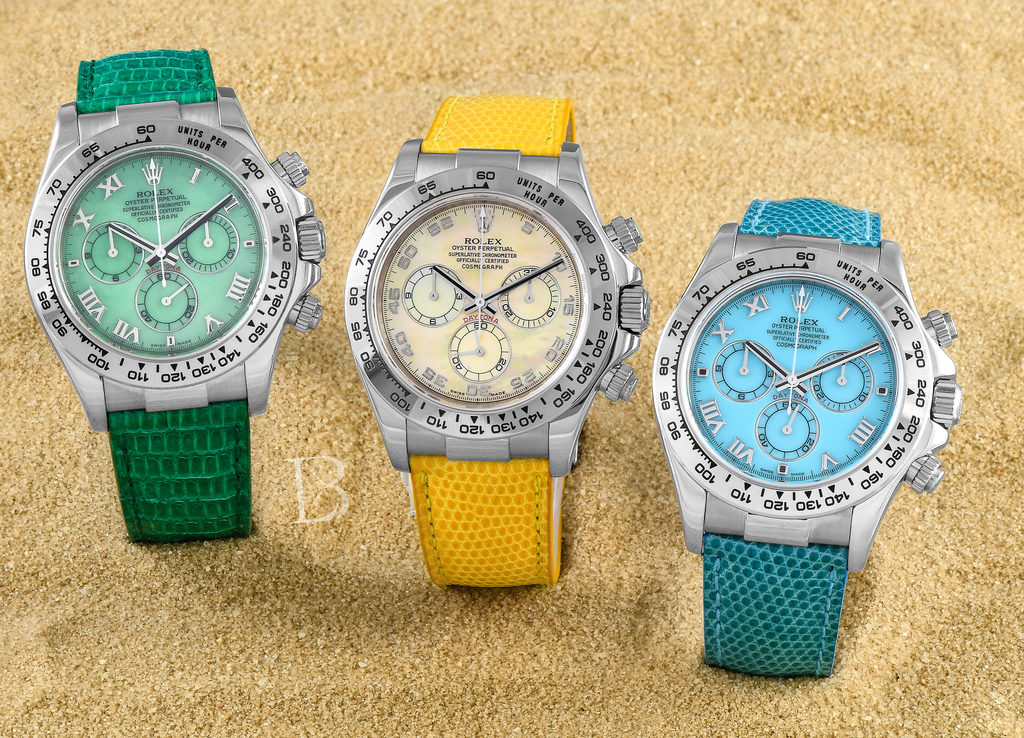
In 2000, Rolex launched the Daytona Beach collection, featuring white gold cases, colorful stone dials, and matching lizard straps.
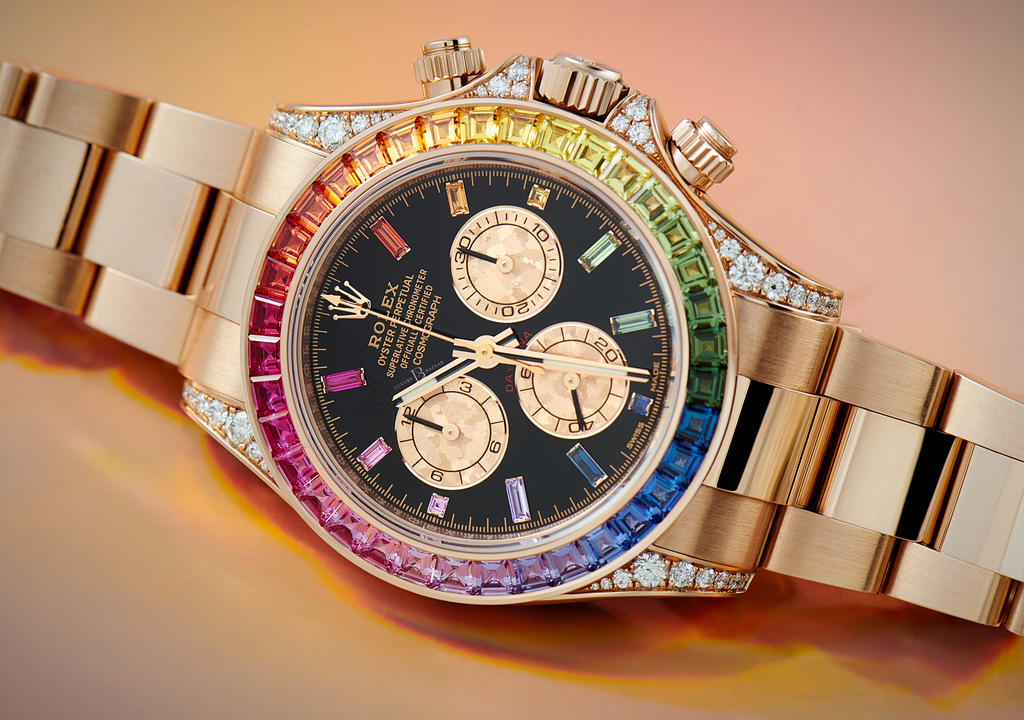
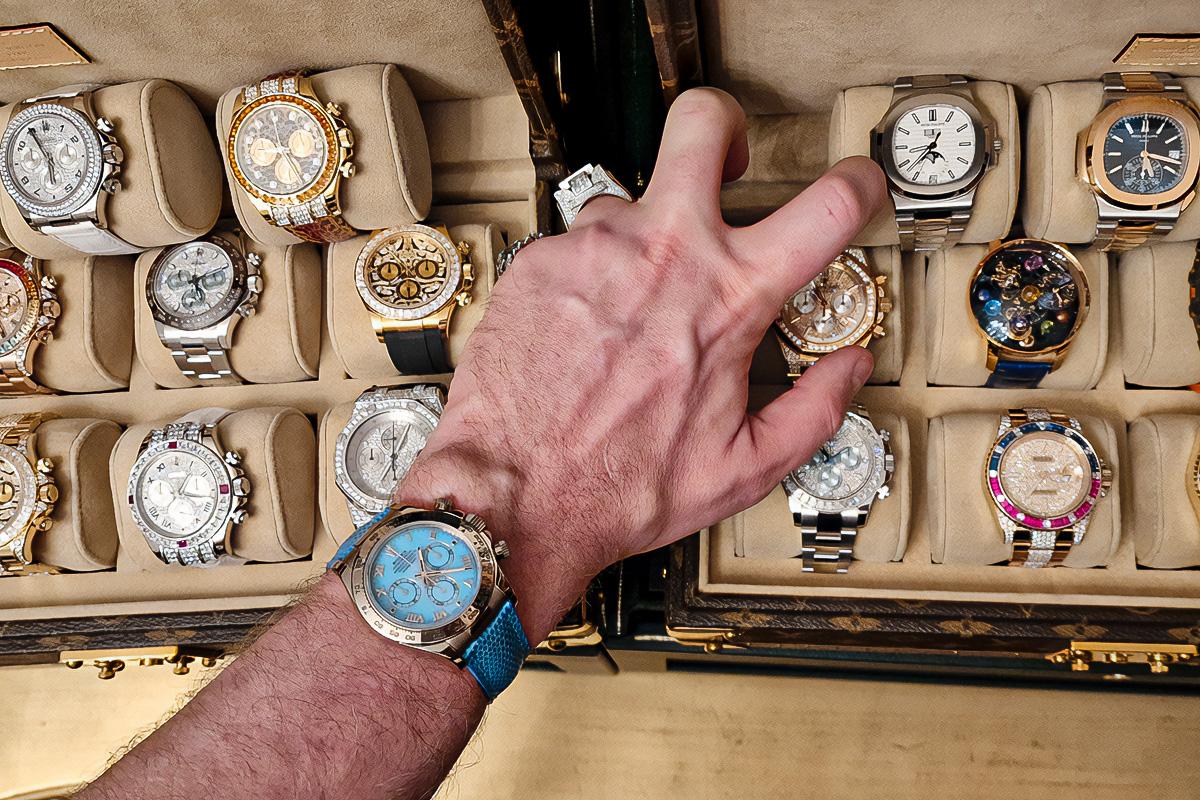
Rolex continued to release special (and often off-catalog) Daytonas throughout the 116xxx era, perhaps most notoriously the Rainbow Daytona. It’s the watch that started the rainbow luxury watch craze. Most versions of the Rainbow Daytona sell for well over $300,000 nowadays, although it was often mocked when it first launched in 2012.
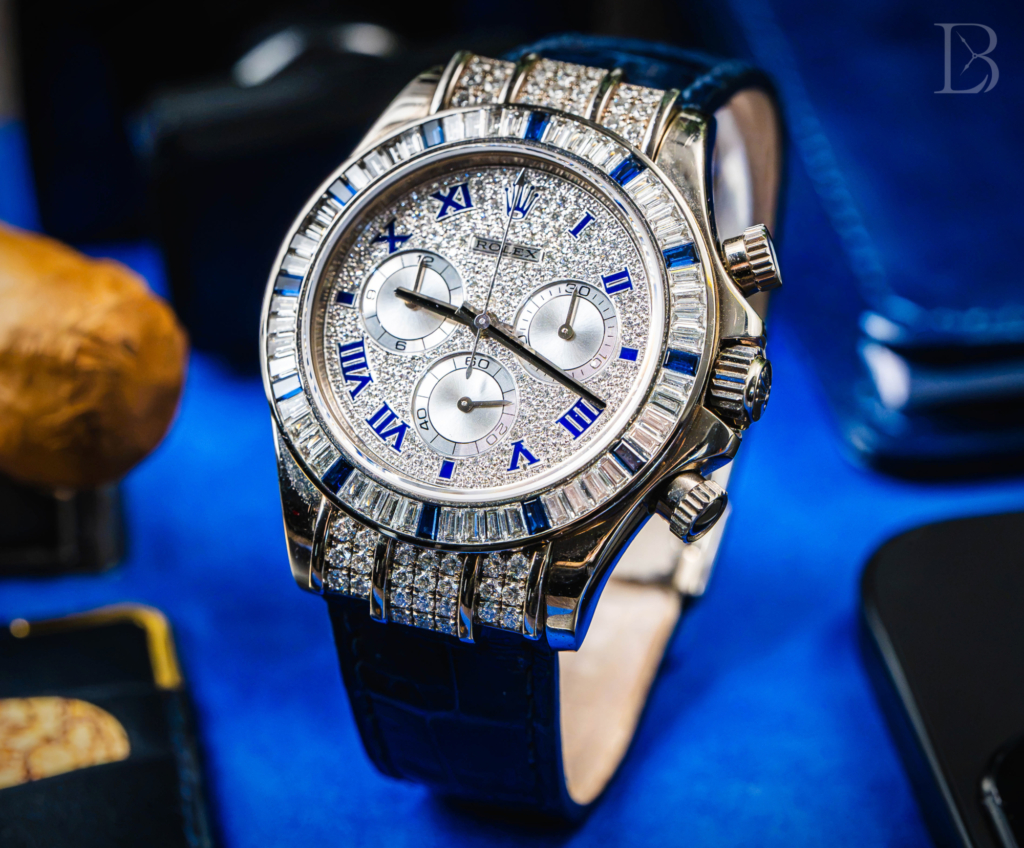
You can expect to pay around $110,000 for an iced-out 1165xx model on a leather strap like ref. 116599-12SA:
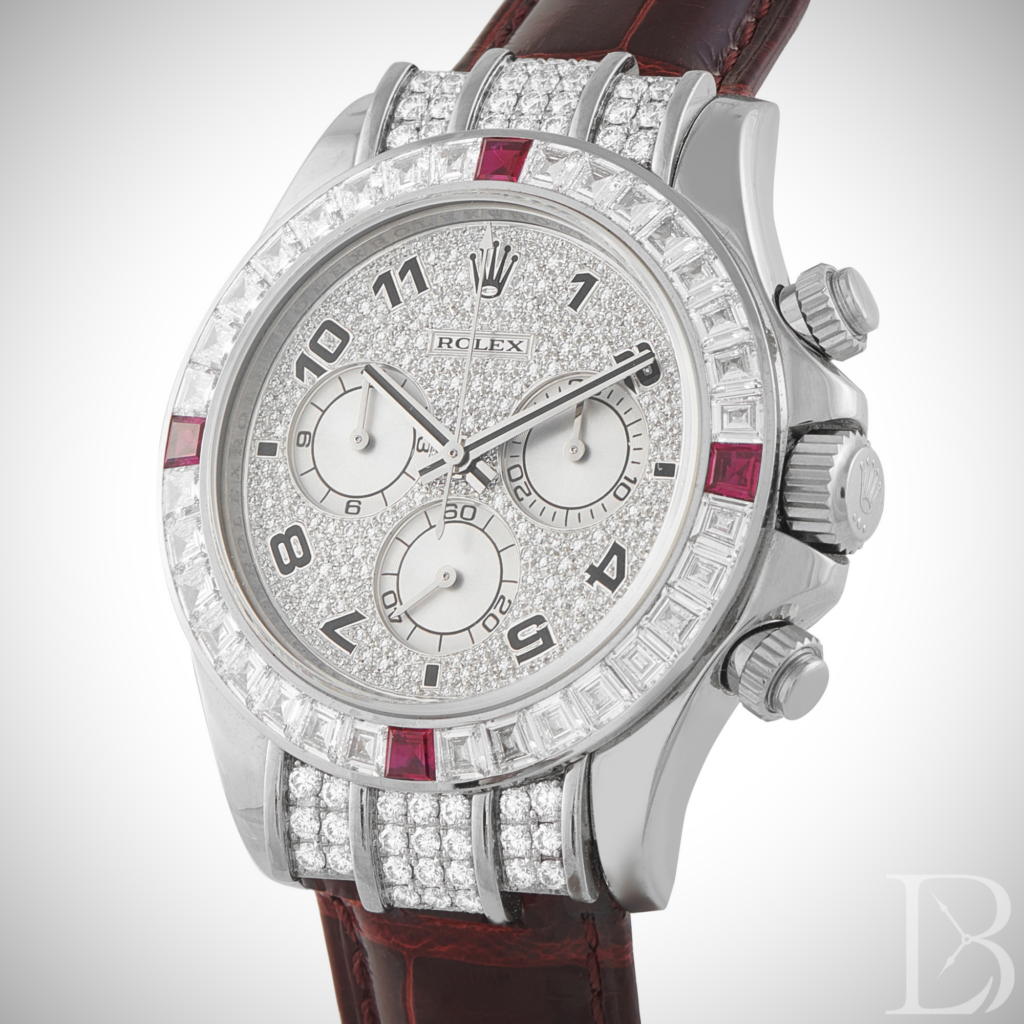
Ref. 116599-4RU would be in a similar price range:
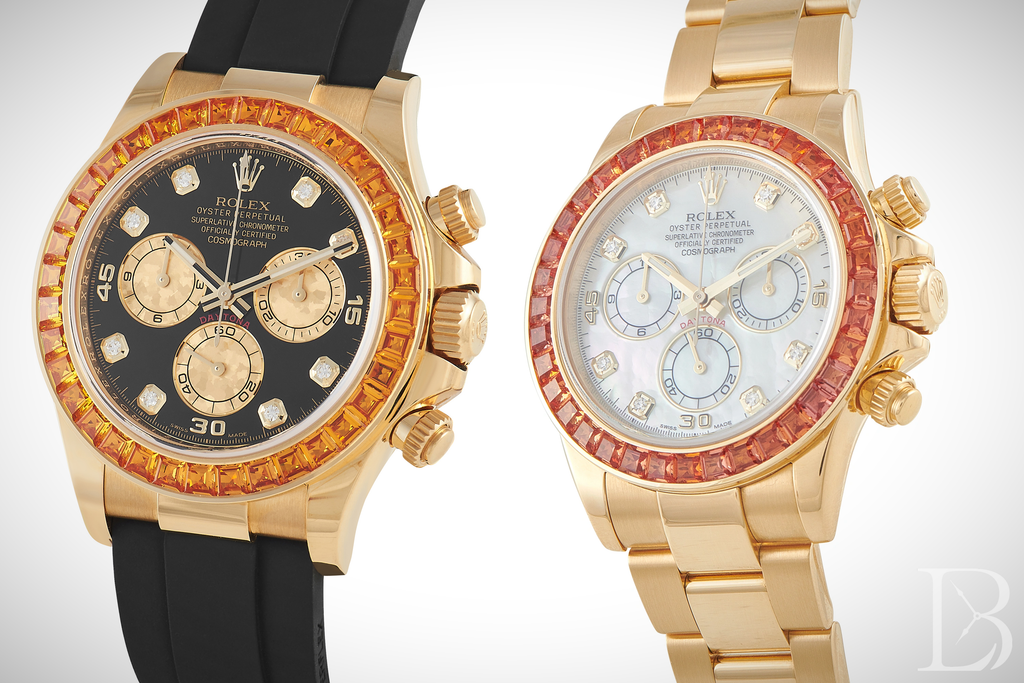
Numerous other off-catalog Daytonas were released during the 116 era too. Models with cognac (orange) sapphire bezels tend to go for over $200,000, for example.
Here’s a full breakdown of 1165xx Daytonas and their approximate market values as of 2026:
Rolex Daytona 116xxx References
| Reference | Debut year | Case material | Bezel | Bracelet / strap | Approx. market value |
|---|---|---|---|---|---|
| 116520 | 2000 | Stainless steel | Stainless steel | Oyster bracelet | $24,000 (Typical white or black dial) $90,000 (Panna dial) |
| 116500LN | 2016 | Stainless steel | Black ceramic | Oyster bracelet | $28,500 (Black dial) $32,500 (Panda dial) |
| 116515LN | 2011 | 18k Everose gold | Black ceramic | Leather (Pre-2017) Oysterflex (2017+) | $33,000 (Leather) $36,500 (Oysterflex) |
| 116518LN | 2017 | 18k yellow gold | Black ceramic | Oysterflex bracelet | $41,500 |
| 116519LN | 2017 | 18k white gold | Black ceramic | Oysterflex bracelet | $43,000 |
| 116523 | 2000 | Stainless steel and 18k yellow gold | 18k yellow gold | Oyster bracelet | $20,000 |
| 116503 | 2016 | Stainless steel and 18k yellow gold | 18k yellow gold | Oyster bracelet | $22,000 |
| 116528 | 2000 | 18k yellow gold | 18k yellow gold | Oyster bracelet | $41,000 (Typical dial) $54,000 (Mother-of-pearl dial) |
| 116508 | 2016 | 18k yellow gold | 18k yellow gold | Oyster bracelet | $50,000 (Typical dial) $80,000 (Green dial) |
| 116518 | 2000 | 18k yellow gold | 18k yellow gold | Leather strap | $30,000 |
| 116505 | 2008 | 18k Everose gold | 18k Everose gold | Oyster bracelet | $43,000 (Typical dial) $115,000 (Meteorite dial) |
| 116509 | 2004 | 18k white gold | 18k white gold | Oyster bracelet | $36,500 |
| 116519 | 2000 | 18k white gold | 18k white gold | Leather strap | $29,000 (Typical dial) $85,000 (Daytona beach) |
| 116506 | 2013 | Platinum | Brown ceramic | Oyster bracelet | $95,000 (Standard ice blue dial) $115,000 (Ice blue dial with baguette markers) $150,000 (Pave diamond dial or Eastern Arabic dial) |
| 116568 | 2001 | 18k yellow gold | Baguette diamond | Oyster bracelet | $145,000 |
| 116576 TBR | 2014 | Platinum | Baguette diamond | Oyster bracelet | $210,000 (Pave diamond dial) $225,000 (Ice blue dial) $280,000 (Eastern Arabic dial) |
| 116589 BRIL | 2001 | 18k white gold | Baguette diamond | Leather strap | $120,000 |
| 116599 TBR | 2004 | 18k white gold; diamond-set endlinks | Baguette diamond | Leather strap | $100,000 |
| 116588 TBR “Eye of the Tiger” | 2019 | 18k yellow gold | Trapezoidal diamond | Oysterflex bracelet | $200,000 |
| 116589 TBR “Eye of the Tiger” | 2019 | 18k white gold | Trapezoidal diamond | Oysterflex | $220,000 |
| 116598 TBR “Eye of the Tiger” | 2021 | 18k yellow gold | Trapezoidal diamond | Oyster bracelet, optional diamond-set center links | $270,000 (add $80,000 for diamond center links) |
| 116589 RBR | 2000 | 18k white gold | Diamond | Leather strap | $75,000 |
| 116599 RBR | 2001 | 18k white gold | Diamond | Leather strap | $87,500 |
| 116578 SACO | 2019 | 18k yellow gold | Orange sapphire | Oyster bracelet | $250,000 |
| 116588 SACO | 2019 | 18k yellow gold | Orange sapphire | Oysterflex bracelet | $220,000 (first generation, diamond hours with gold flake subdials) $300,000 (second generation, orange sapphire baguette hours) |
| 116598 SACO “Leopard Daytona” | 2004 | 18k yellow gold; diamond-set endlinks | Orange sapphire | Leopard-print leather strap | $100,000 |
| 116588 SARO | 2001 | 18k yellow gold | Pink sapphire | Leather strap | $350,000 |
| 116598 SARO | 2005 | 18k yellow gold; diamond-set endlinks | Pink-sapphire-set | Leather strap | $300,000 |
| 116589 SACI | 2000 | 18k white gold | Blue baguette sapphire | Leather strap | $140,000 (Sodalite or mother-of-pearl dial) $225,000 (Pave diamond dial) |
| 116589 SALV | 2007 | 18k white gold | Violet baguette sapphire | Leather strap | $300,000 |
| 116599 12SA | 2001 | 18k white gold | Diamond + blue sapphire | Leather strap | $110,000 |
| 116599 4RU | 2001 | 18k white gold | Diamond + ruby | Leather strap | $110,000 |
| 116595 RBOW “Rainbow Daytona” | 2018 | 18k Everose gold; diamond-set lugs | Rainbow sapphire | Oyster bracelet | $380,000 (add $80,000 for diamond center links and/or pave diamond dial) |
| 116598 RBOW “Rainbow Daytona” | 2012 | 18k yellow gold; diamond-set lugs | Rainbow sapphire | Oyster bracelet | $300,000 |
| 116599 RBOW “Rainbow Daytona” | 2012 | 18k white gold; diamond-set | Rainbow sapphire | Oyster bracelet | $275,000 |
More on Rolex:
Note that Rolex improved Chromalight (their proprietary luminous material) in 2022 to make it brighter, so the very last 1165xx Daytonas should glow in the dark a bit better than earlier ones. Now let’s talk about the current generation of Daytonas.
126xxx Era (2023+)
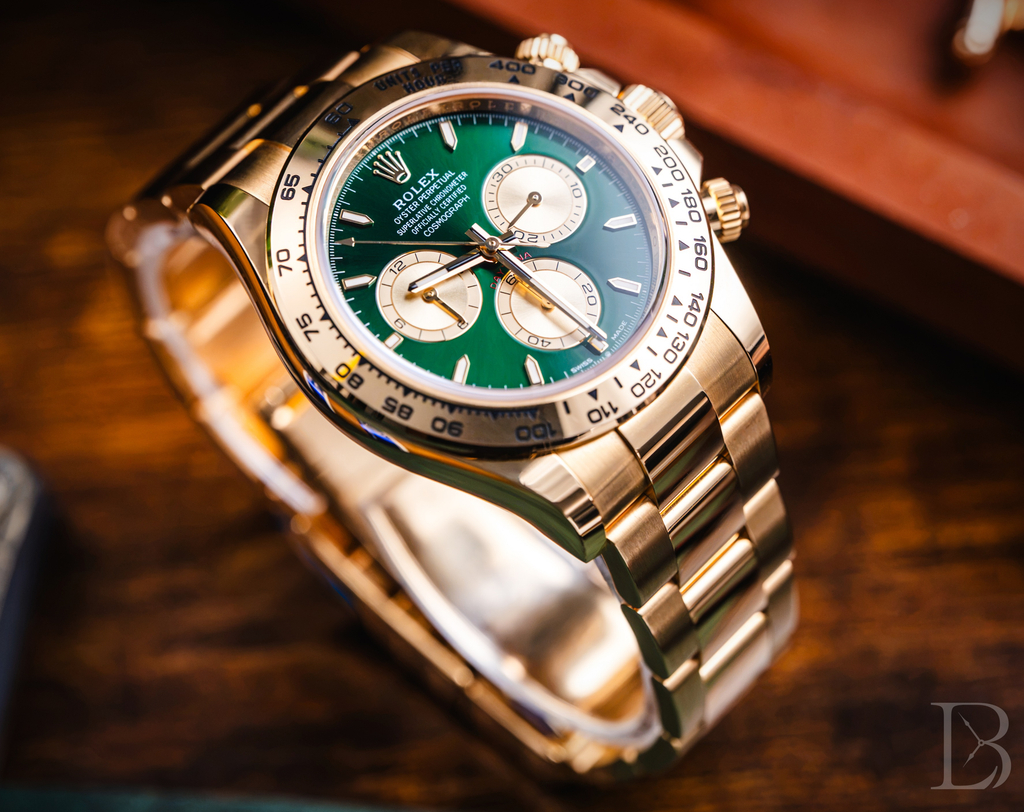
The entire Rolex Daytona lineup was updated in 2023. The 126500LN replaced the 116500LN, and so forth.
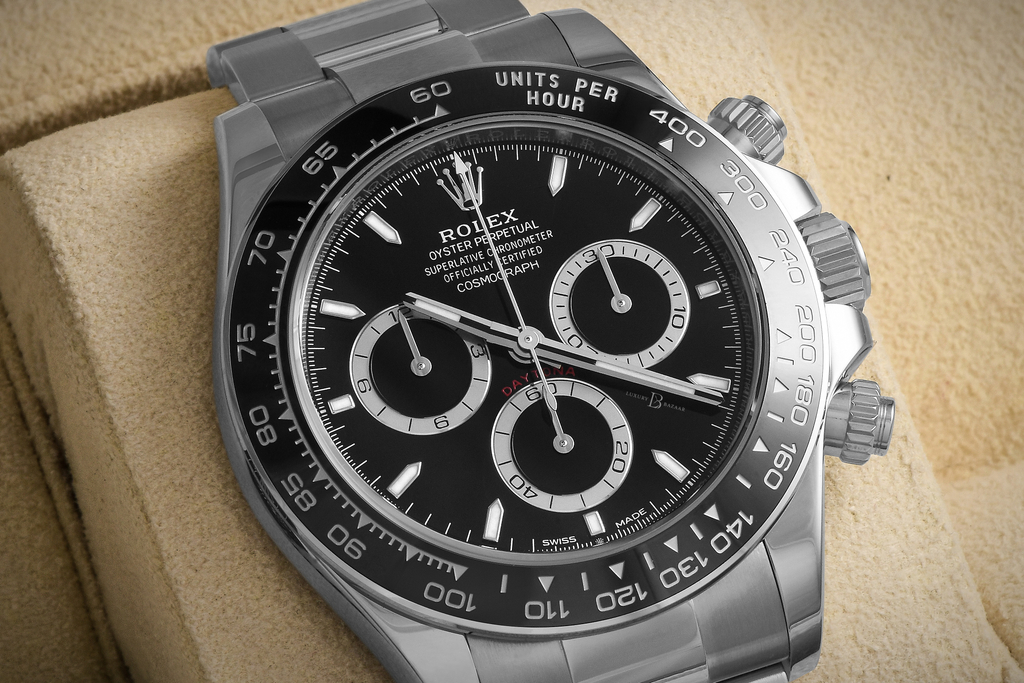
The 1265xx Rolex Daytona generation received several subtle tweaks:
- Slimmer rings around the chronograph subdials
- Subdial rings on steel models with white dials are now black, thus the nickname “Panda dial”
- A metal rim around the bezel
- A more angular, substantial crown guard
- Lugs are symmetrical on all models now (Previously, the right lug was slimmer on models with steel or yellow gold bracelets)
- Narrower, straighter hour markers (more pencil-like, less home plate-like)
- Upgraded movement: caliber 4131 adds Rolex’s Chronergy escapement, Paraflex shock absorbers, an openworked rotor, and Côtes de Genève decoration on the bridges
- A small Rolex coronet beneath the 6 o’clock marker
- Revised case proportions: 0.2mm thinner and 1.3mm longer from lug to lug
- Platinum and Le Mans Daytonas get exhibition casebacks
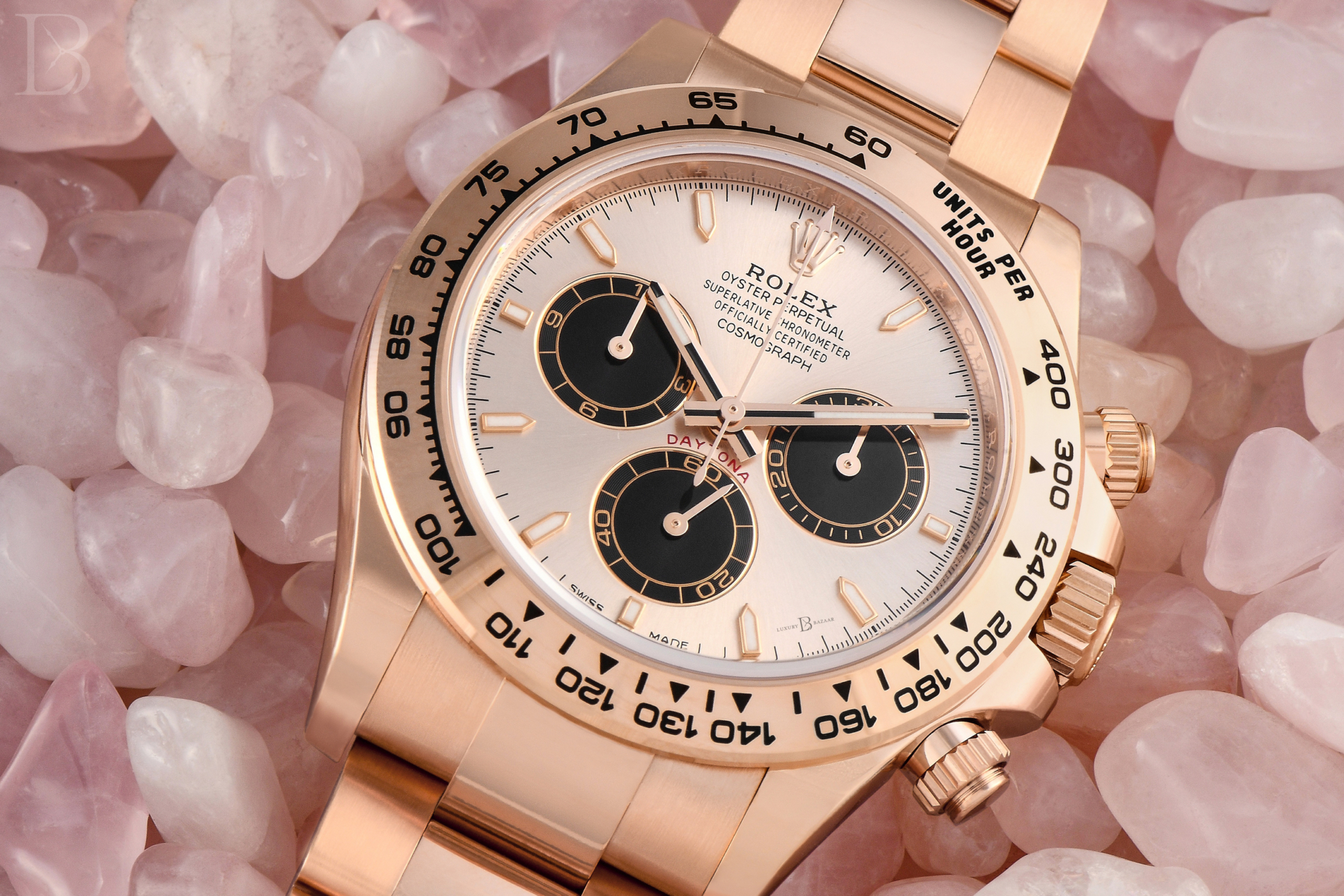
There’s nothing wrong with the 1165xx Daytona, but I think Rolex was on-point with the adjustments they made. The slimmer subdial rings do look better in my opinion:
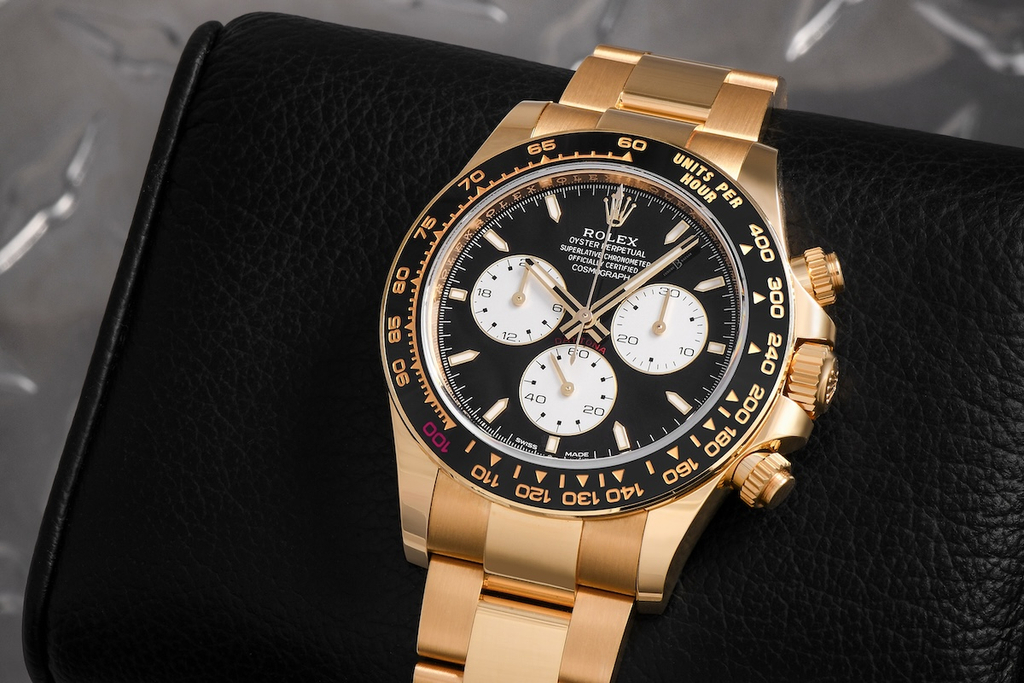
The ultra-desirable Le Mans Daytona, featuring a 24-hour counter instead of the usual 12-hour one, has subdials that pay homage to the first-generation Paul Newman Daytona models.
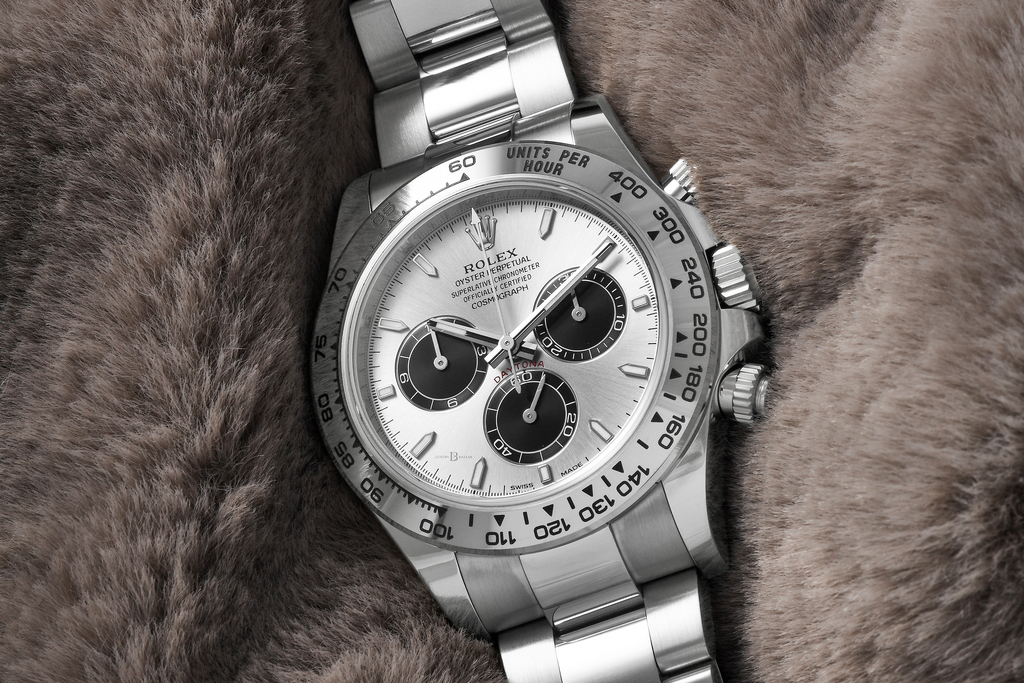
Rolex has continued to release increasingly exotic off-catalog Daytonas in recent years, such as Drake’s one-of-one “Ice Gradient” Daytona, and many of them are among the most expensive Rolex watches ever. Let’s go over all the 1265xx references now:
126xxx Rolex Daytona References
| Reference | Debut year | Case material | Bezel | Bracelet / strap | Approx. market value |
|---|---|---|---|---|---|
| 126500LN | 2023 | Stainless steel | Black ceramic | Oyster bracelet | $32,000–$33,000 (Black dial) $32,000–$38,500 (Panda dial) |
| 126515LN | 2023 | 18k Everose gold | Black ceramic | Oysterflex bracelet | $51,000 (Typical dial) $95,000 (Meteorite dial) |
| 126518LN | 2023 | 18k yellow gold | Black ceramic | Oysterflex bracelet | $55,000 (Typical dial) $100,000 (Meteorite dial) $125,000 (Turquoise dial) |
| 126519LN | 2023 | 18k white gold | Black ceramic | Oysterflex bracelet | $50,000 (Typical dial) $95,000 (Meteorite dial) |
| 126529LN “Le Mans” | 2023 | 18k white gold | Black ceramic; red “100” | Oyster bracelet | $230,000 |
| 126528LN “Le Mans” | 2024 | 18k yellow gold | Black ceramic; red “100” | Oyster bracelet | $200,000 |
| 126525LN “Le Mans” | 2025 | 18k Everose gold | Black ceramic; red “100” | Oyster bracelet | $200,000 |
| 126502 “Albino” (Enamel dial) | 2026 | Stainless steel w/platinum bezel and caseback surround | Anthracite ceramic insert in platinum bezel | Oyster bracelet | $120,000 |
| 126503 | 2023 | Stainless steel and 18k yellow gold | 18k yellow gold | Oyster bracelet | $25,000 |
| 126508 | 2023 | 18k yellow gold | 18k yellow gold | Oyster bracelet | $60,000 (Typical dial) $85,000 (Green “John Mayer 2” dial) |
| 126505 | 2023 | 18k Everose gold | 18k Everose gold | Oyster bracelet | $55,000 |
| 126509 | 2023 | 18k white gold | 18k white gold | Oyster bracelet | $50,000 (Typical dial) $58,500 (Blue dial) |
| 126506 | 2023 | Platinum | Brown ceramic | Oyster bracelet | $115,000 (Typical dial) $125,000 (Baguette diamond dial) $200,000 (Eastern Arabic dial) |
| 126589RBR | 2024 | 18k white gold | Brilliant-cut diamond | Oysterflex bracelet | $88,000 |
| 126579RBR | 2024 | 18k white gold | Brilliant-cut diamond | Oyster bracelet | $90,000 |
| 126535TBR | 2024 | 18k Everose gold; diamond-set lugs | Trapezoidal diamond | Oysterflex bracelet | $170,000 |
| 126538TBR | 2024 | 18k yellow gold; diamond-set lugs | Trapezoidal diamond | Oysterflex bracelet | $155,000 (Typical dial) $780,000 (Turquoise stone dial) |
| 126539TBR | 2024 | 18k white gold; diamond-set lugs | Trapezoidal diamond | Oysterflex bracelet | $165,000 |
| 126595TBR | 2024 | 18k Everose gold; diamond-set lugs | Trapezoidal diamond | Oyster bracelet | $185,000 |
| 126598TBR | 2024 | 18k yellow gold; diamond-set lugs | Trapezoidal diamond | Oyster bracelet | $170,000 |
| 126576TBR | 2024 | Platinum | Trapezoidal diamond | Oyster bracelet | $240,000 (Ice blue or pave diamond dial) $380,000 (Eastern Arabic dial) |
| 126555TBR “Giraffe” | 2025 | 18k Everose gold; diamond-set lugs | Trapezoidal diamond | Brown Oysterflex bracelet | $275,000 |
| 126538TRO “Barbie” | 2024 | 18k yellow gold; diamond-set lugs | Pink sapphire | Pink alligator strap | $1,000,000 |
| 126598TRU | 2023 | 18k yellow gold; diamond-set case | Trapezoidal pigeon blood ruby | Oyster bracelet | $1,200,000 |
| 126599TRU | 2023 | 18k white gold; diamond-set case | Trapezoidal pigeon blood ruby | Oyster bracelet | $1,200,000 |
| 126599TSA | 2025 | 18k white gold; diamond-set case and lugs | Trapezoidal blue sapphire | Oyster bracelet | $1,100,000 |
| 126595RBOW “Rainbow Daytona” | 2024 | 18k Everose gold; diamond-set lugs | Rainbow sapphire | Oyster bracelet | $450,000 |
| 126598RBOW “Rainbow Daytona” | 2024 | 18k yellow gold; diamond-set lugs | Rainbow sapphire | Oyster bracelet | $450,000 |
| 126599RBOW “Rainbow Daytona” | 2024 | 18k white gold; diamond-set lugs | Rainbow sapphire | Oyster bracelet | $430,000 |
| 63-Carat Daytona | 2023 | 18k white gold; baguette diamond-set lugs | Trapezoidal diamond | Oyster bracelet fully set with baguette diamonds | $3,500,000 |
| Drake’s “Ice Gradient” | 2026 | 18k white gold; baguette diamond+sapphire-set lugs | Trapezoidal blue sapphire | Oyster bracelet fully set with baguette diamonds graduating into light and dark blue sapphires | $10,500,000 |
That should just about cover everything you need to know if you’re shopping for a Rolex Daytona. Make sure you always thoroughly research the specific model number you’re looking at, and most importantly, “buy the seller” as they say.


Leave a Reply