How to Spot a Fake Rolex: The Ultimate Guide

Fake Rolex Serial Number Check

If you’re considering buying a pre-owned Rolex, one of your biggest concerns is likely avoiding fakes. Counterfeit Rolexes are notoriously common, and they’re only getting more and more accurate. While it’s almost impossible to spot the most advanced modern “superclone” Rolexes without examining them closely in person, the vast majority of fakes will have tells that can be spotted if you’re aware of some fundamentals. Here’s our updated guide to spotting a fake Rolex.
How to Spot a Fake Rolex: The Basics
There are a few things I immediately tell people when they ask me how to spot a fake Rolex.
Know the reference you’re looking at
Ultimately, one of the best ways to spot a counterfeit is by knowing what a real version of that particular model looks like. If you’re looking at a Submariner Date, figure out if it’s a 16610 or 116610 etc. and know the characteristics of each.
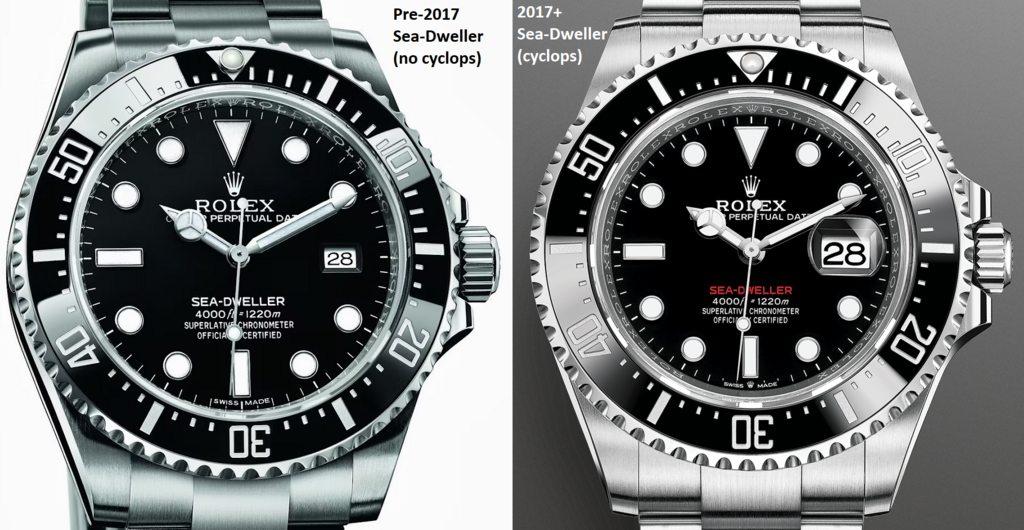
Knowing the reference number helps you know what the watch should look like. For instance, this way you’ll know that a Sea-Dweller ref. 126600 should have a cyclops, while all other Sea-Dwellers shouldn’t. In general, a Rolex sales listing without a proper model number is a red flag.
Do I need the box and papers?
Modern luxury watches should generally be accompanied by warranty documentation. It’s very common for old watches to be missing paperwork, though; life happens. But a 2-year-old Rolex with no warranty card is a bit of a red flag. Regardless, don’t let your guard down even if a seller has the box and papers–they can be faked too.
Buy the seller!
If you’re shopping for a pre-owned Rolex it’s best to choose a trusted grey market dealer with a good reputation and an authenticity guarantee. “Buy the seller, not the watch” is an enduring mantra among watch enthusiasts for a reason.
More Guides to Spotting Fakes:
How to Avoid Buying a Fake Audemars Piguet
How to Avoid Buying a Fake Richard Mille Watch
How to Spot a Fake Cartier Love Bracelet
When Did Fake Rolexes First Appear?
While Rolex has been successful ever since the launch of their Oyster in 1926, they didn’t become “hot” with celebrities until the mid-1960’s, and they only started surpassing Omega in sales (based on chronometer certifications) and leading the luxury watch world around 1970. Fake Rolexes seemed to first appear in a big way in the 1980s. And they didn’t really get “scary” accurate for the most part until the 2010s.
Very old unpopular Rolex models are very unlikely to be faked. So if you see a tiny 1940’s Rolex cocktail watch, for instance, it’s probably real. Counterfeiters tend to fake the most popular Rolex models of their day, primarily because they are liquid, and these are what they fake most accurately. The most common faked Rolex models seem to be the Datejust and Submariner, followed by the GMT-Master II and Daytona.
How to Spot a Fake Modern Rolex Movement
Decades ago, most fake Rolexes had cheap quartz movements which ticked once per second. So sometimes people associate a “sweeping” motion with a real Rolex. The thing is, nowadays, low-quality mechanical movements that sweep (i.e. tick 8 times per second) are cheap to manufacture and almost all fakes have them.
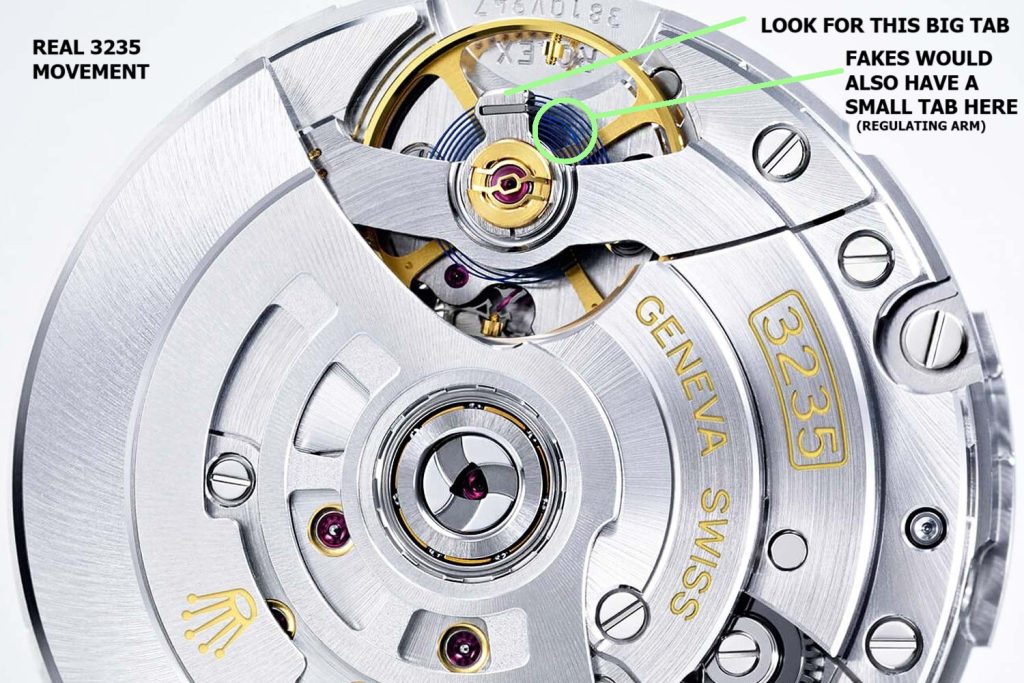
In my opinion, the #1 way to check if a Rolex movement is fake is to look for the Microstella system. Modern Rolexes use a “Microstella key” to slightly adjust the rate faster or slower, instead of a traditional regulating arm. So if you know how to spot a regulating arm you can spot a fake Rolex movement in most cases!
Rolex Cyclops Real vs Fake
Rolex’s cyclops provides a distinctive 2.5x magnification, and the date should fill up the cyclops window nicely. A lack of magnification is a common indicator of a counterfeit. The date numerals should be nicely centered within the white box; fakes are often off-center, like the two images on the left below. The cyclops on the right is real.


Note that on vintage Rolexes, cheap aftermarket crystals are common, so bad magnification alone isn’t a guarantee of inauthenticity. Also, Rolex notoriously produced a faulty batch of cyclops in about 2014 (it was so bad they had to remove all mentions of “2.5x magnification” from their website), so if you see a watch from that era with a “low-mag” crystal, it could be legit. And if you’re looking at a Sea-Dweller manufactured before 2017 (or a Datejust made before 1953) it should not have a cyclops at all.
How to Spot a Fake Rolex Caseback
With few exceptions (such as the Sea-Dweller and Milgauss), Rolex watches do not have specs, logos, or branding on their casebacks. A few vintage ladies’ models actually do say “stainless steel” on the back, and very old Rolexes often have serial/model numbers on the back. But as a rule, Rolex casebacks should be sterile (blank) aside from personal engravings.
Rolex released three watches with clear casebacks in 2023: The 1908, an updated platinum Daytona, and the “LeMans” Daytona. Four Cellini Prince references made from about 2005-2015 have exhibition casebacks as well, but aside from that, Rolex has always used solid casebacks.
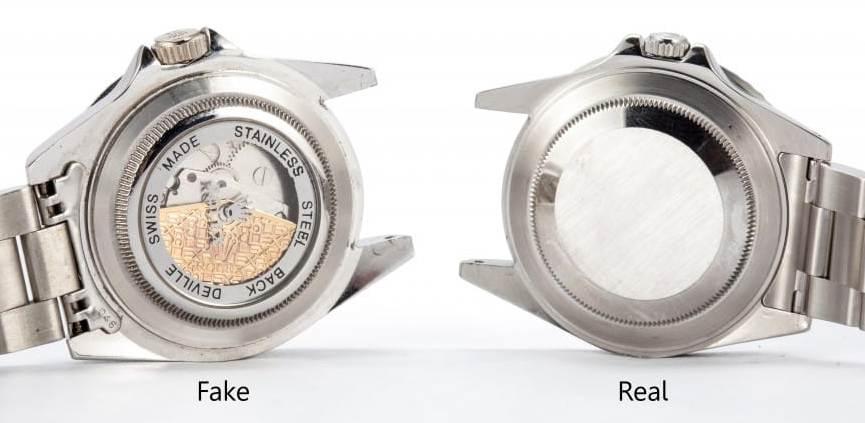
Counterfeiters often try to get overly fancy, and go overboard by putting clear casebacks on watches that shouldn’t have them. Although aftermarket sapphire casebacks can be installed on Rolexes, it’s certainly a red flag when assessing authenticity. If you know how simple a Rolex caseback should look, you can spot fake nonsense like the “Deville Swiss Made” back below in no time:
Caseback Stickers
For years, Rolex put stickers on their casebacks, apparently as an anti-counterfeiting measure. Naturally, counterfeiters were quick to start faking those too. Although Rolex dropped caseback stickers around 2006, counterfeiters actually kept putting stickers on much longer. So a caseback sticker that looks “too new” can be a red flag. Here’s an idea of what some legit caseback stickers look like:

Engraved Rehaut
The rehaut plays an important role in knowing how to spot a fake Rolex. Since 2008, all Rolex rehauts have had the “ROLEXROLEXROLEX” engraving. The serial number should be at 6 o’clock, so if the “ROLEXROLEXROLEX” writing goes all the way around with no break for a serial number at the bottom, that’s a sure sign of a cheap fake.
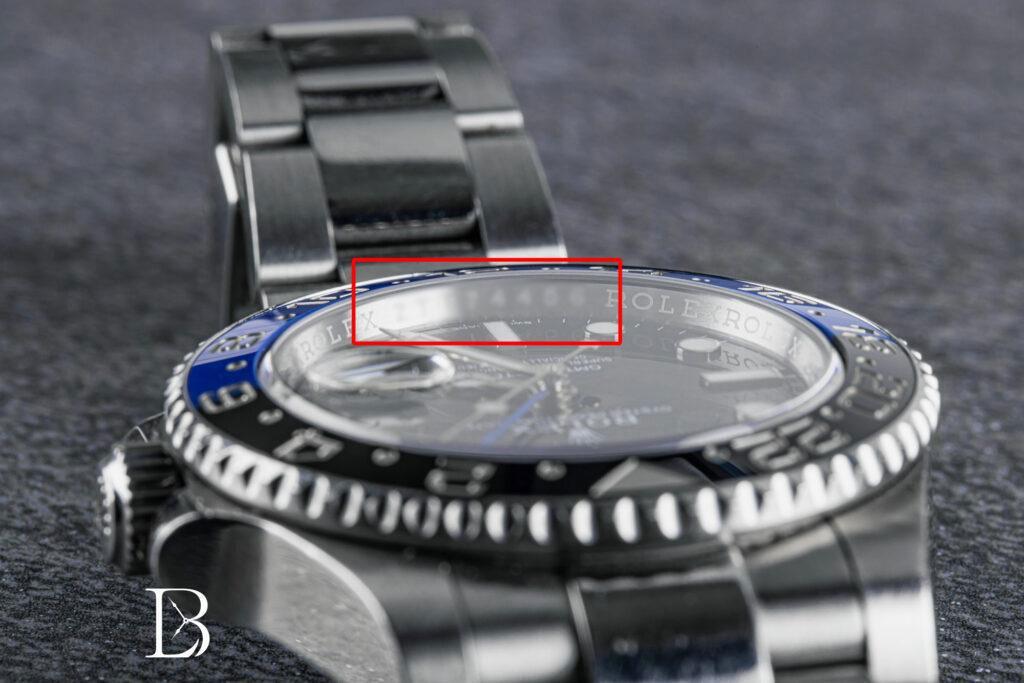
Real Rolex rehauts aren’t always aligned perfectly, but they should be close. The minute lines might not exactly bisect each letter, but if any minute line is so far off that it’s not even touching a letter, that’s a pretty conclusive sign of a fake.
Rehaut engravings on current Rolexes have a clean, sandblasted appearance. Some earlier engraved rehauts were hollow block letters, but they look very clean. Low-quality etching is indicative of a counterfeit.
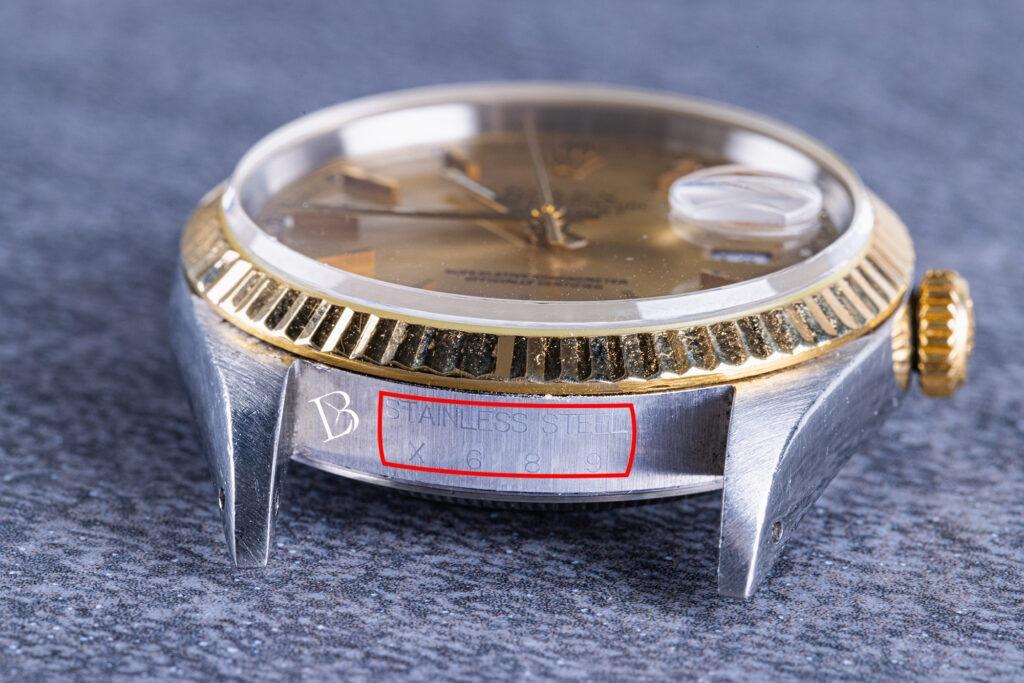
Before the engraved rehauts, Rolex serial numbers were engraved on the case between the bottom lugs. Fakes often have poorly-engraved serials, or none at all.
Dial Stampings
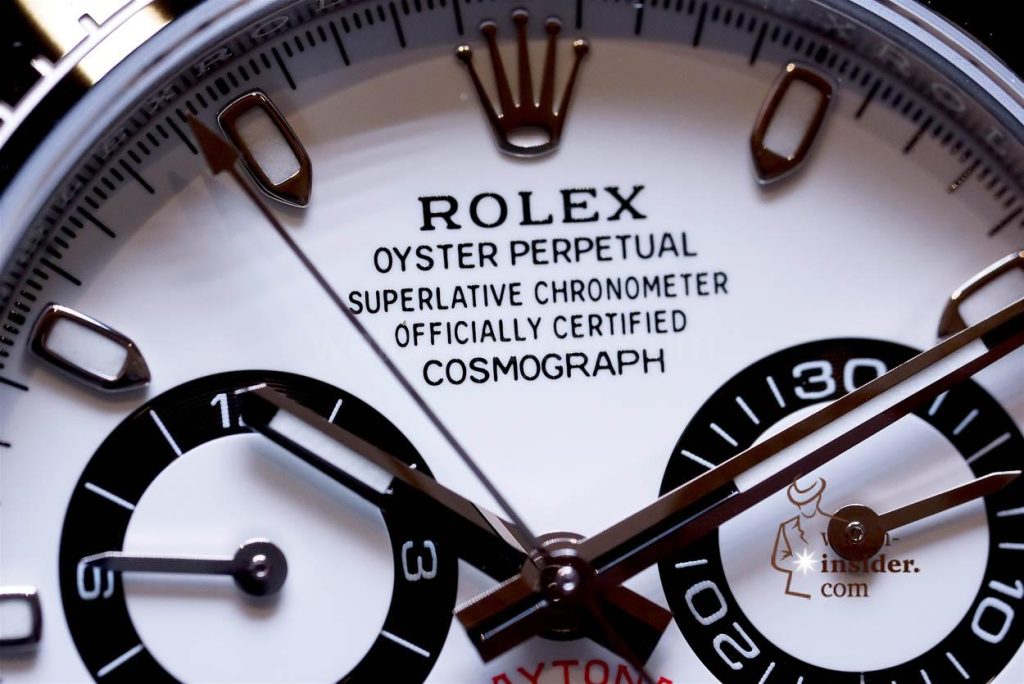
As with the serial number, the stampings on the front of a fake Rolex may look faded, uneven or even misspelled. In this macro shot of a ref. 116500 Daytona, we can see crisp, glossy, slightly raised lettering:
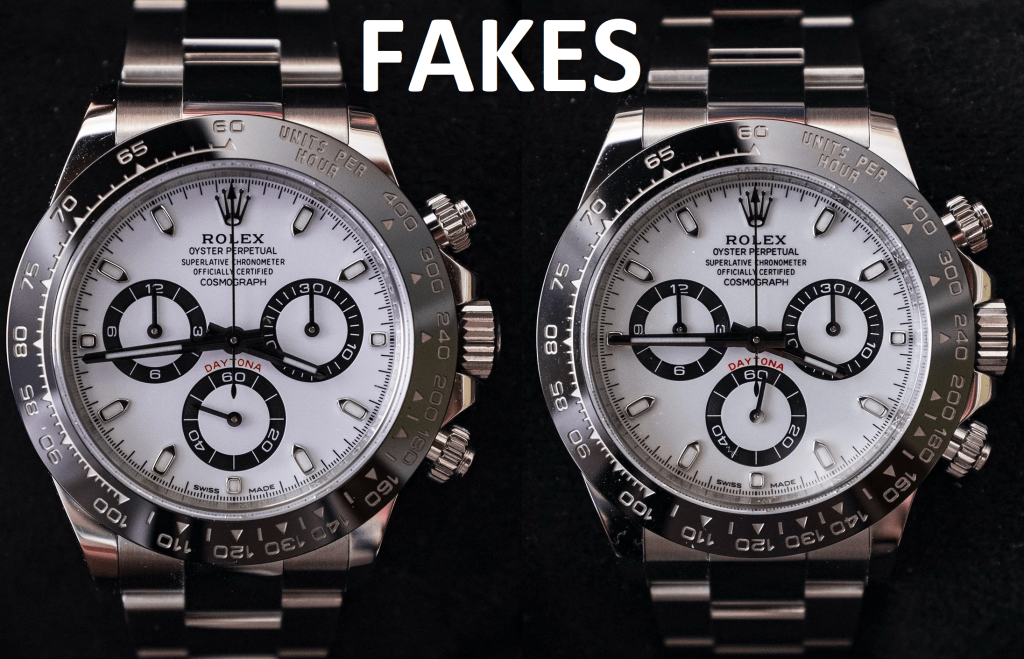
Even these modern “high-end” fakes have lettering with a more flat, painted-on appearance:
More on the Rolex Daytona:

Laser-Etched Coronet (“LEC”)
From 2002 onward, Rolex started engraving the crystal with a tiny laser-etched coronet (crown logo) next to the 6 o’clock mark as an anti-counterfeiting measure. Counterfeiters often fake this, but they make it too visible, so counterintuitively, seeing this laser-etched coronet in photos is actually a red flag. A skilled photographer can capture a real LEC with the right lighting though, as shown below.
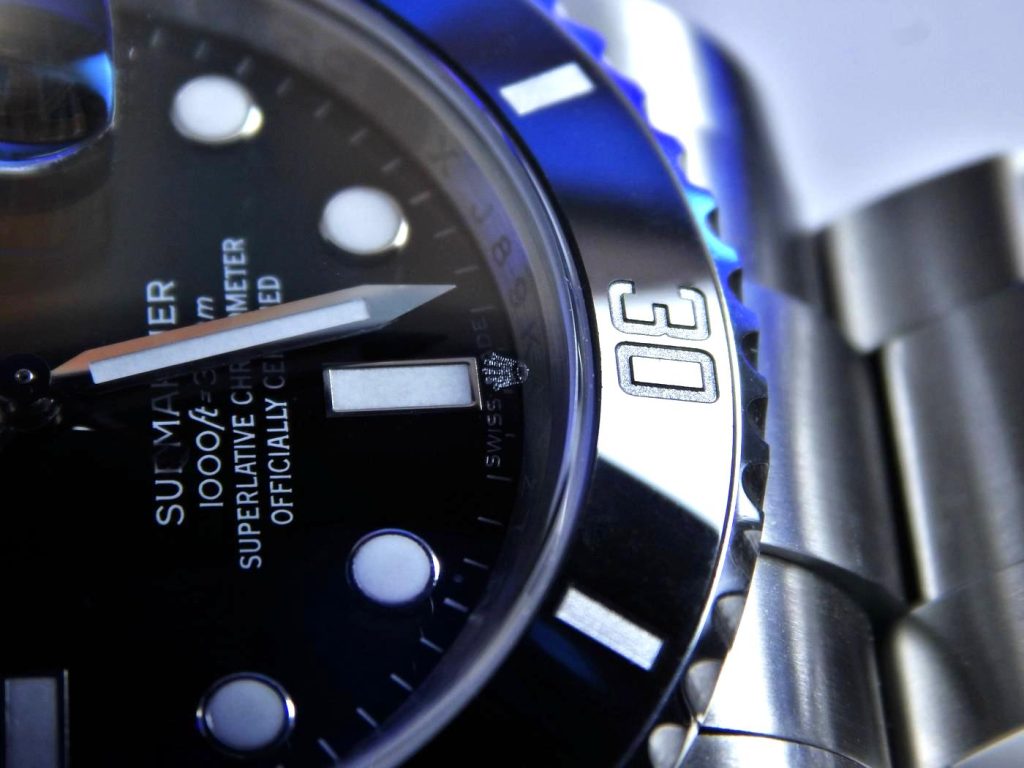
See how cleanly pointillated the above coronet is? Fake LEC’s look more smudgey/foggy and less pointillated, and they’re way easier to see. Like this:

Weight
Rolex watches are made with high quality materials, and their modern bracelets are quite heavy. Some fakes are indeed lighter, but being heavy certainly doesn’t mean it’s real. And being light doesn’t mean it’s fake–vintage Rolexes are far lighter than new ones, and owners of modern Rolexes sometimes (wrongly) assume old Rolexes are fake because of their lack of heft. But fake gold watches are never solid gold, so they’ll never feel as heavy as a gold watch should.
Bezel
Rolex bezels are often quite distinctive, and low-quality ones can be one way to spot a fake.
Feel
Rotating a Submariner bezel results in smooth, subtle clicks. It feels noticeably better than bezels on cheap divers. Modern GMT-Master II models have spring-loaded ball bearings underneath their bezels, resulting in a smooth, satisfying rotating action. If you’re not sure if the Sub or GMT in your hands is legit, give the bezel a spin and see if it feels “cheap.”
How to Spot a Fake Rolex Fluted Bezel: Too Smudgey
Real fluted Rolex bezels are made of solid gold, and they are extremely shiny. The fluted bezels of stainless steel fakes often show smudges and fingerprints more than a real one would. Honestly that “smudgey” fluted bezel is an underrated part of knowing how to spot a fake Rolex. On this same fake Rolex we can also see the poor rehaut alignment mentioned earlier. Minute markers should each go through a letter of the word “ROLEX” and although even real ones are often aligned imperfectly, the spacing won’t be this wonky:

While Rolex fluted bezels are very precisely cut, fake ones often a cheap so-called “Reese’s cup bezel” look to them.
Basic Indicators of Age: Do They Match Up?
Even within a single reference, Rolex has been known to produce several variations. For ref. 16610 Submariner Date models, for example, solid end links (“SEL”) replaced hollow end links (“HEL”) around 2000. The SEL’s aren’t really that much more solid than “hollow” ones (“slightly reinforced” might be more accurate, as you can see below). However, collectors almost universally agree that the SEL’s indeed feel significantly more solid than the HEL’s, which have their own lightweight charm.
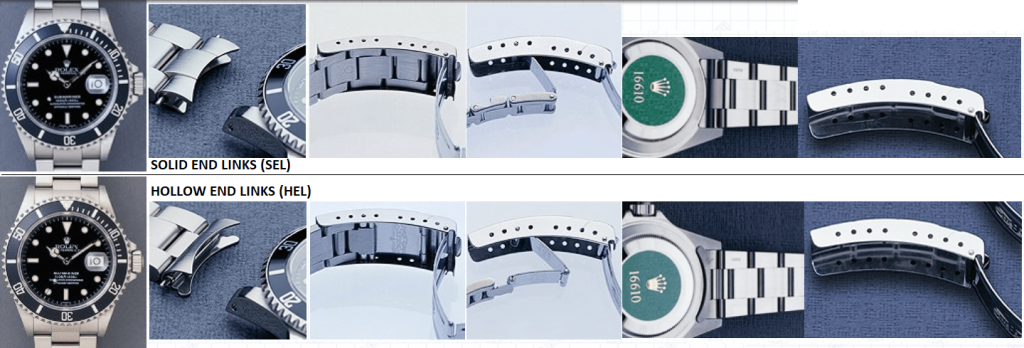
Knowing what hollow end links look like, and when they were phased out, is helpful when assessing the age and legitimacy of a “Rolex” watch.
And if a watch seems to have mismatched indicators of its age, that can be a red flag. For instance, a real Rolex will never have an engraved rehaut on a dial that says “T Swiss Made T” because that engraving came years after tritium was phased out. Knowing this timeline can help spot things like that:
Notable Rolex Evolution Timeline
| 1997-2000: Tritium phased out | Modern non-radioactive lume began to replace tritium in the Rolex lineup in 1997. If you see a watch that looks like a Rolex that came out in 2012, but it says “T SWISS T” at the bottom, it’s fake. |
| 2000 – Solid end links debuted | As mentioned, the Sub Date got SEL’s in 2000, and they were added to the rest of the lineup in the following years. |
| 2002 – Lugholes disappearing | Lugholes were removed from Sub Dates and GMT’s around 2002. If you see a 16610T or 16710T model, just remember the “T” as being short for “there’s no lugholes!” 5-digit no-date Submariners kept their lugholes until the end, though; 14060m was the final Rolex model with lugholes. |
| 2002 – Laser-etched coronet | The LEC also began appearing around 2002. So if you see a 1970’s model with the LEC, for instance, run away. Note that the Milgauss GV, with its green sapphire crystal, has no LEC. |
| 2004-2008 – Engraved rehaut debuts | The engraved rehaut first appeared on some Turn-O-Graph models in 2004, but it wasn’t commonly seen until 2005 and it wasn’t on the entire lineup until 2008. |
| 2006 – No more caseback stickers | Since 2006, Rolexes no longer come with green stickers on the casebacks. |
Made in USA? On a Rolex?
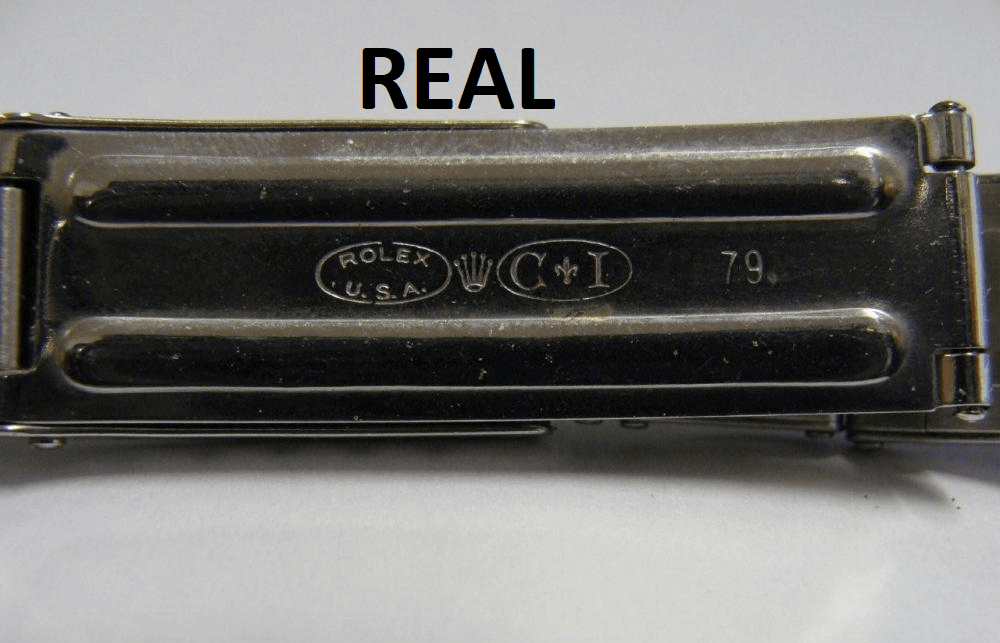
One might think that “U.S.A” stampings on the bracelet of a Swiss watch would be a red flag, but from about 1959-1979, Rolex frequently used locally-sourced bracelets. Complete watches were often taxed more heavily than incomplete ones, which is why you can find real vintage Rolex bracelets made in the U.S.A, as well as Mexico, Japan, England and South America. Nowadays, Rolex’s supply chain is more vertically integrated and entirely Swiss-made.
Clasp Engravings
Some fake clasps are extremely convincing these days, but many don’t even use the correct model number. For instance, a quick search of “62523H” reveals that code belongs on a two-tone Jubilee bracelet, not a steel Oyster.
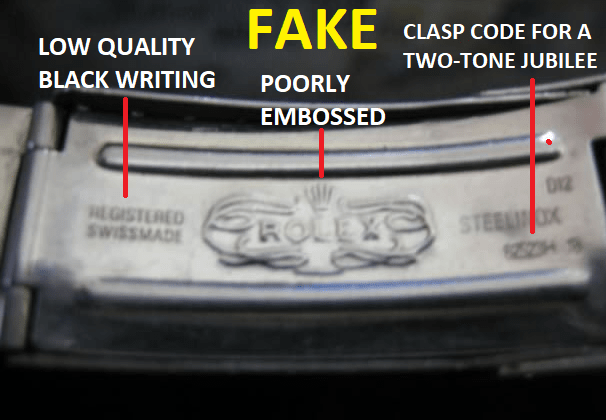
So, make sure the watch you’re considering has the correct bracelet model number on the clasp. You can use our Rolex serial and clasp code lookup tool to decode the date code, like the “D12” in the top right of this fake).
“South American” Fakes
If you hear a collector use the term “South American fake,” it refers to an actual vintage watch which has been retroactively marked with the brandings of a more expensive brand. Look for things like parts with mis-matched patina on the movement parts, and laser-etched engravings on watches made before laser engraving existed.
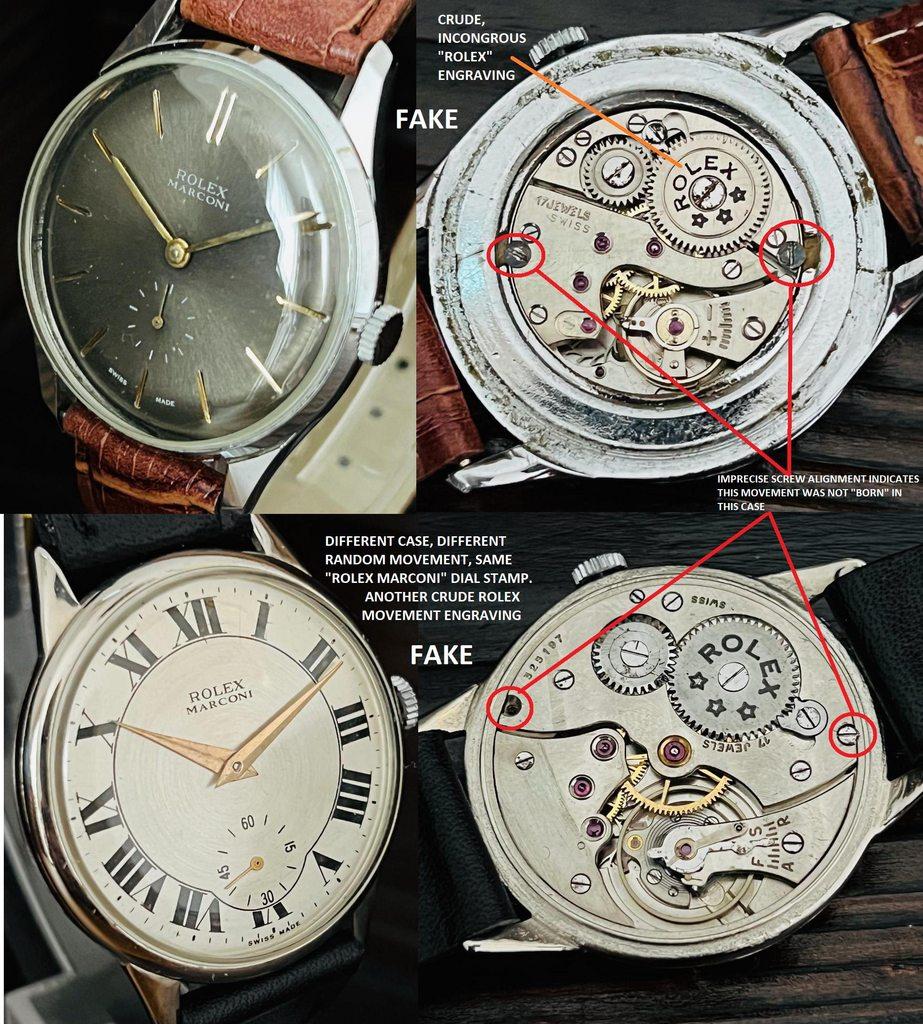
Marconi is an often-faked early brand of Rolex Watch Co. (you can find some real Rolex Marconi watches from the 1920’s) for example. Watches like the one above are hodgepodges of old watch parts with a “Rolex Marconi” stamp added to the dial, and they used to be all over eBay. To their credit, when we called out eBay for all the fakes on their platform, they made a concerted effort to remove most of the fake Rolex Marconis. Still, if you’re venturing into the vintage world, it’s good to be aware of this type of fake, especially if you can’t find comparable examples to one you’re looking at.
What is a “Floating M” Rolex Submariner?
Rolex Submariner dials have gone through various tiny typeface and spacing adjustments over the years. Where it says “1000 ft. = 300 m” on the dial, the bottom of the “m” almost always aligns with the bottom of the 0’s. If the “m” is a bit raised, that’s called a “floating m” and a lot of fake Submariners have that. However, although relatively uncommon, that is a real dial variant! So if you already have concerns about a Rolex you’re looking at, a “floating m” should make you even more suspicious. But it’s not enough to condemn a watch as fake on its own. Also, note that some dials have a bit of extra horizontal space between the “300” and the “m” but that’s not a floating m; it’s about the vertical alignment.
Gold “Acierinox” Buckles
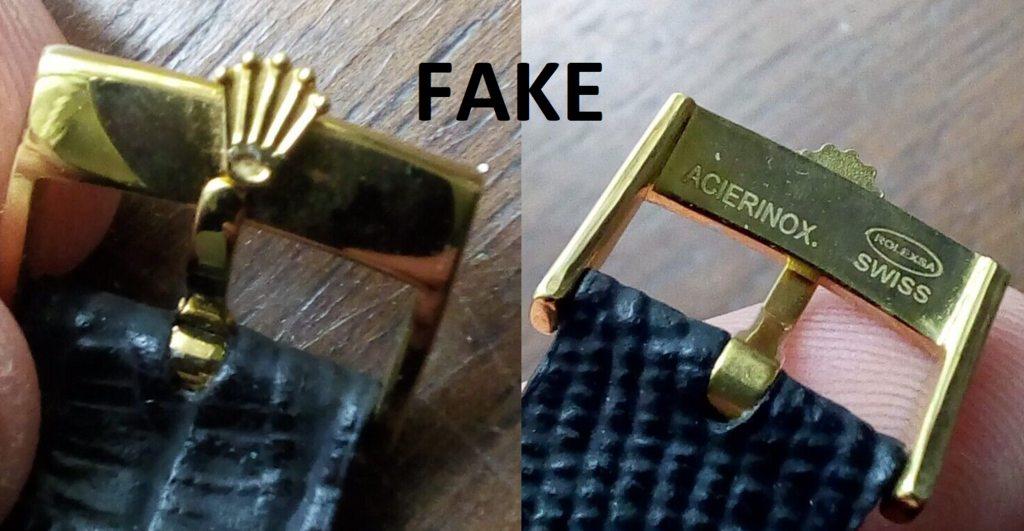
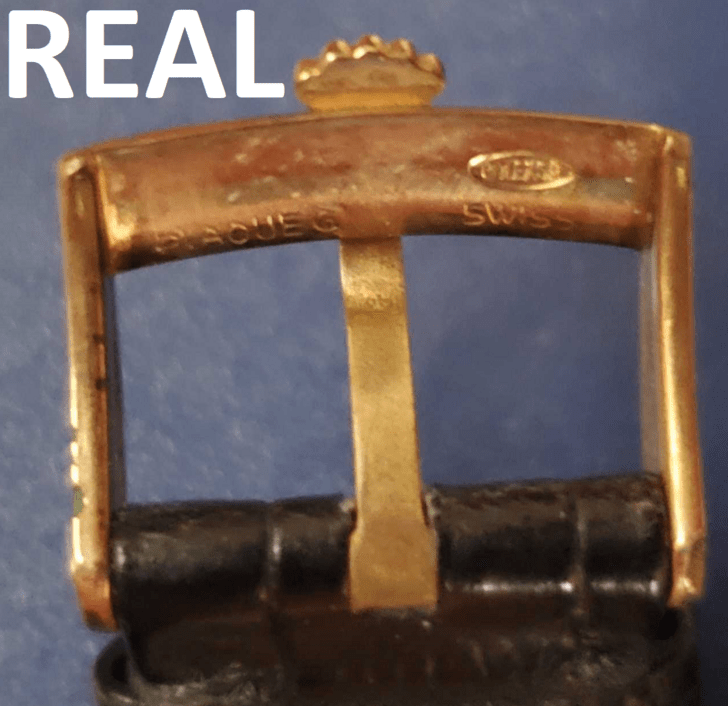
While you’re avoiding ebay Marconis, go ahead and skip ebay Rolex buckles too. Fake Rolex buckles are so common that it’s healthy to be skeptical if you get one anywhere except a Rolex Service Center. Often, gold-plated fake buckles will say “ACIERINOX” which, humorously enough, means “stainless steel.” Real gold-plated vintage Rolex buckles do exist but they say “PLAQUE.”
Here’s an example of a genuine vintage gold-plated Rolex buckle:
Shrink Wrap
While it is theoretically possible for resellers of genuine Rolexes to wrap their watches in plastic, it’s not a common practice. Seeing the lugs wrapped in this stupid shrink wrap is a huge red flag, and often “904L” will be written in red:

“Quartz” on the Dial
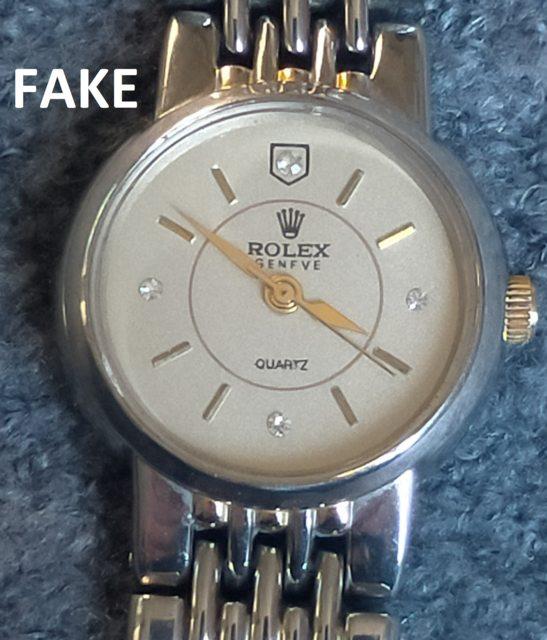
Aside from the rare ref. 5100 prototypes, Rolexes never say “Quartz” on the dial unless it’s part of the word “Oysterquartz.” This tip can be useful when scrounging through estate sales or Goodwill, so you can quickly disregard supposed quartz Rolex watches such as this:
How to Spot a Fake Rolex Cellini: Date Windows, Lume, Seconds
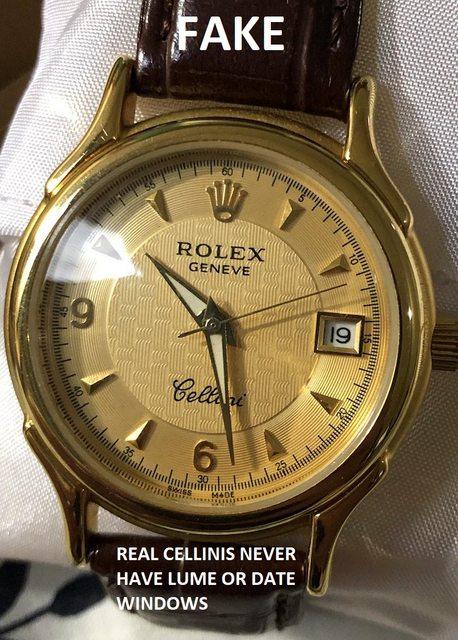
Rolex has never put lume, nor a date window, on any of their Cellini models. Also, aside from the 2013-2023 models, Rolex Cellinis never have seconds hands! Those three facts are enough to know how to spot a fake Rolex Cellini in many cases:
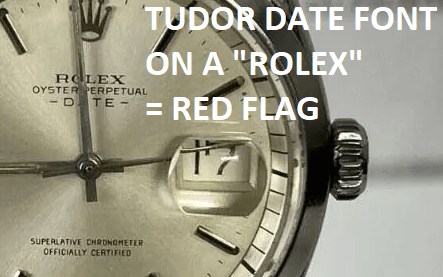
Avoid Tudor Date Fonts on a “Rolex”
Vintage Tudor watches have several parts that are similar (and often interchangeable) to those of their Rolex counterparts. However, Tudors have their own distinctive date fonts. Sometimes, counterfeiters will use a mix of counterfeit, Tudor, and Rolex parts. Since many Tudors use ETA movements, and many fakes do too, it’s easy for fakers to use Tudor date wheels. If you recognize the Tudor date font on a so-called “Rolex,” that’s likely a “franken” like the watch below. If you know what a Tudor date font looks like, you should know how to spot the red flag on this fake/Frankenstein Rolex:
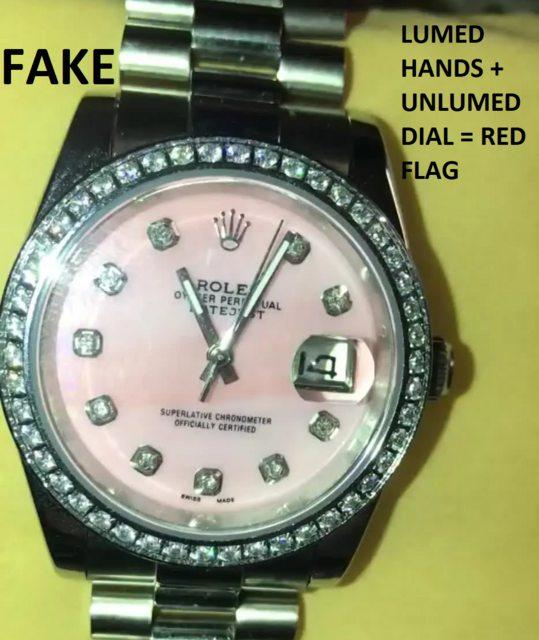
Lumed Hands (Usually) Belong on an Unlumed Dial
With few exceptions, if a Rolex has no lume on the dial, it shouldn’t have lume on the hands, either. Sometimes collectors and resellers of genuine Rolexes do “dial swaps” and forget to match the hands, but in general, lumed hands on an unlumed dial are a red flag.
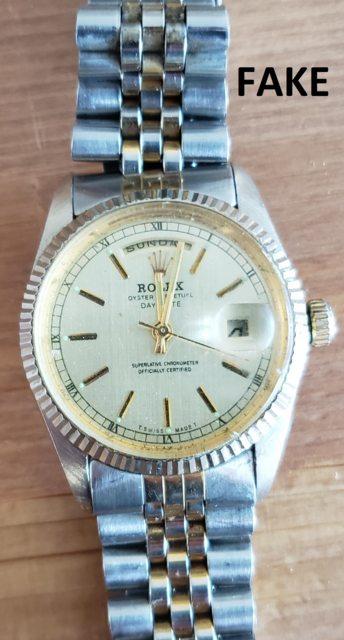
Avoid Two-Tone Day-Dates
Rolex never made a steel-and-gold Day-Date. Two-tone “Day-Dates” like the one below are some of the most common fakes around. You don’t have to know how to spot a fake Rolex like a pro to know this one is fake:
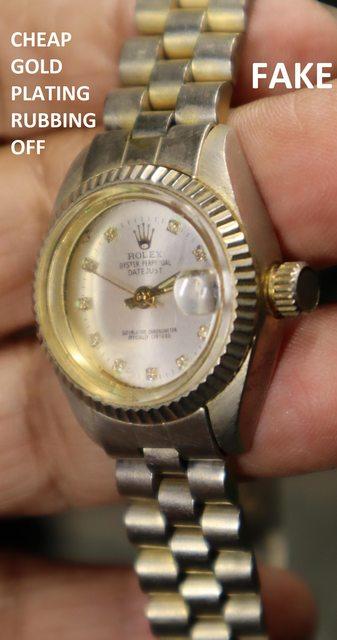
How to Spot a Fake Gold Rolex: Gold Plating Rubbing Off
Although some obscure gold-plated vintage Rolex models do exist, Rolex has never used gold plating on any sports model, Day-Date, or Datejust. If you see gold plating that has rubbed off on these models, stay away.
Although the accuracy of counterfeiters is only going to get scarier and scarier, if you keep these guidelines in mind, you should know how to spot a fake Rolex in most cases. Just remember to research the model you’re purchasing, and that there’s no substitute for buying from a trusted, reputable dealer!
More Rolex Collector’s Guides:


Leave a Reply