An Introduction to Ferdinand Berthoud

Ferdinand Berthoud was an 18th‑century titan of marine chronometry, and since the brand’s 2015 relaunch under Chopard’s Karl-Friedrich Scheufele, they’ve quickly become a titan in the modern $200,000+ luxury watch segment. When you consider that every one of their watches contains either a cylindrical hairspring or a fusée-and-chain mechanism, the prices start to make sense. Here’s our quick guide to Ferdinand Berthoud.
History
Chopard, owned by the Scheufele family, purchased the Ferdinand Berthoud name in 2006, but watches produced under that brand name didn’t appear until 2015. Ferdinand Berthoud has deservedly become one of the most expensive watch brands in the world today, despite having no discernible historical connection to Ferdinand Berthoud, the man, aside from heavily taking inspiration from his Marine Clock No. 8. But I’m going to talk about him anyway.
Saying that Ferdinand Berthoud was an important figure in marine chronometry would be an understatement. While Christiaan Huygens was the first known clockmaker to attempt building a sea-worthy chronometer for navigation purposes in the 1670s, the first sufficiently robust and practical example came from John Harrison in 1759, and Berthoud wasn’t far behind.
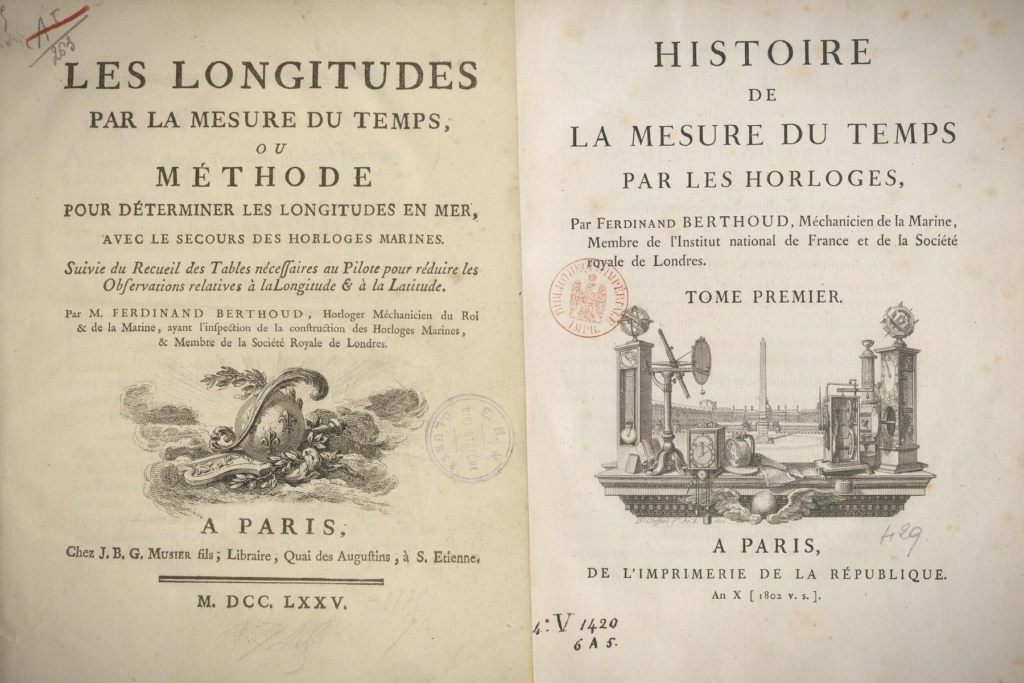
When two of his marine chronometers underwent testing by the French Navy, they were so impressed that by 1770 Berthoud was named Horloger-mécanicien du Roi et de la Marine (“Horologist‑Mechanic by appointment to the King and to the Navy of France”). In 1773, Berthoud became the first person to write a book comprehensively explaining how to make and maintain a marine chronometer. High-quality clocks became invaluable for sea navigation.
Let’s say solar noon at your location happens when your chronometer, which is presumably set to Greenwich Mean Time, says 2:00. You are two hours (1/12th of a day) behind Greenwich, and thus you are 1/12th of the earth (30 degrees) West of Greenwich. Put simply, every four minutes is a degree.
That was how you got your longitude, while your latitude was calculated with a sextant, the height of the noon sun, and a chart. Pretty cool! But now let’s talk about some quarter-million dollar watches that were made a quarter-millennium after Ferdinand Berthoud’s important book.
Achievements of the Modern Ferdinand Berthoud Brand
In the six-figure price range, tourbillon watches are common, but I can name only eight modern brands that have made watches with fusée‑and‑chain transmissions. A. Lange & Söhne, Breguet, Zenith, Romain Gauthier, Leroy, Cabestan, and Christophe Claret are the other seven (Claret uses more of a “cable” than “chain” but we’ll let it slide). Ferdinand Berthoud is one of only three brands that combines both.
A fusée‑and‑chain is a type of constant‑force mechanism, meaning its purpose is to keep the torque to the escapement as steady as possible–whether the power reserve is full or nearly empty. A fusée is a cone‑shaped pulley with a helical groove cut into it, and the chain’s purpose is to move along that cone so the effective radius where it pulls changes as the mainspring’s torque decreases. A fuller power reserve will cause a shorter effective radius and vice versa.
Torque equals force times radius, so this has a self-correcting effect on the torque delivery. Meanwhile the tourbillon’s purpose (aside from looking good and being an additional flex) is to even out the effects of gravity.
Immediate Recognition
When your brand’s first watch combines a tourbillon with a fusée‑and‑chain mechanism, collectors take note. Thus the Chronomètre FB 1.1 won the top prize in the watch industry’s top awards show (GPHG) in 2016. Ferdinand Berthoud took home four additional GPHG awards in the following years.
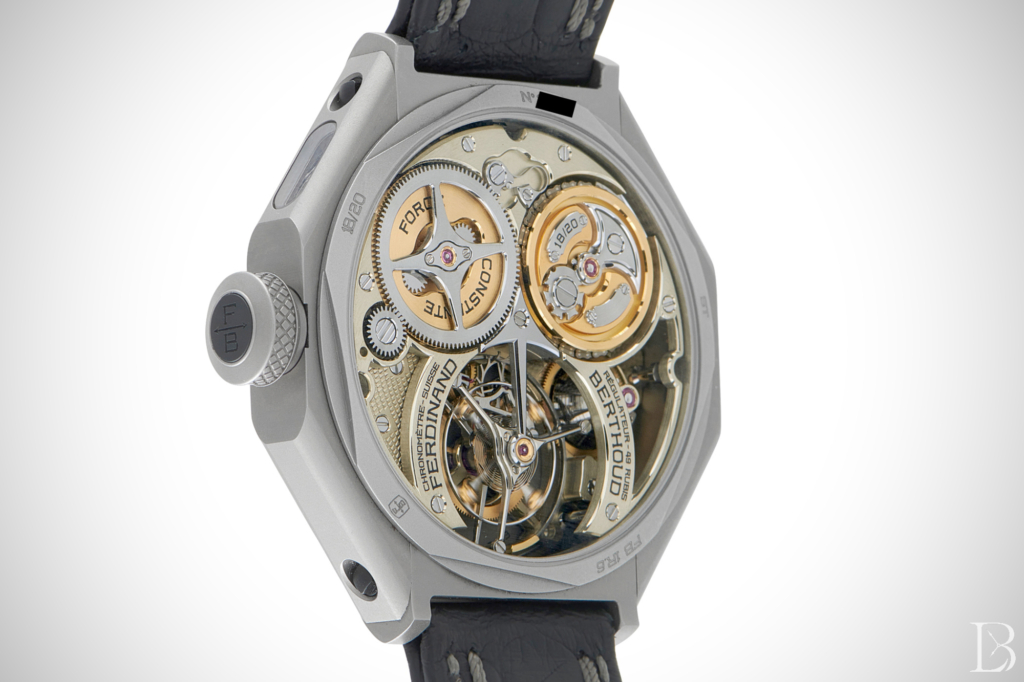
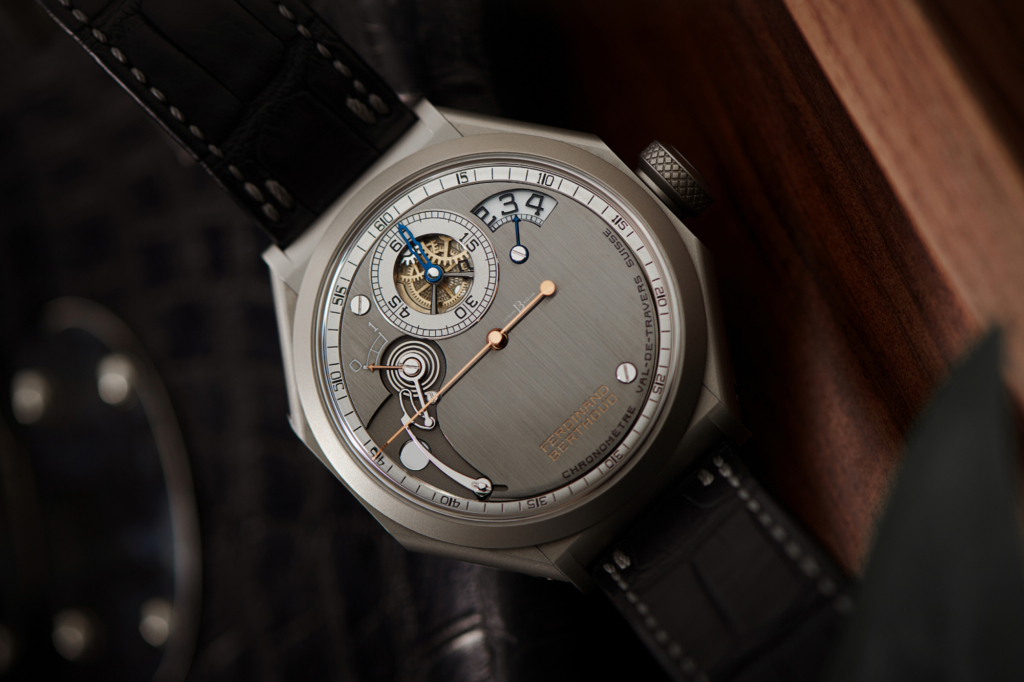
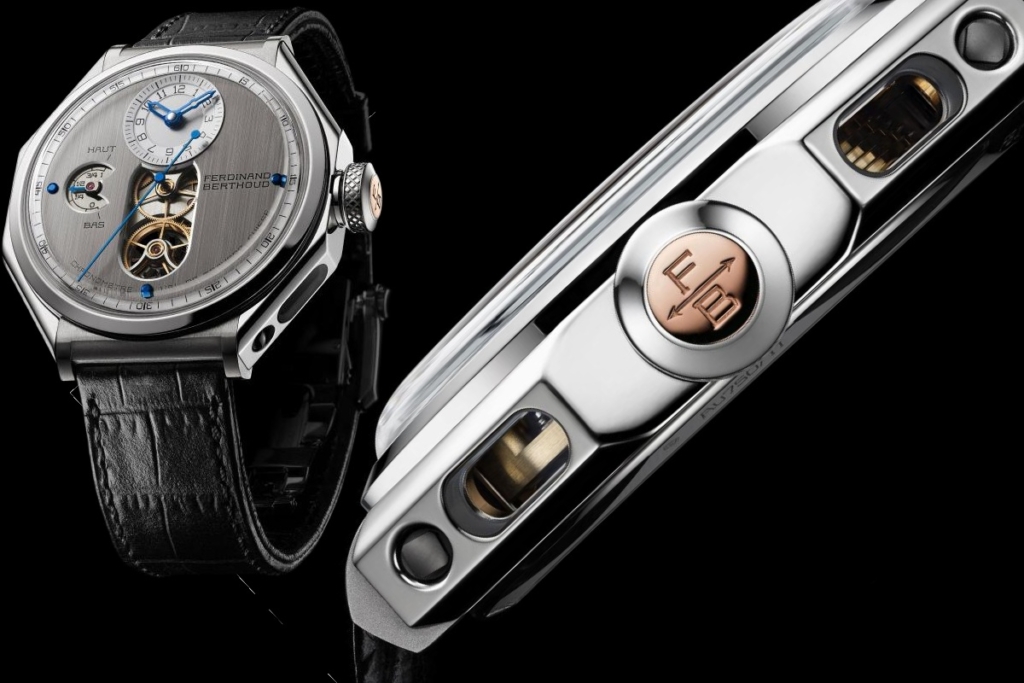
All pre-2020 Ferdinand Berthoud watches came in 44mm octagonal cases with the minutes displayed in a subdial at 12 o’clock. Octagonal FB watches all have central seconds hands and the aforementioned fusée‑and‑chain mechanism connected to a tourbillon at 6 o’clock. The tourbilon is best seen (or sometimes only seen) through the exhibition caseback.
Ferdinand Berthoud Régulateur Watches
While the first FB 1 models put the hour hand in the same subdial as the minute hand, in 2017 the first Regulator models appeared, ditching the hour hand in favor of a numerical drag-hours display at 2:30.
Traditional regulator watches have a central minute hand, but as long as the hour, minute, and seconds hands are all separate, it technically meets the definition of a “regular watch.”
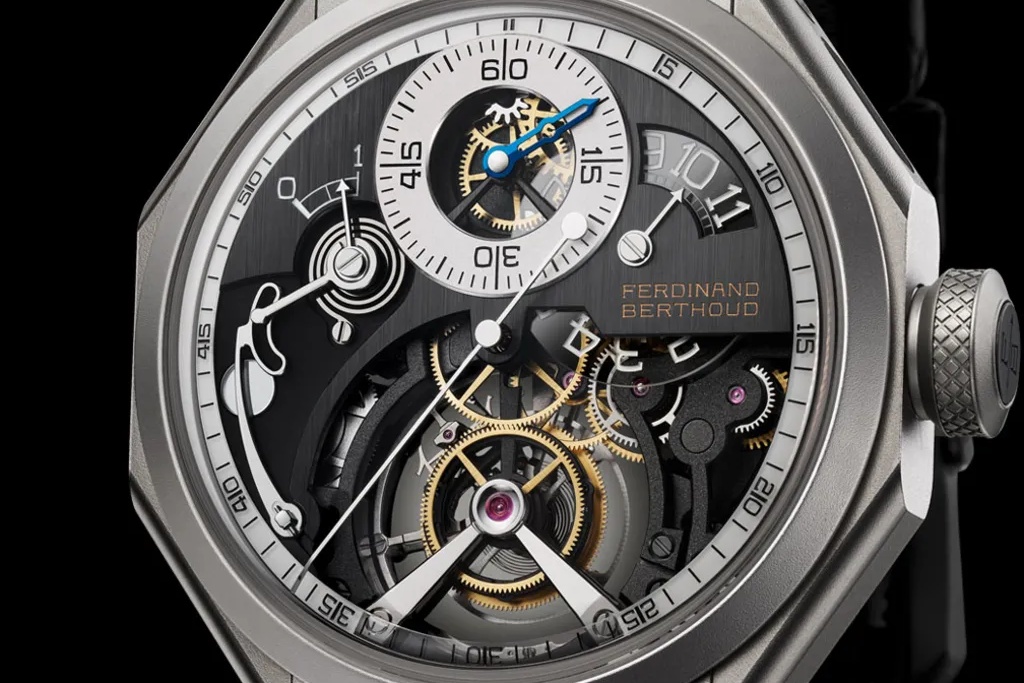
Skeletonized (Squalette) regulator models (like the one shown above) came a few years later, and a range-topping deadbeat seconds regulator (Régulateur Seconde Morte) followed in 2022. Each RSM movement was co-created with an apprentice as a watchmaking graduation project.
Deadbeat seconds complications–meaning the seconds hand ticks only once per second–add friction, shock sensitivity, and tolerance headaches; getting one to run reliably and still pass strict chronometer criteria is non‑trivial. That’s why the overwhelming majority of Rolex Tru-Beat models have broken deadbeat mechanisms today.
Double Moonphase
In 2019, Ferdinand Berthoud released their first moonphase. It has two duplicative moonphase displays: one on the edge of the dial, designed to quickly show if the moon is waxing (growing) or waning (shrinking), and a numbered retrograde age-of-moon scale. While most retrograde watches simply “snap back” to their starting point when their trajectory is complete, this hand goes up for 14.75 days and then comes back down for 14.75 days–a major engineering feat.
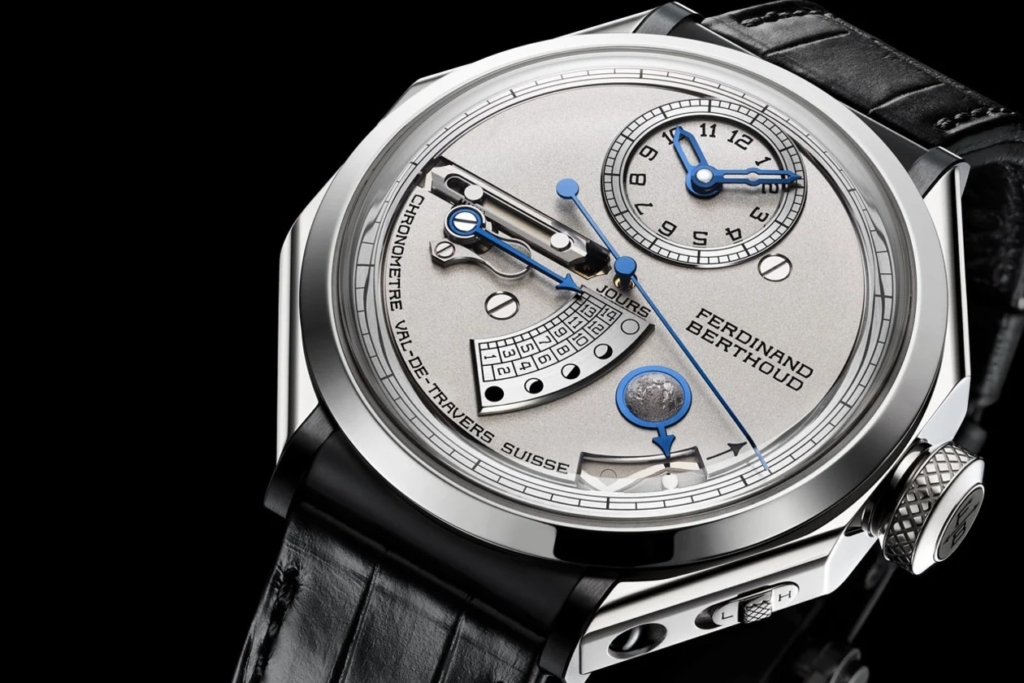
All previous Berthouds were given a power reserve indicator on the left side of the dial, and on Regulator versions its swan‑neck‑shaped feeler spindle is partially visible, arcing out from under the dial as it presses on a cone and drives the power‑reserve indicator. But the FB 1L models move the power reserve indicator to the back, and put a hotel-door-lock-looking thing on the front instead. That’s the sliding rack and feeler‑spindle assembly that moves up and down along the edge of the dial, “tracing” the large lunar cam and converting its profile into the position of the age‑of‑the‑moon hand on the front.
The First Ferdinand Berthoud Remontoir d’Égalité (and First Round Case)
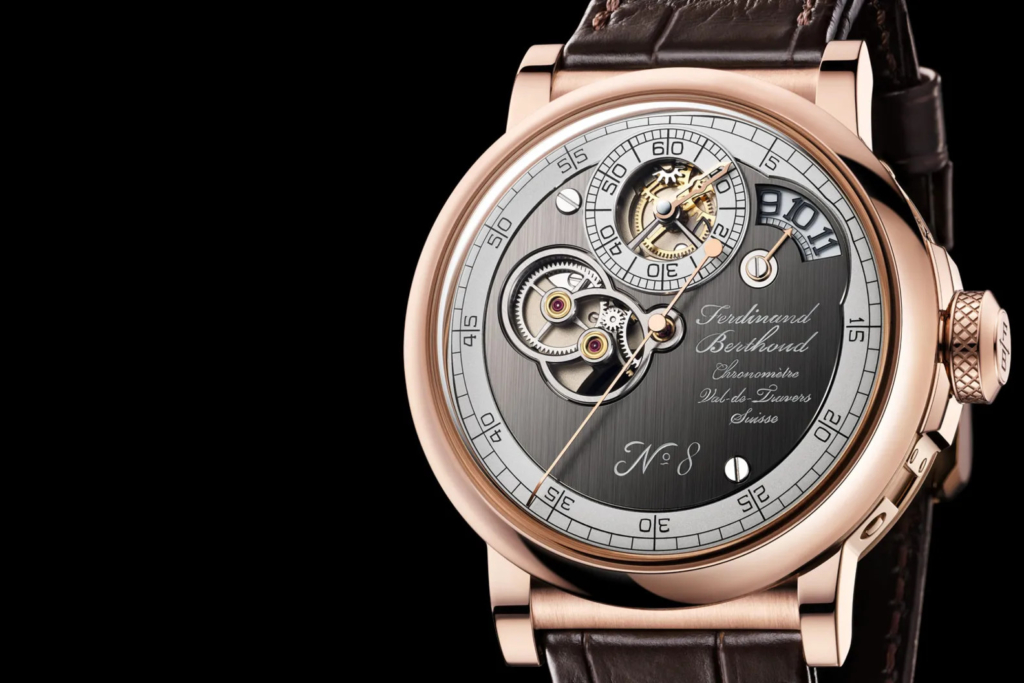
While a fusée‑and‑chain transmission basically evens out long‑term deviations in torque delivery, a remontoir d’égalité evens out the short‑term variations in driving force from one oscillation to the next. A remontoir alone is a highly complicated mechanism that puts a watch into elite horological territory with brands like F.P. Journe, Arnold & Son and Greubel Forsey. But combining a fusée‑and‑chain transmission and a remontoir d’égalité was a historical wristwatch first when Ferdinand Berthoud released the FB 2RE in 2020.
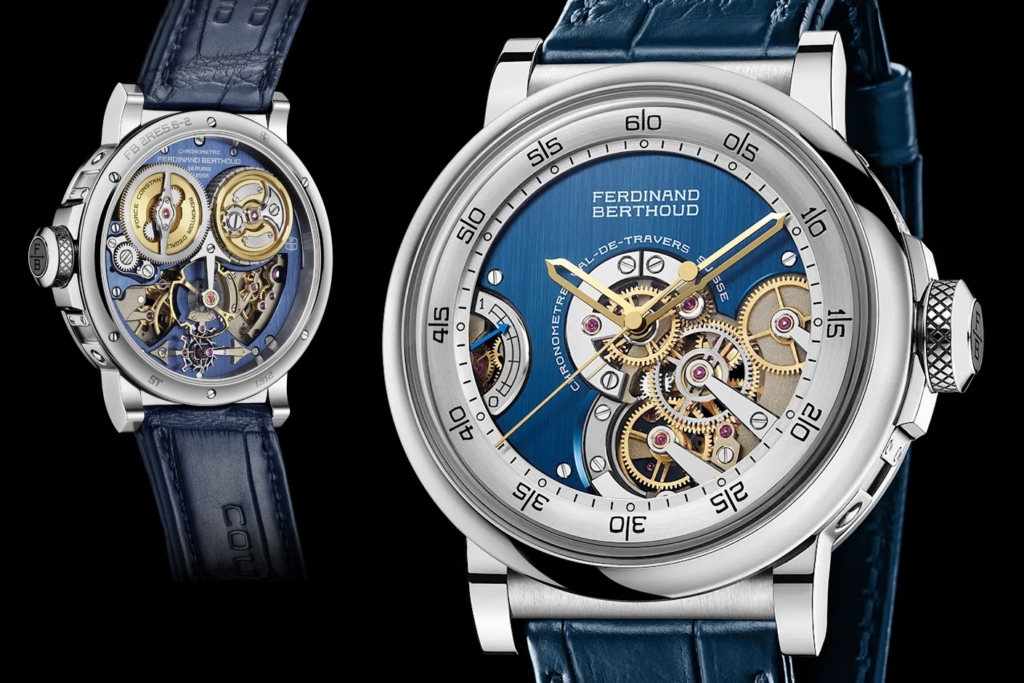
It was the brand’s first round watch, their first non-tourbillon watch, and also their first use of central hours/minutes. Remontoir watches often are timed to release their energy once per second, so watchmakers can use this synergistically to drive the seconds and thus achieve “deadbeat seconds” without an additional complication–and that’s what Ferdinand Berthoud did with their remontoir movements. Skeletonized versions, such as the one shown above, appeared in the Ferdinand Berthoud catalog in 2024.
These Remontoir movements have since been offered in the original octagonal case as well. The brand is increasingly–but not entirely–moving towards a “choose your movement and then choose your case” paradigm, often with some room for customization, rather than a strict lineup of available configurations. That’s exactly how the watch world worked over a century ago, and I think that insanely-old-school approach makes sense for a brand in their price tier.
Now let’s talk about Ferdinand Berthoud’s third case style, which debuted alongside another major horological breakthrough.
Cylindrical Hairsprings
Hairsprings, the small spiral springs at the heart of a mechanical watch’s regulating system, are one of the most notoriously difficult watch parts to produce. Even tiny imperfections can affect timekeeping, which is why only a handful of brands worldwide actually manufacture them. Fewer still are able to produce cylindrical hairsprings, rather than flat ones.
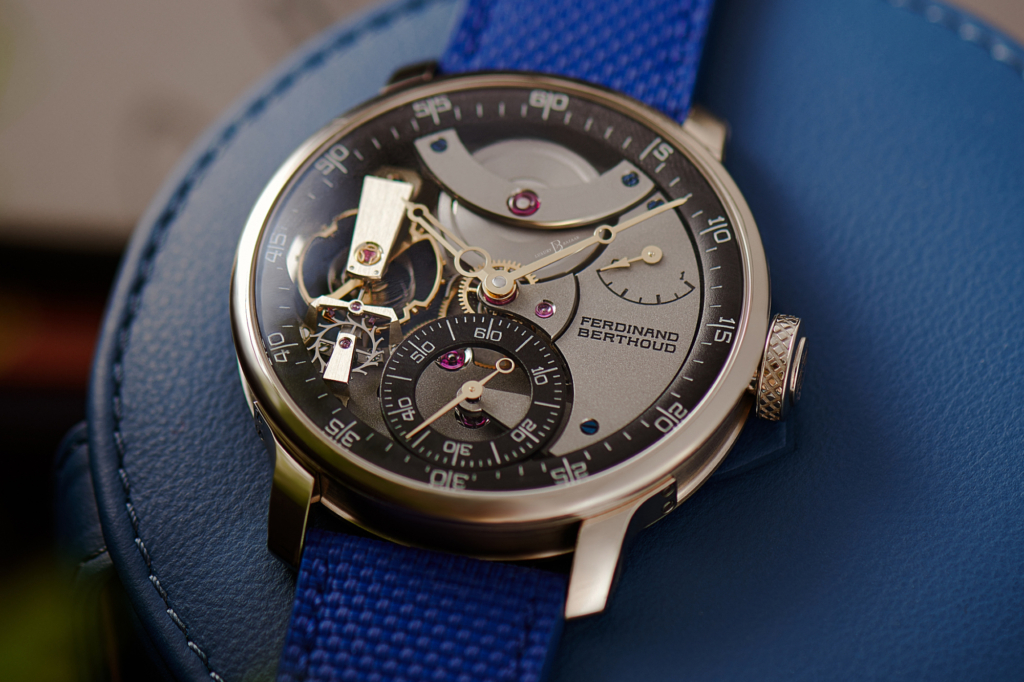
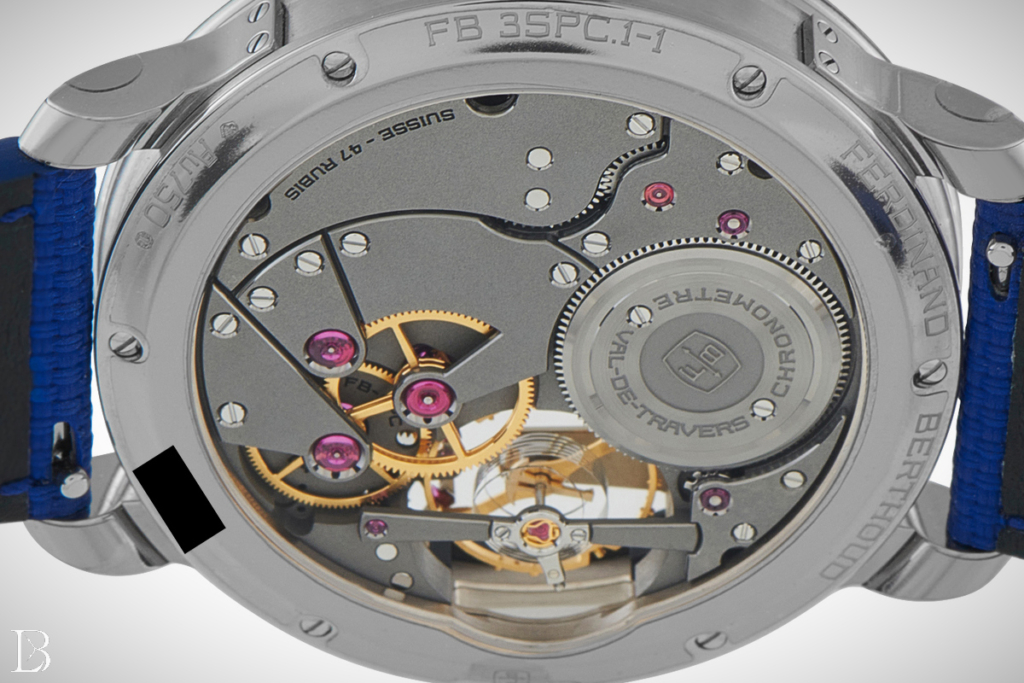
The benefit of a cylindrical hairspring is that it pulsates (“breathes”) more concentrically than a flat spiral, which improves isochronism and reduces positional errors. Ferdinand Berthoud joined the elite cylindrical hairspring club in 2022 with the release of the FB 3SPC. The SPC is the only chronometer-certified watch ever made with a cylindrical hairspring.
The FB 3 case is round, but its lugs are a bit sportier than the FB 2. While the FB 1 and FB 2 are both 44mm wide, the FB 3 is slightly smaller at 42.3mm. More notable is its slim case height (only 9.4mm instead of about 13-14mm for other FB’s). So far, every FB 3 has gotten the SPC (cylindrical hairspring) movement, and its only complication aside from hours, minutes, and small seconds is a power reserve indicator at 2:30.
Understanding Ferdinand Berthoud Model Numbers
Fortunately, Ferdinand Berthoud reference numbers are pretty straightforward. All Ferdinand Berthoud models start with “FB” and then a number 1 through 3. That number tells you the case shape: 1 is the classic 44mm octagon, 2 is a dressy round style with half-hooded lugs, and 3 is the slightly sportier round design I just mentioned. Then you’ll see between zero and three letters representing one of the brand’s eight movement types, one digit signifying the case material, and then (sometimes) an additional number indicating a dial variant. We’ve summed it up in an infographic for you:
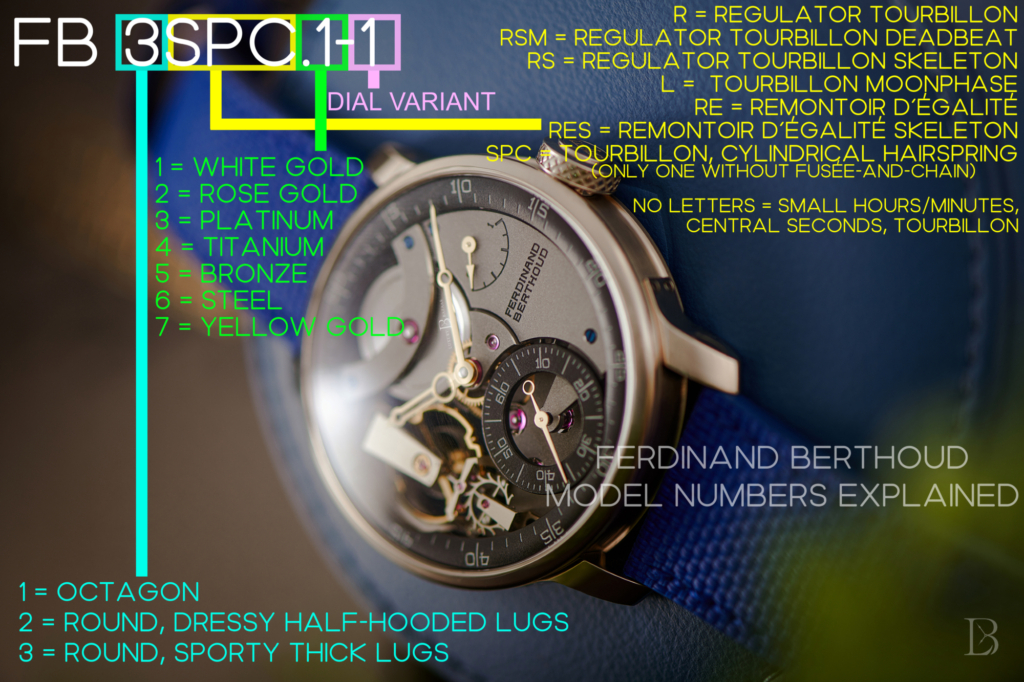
Precious metal cases are common in the Ferdinand Berthoud lineup, but they also dabble in stainless steel (sometimes thermochemically hardened), bronze and titanium (sometimes with a ceramicized outer layer).
Ferdinand Berthoud Model Timeline
Because Ferdinand Berthoud allows so much customization and has several small-batch special editions, I haven’t quite included every FB configuration ever made in this list, but this timeline should give you a good idea of the progression of the brand. Note that Ferdinand Berthoud watches are all manual-wind, and aside from the SPC models, they all have fusée-and-chain mechanisms.
| Year | Reference / Model | Name / D escription |
|---|---|---|
| 2015 | FB 1.1 | Chronomètre in white gold; octagonal case, tourbillon with fusée‑and‑chain, central hours/minutes/seconds, power reserve on caseback, calibre FB‑T.FC, 50 pieces. |
| 2015 | FB 1.2 | Chronomètre in rose gold with same octagonal architecture and FB‑T.FC movement |
| 2016 | FB 1.3 | Chronomètre in platinum with nickel‑silver dial |
| 2017 | FB 1.4 | Chronomètre in titanium; lighter octagonal case with updated FB‑T.FC‑2 movement |
| 2017 | FB 1.1‑2 | Chronomètre “Oeuvre d’Or” in white gold; richly engraved case and dial |
| 2017 | FB 1.2‑1 | Chronomètre “Oeuvre d’Or” in rose gold; richly engraved case and dial |
| 2017 | FB 1R.6‑1 | Chronomètre Régulateur; steel octagonal case, separate hours/minutes/seconds, power reserve, tourbillon, limited to 20 pieces |
| 2017 | FB 1R.5‑1 through -5 | Chronomètre Régulateur in patina bronze case, only 5 made (each with its own -# because of unique patina) |
| 2019 | FB 1.3-1 | Chronomètre in platinum with ceramic inserts, sapphire blue dial |
| 2019 | FB 1L.1 | Chronomètre Lune “Near Side of the Moon” in white gold with dark crater‑style lunar display; hours/minutes/seconds plus age and phase of the moon, PR on back |
| 2019 | FB 1L.4 | Chronomètre Lune in rose gold with black dial |
| 2020 | FB 2RE.1 | Chronomètre FB 2RE in 18k rose/pink gold; round 44 mm case, grand feu enamel dial, central time, deadbeat seconds via one‑second remontoir, COSC‑certified. |
| 2020 | FB 2RE.2 | Chronomètre FB 2RE in 18k white gold with enamel dial; same FB‑RE.FC calibre and display, limited to 10 pieces per metal. |
| 2021 | FB 1RS.6 | Chronomètre Régulateur Squelette in carburised steel; skeletonised regulator plate, separate hours/minutes/seconds, dial‑side PR, tourbillon + fusée calibre FB‑T.FC‑RS. |
| 2022 | FB 2RSM.1 | Chronomètre Régulateur Squelette Seconde Morte – Like the RS but with independent deadbeat seconds, round white gold case |
| 2022 | FB 2RSM.2 | Chronomètre Régulateur Squelette Seconde Morte – Like the RS but with independent deadbeat seconds, round rose gold case |
| 2022 | FB 2RSM.2‑1 | Chronomètre FB 2RSM.2‑1 – rose‑gold case with salmon dial |
| 2022 | FB2 RSM (configurable) | Chronomètre Régulateur Squelette Seconde Morte in a round case with half-hooded lugs; metal and dial options chosen by customer, limited to 20 movements total |
| 2022 | FB1 RSM (configurable) | Chronomètre Régulateur Squelette Seconde Morte in octagonal case; metal and dial options chosen by customer, limited to 20 movements total |
| 2022 | FB 3SPC.1 | Chronomètre FB 3SPC – first FB wristwatch with cylindrical balance spring; round white gold case, vertical regulating organ, small seconds, calibre FB‑SPC |
| 2023 | FB 3SPC “Only Watch” | Chronomètre FB 3SPC one-off for Only Watch 2023 with bronze case and yellow gold movement components |
| 2024 | FB 2RES (configurable) | Configurable Remontoir d’Égalité Squalette (38 movements total, 200+ aesthetic variants) using calibre FB‑RES.FC with one‑second remontoir, central deadbeat seconds, PR, dressy round case option |
| 2024 | FB 1RES (configurable) | Configurable Remontoir d’Égalité Squalette (38 movements total, 200+ aesthetic variants) using calibre FB‑RES.FC with one‑second remontoir, central deadbeat seconds, PR, octagonal case option |
| 2024 | FB 2RES.1‑1 | Chronomètre Remontoir d’Égalité Squalette in white gold round case, openworked dial with three bridges, calibre FB‑RES.FC featuring a one‑second remontoir, central deadbeat seconds, and PR indicator |
| 2024 | FB 2RES.2‑1 | Chronomètre Remontoir d’Égalité Squalette in rose gold |
| 2024 | FB 2RES.6‑2 | Chronomètre Remontoir d’Égalité Squalette in stainless steel with blue dial |
| 2024 | FB 1RES.3 | Chronomètre FB 1RES.3 “Sincere Platinum Jubilee Edition” – octagonal platinum case, green dial, LE of 3 pieces for Sincere; calibre FB‑RES.FC. |
| 2024 | FB 1RES.4 | Chronomètre FB Remontoir d’Égalité Squelette octagonal ceramicized titanium case, anthracite sand‑blasted dial, calibre FB‑RES.FC with one‑second remontoir, central deadbeat seconds, PR. |
| 2024 | FB 3SPC.2 | Chronomètre FB 3SPC – Cylindrical balance spring; round rose gold case, vertical regulating organ, small seconds, calibre FB‑SPC |
| 2024 | FB 3SPC.4 | Chronomètre FB 3SPC.4 ART IN TIME Monaco Edition, sandblasted titanium case, cylindrical hairspring, limited to 5 pieces |
| 2025 | FB 3SPC.3 | Chronomètre FB 3SPC.3 – platinum case, cylindrical hairspring, salmon dial |
| 2025 | FB 3SPC.3‑3 | Chronomètre FB 3SPC.3‑3 – as above but with baguette diamond bezel |
| 2025 | FB 3SPC.3‑1 | Chronomètre FB 3SPC.3‑1 – platinum case, cylindrical hairspring, slate dial, black PVD movement |
| 2025 | FB 3SPC.3‑2 | Chronomètre FB 3SPC.3‑2 – as above but with baguette diamond bezel |
| 2025 | FB 3SPC.3‑4 | Chronomètre FB 3SPC.3‑4 “Seddiqi 75ᵗʰ Anniversary Edition” – beige/black dial |
Ferdinand Berthoud Prices
Ferdinand Berthoud list prices range from roughly $175,000-$300,000, with skeletonization, complications and material choice being the relevant factors. SPC models are at the lower end of that price scale while the Régulateur Squelette Seconde Morte sits at the top. Secondhand prices tend to be roughly around MSRP or even a touch above.
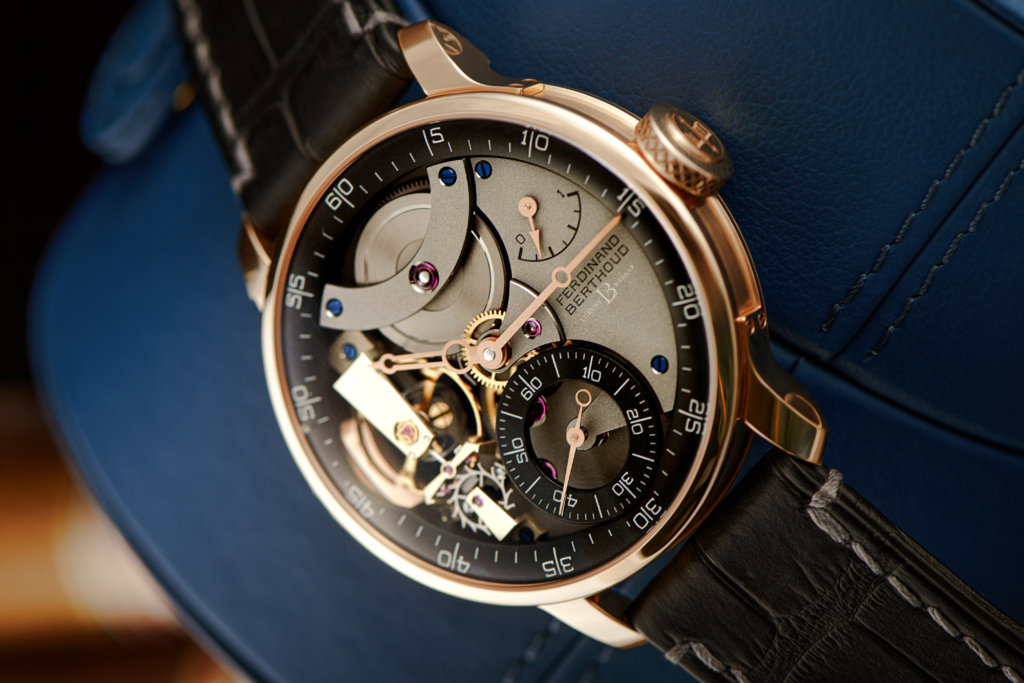
“These are the nicest watches I’ve seen in the metal,” a fellow collector once told me about Ferdinand Berthoud. “And I’ve seen a lot of very fine watches.” He’s not the only one who feels that way. If you need your next watch to be automatic, under 42mm, or under $200,000, Ferdinand Berthoud isn’t the brand for you. Otherwise, I highly suggest considering them.




Leave a Reply