All About the Forgotten Rolex Dustproof

Rolex has been so successful for so long that it seems like everything they do is automatically successful. But they endured their share of marketing failures over the years. Among Rolex’s many mostly-forgotten branding exercises was the Dustproof line of watches that launched in the 1950s. Here’s a quick rundown of Rolex Dustproof models.
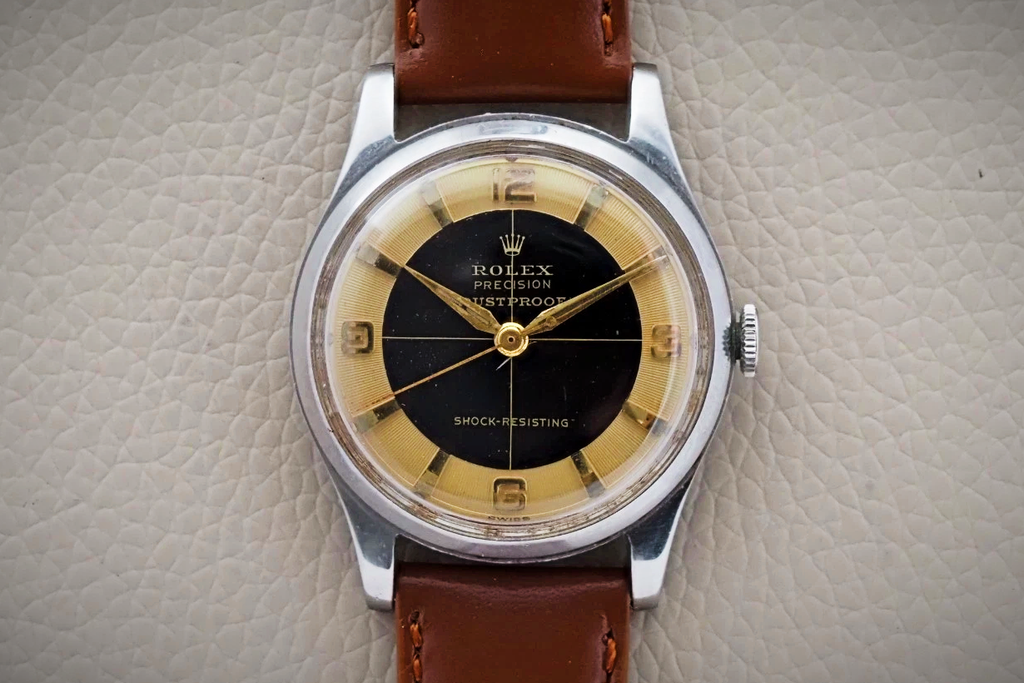
Rolex often used the term “waterproof and dustproof” (which they ripped off from Depollier) to describe their Oyster watches in early advertisements, but here we’re talking about watches that actually have “Dustproof” written on the dial as the model name. In the 1940s and 1950s there were numerous Rolex models that were only (or at least mostly) sold in Canada, and Dustproof is widely believed to be one of them.
What is a Rolex Dustproof?
Rolex Dustproof watches are all manual-wind models made from about 1957-1962 with thick yellow gold applied hour markers, Precision-grade time-only movements, radium lume, and alpha hands. Many have 34mm Oyster cases but some are as small as 30.2mm or as large as 36mm.
In my opinion, the Rolex Dustproof isn’t a full-blown dress watch–and in fact most versions have Oyster cases despite not saying “Oyster” on the dial–but it has more flair than a typical sports watch. Stainless steel is the most common case material by far, although 14k and 18k gold examples have both turned up.
Rolex Dustproof Dials
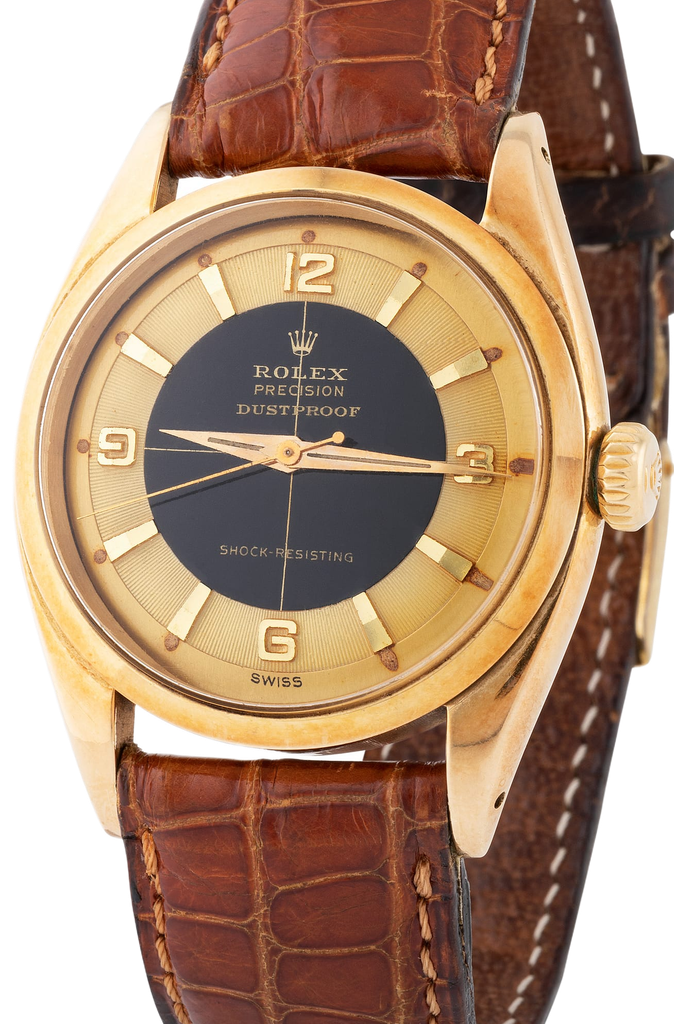
Rolex Dustproof watches always have only five words on the dial, each on its own line: Rolex, Precision, Dustproof, Shock-Resisting, and Swiss. That’s it. They never say “Oyster” on the dial even though most of them do in fact come in Oyster cases.
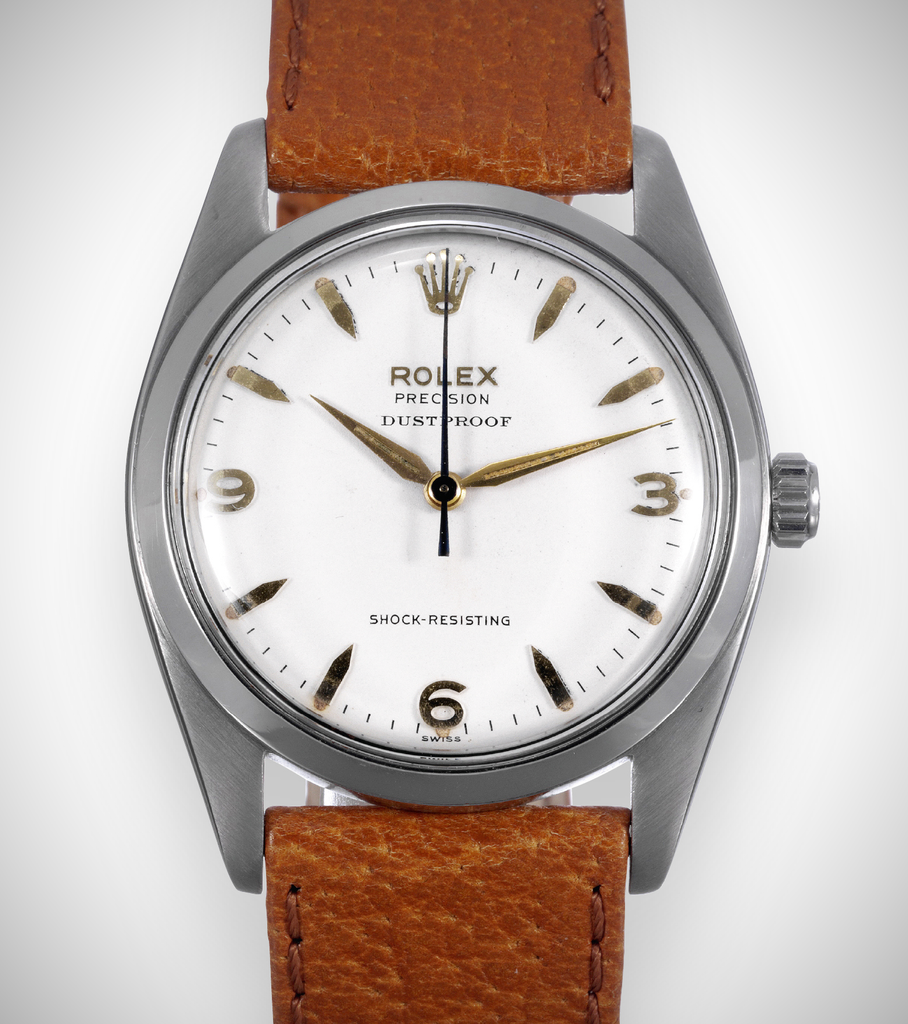
There are only three types of Rolex Dustproof dials, all with thick yellow gold applied 3-6-9 markers:
- Plain light-colored dial with pencil hour markers
- Chevron dial with arrowhead hour markers
- Tuxedo dial with crosshair in the middle and radial textured outer ring
Reference Numbers
Here are all the known references that have been branded as Rolex Dustproof:
| Rolex reference / model | Case diameter | Bezel type | Oyster case? |
|---|---|---|---|
| None (Dennison case) | 30.2 mm | Smooth | No |
| 4444 | 32 mm | Smooth | Yes |
| 4499 | 34 mm | Smooth | Yes |
| 6082 | 34 mm | Smooth | Yes |
| 6223 | 34 mm | Engine-turned | Yes |
| 6422 | 34 mm | Smooth | Yes |
| 9708 | 34 mm | Smooth | No |
| 8010 | 35 mm | Smooth | Yes |
| 6424 | 36 mm | Smooth | Yes |
What Was the Point?
We can only guess at the intended positioning of the short-lived Rolex Dustproof family, and why they never say “Oyster” even when they do in fact have Oyster cases.
Perhaps Rolex wanted to distance the “Oyster” name from anything with a manual-wind movement, or perhaps they were just throwing stuff at a wall to see what sticks. But it’s worth keeping in mind that the Submariner and GMT-Master were still largely regarded as actual professionals’ watches when the Rolex Dustproof was made; 40mm+ sports watches had not yet reached mainstream popularity. That’s probably why Rolex assumed the market would sustain so many variations of medium-sized time-only models.
In any case, the Rolex Dustproof line was not a big commercial success, and thus very few were made. But rarity only matters when collectors care about something. And based on the asking prices of the (few) Dustproof watches that come up for sale–usually double or triple what a typical version of the same reference would cost–they’re starting to.



Leave a Reply