Collector’s Guide to the Breitling Cosmonaute

In 1962, astronaut Scott Carpenter famously wore a prototype of the Breitling Navitimer Cosmonaute watch as he became the second American to ever orbit the Earth. The Cosmonaute, sporting a 24-hour layout specifically requested by Carpenter, thus became the first Swiss watch in space. And the current version of the Breitling Cosmonaute, worn by all of the Artemis II crew members on their April 2026 moon mission, is one of the most recent watches to go to space. Here’s our guide to all six generations of the Breitling Navitimer Cosmonaute.
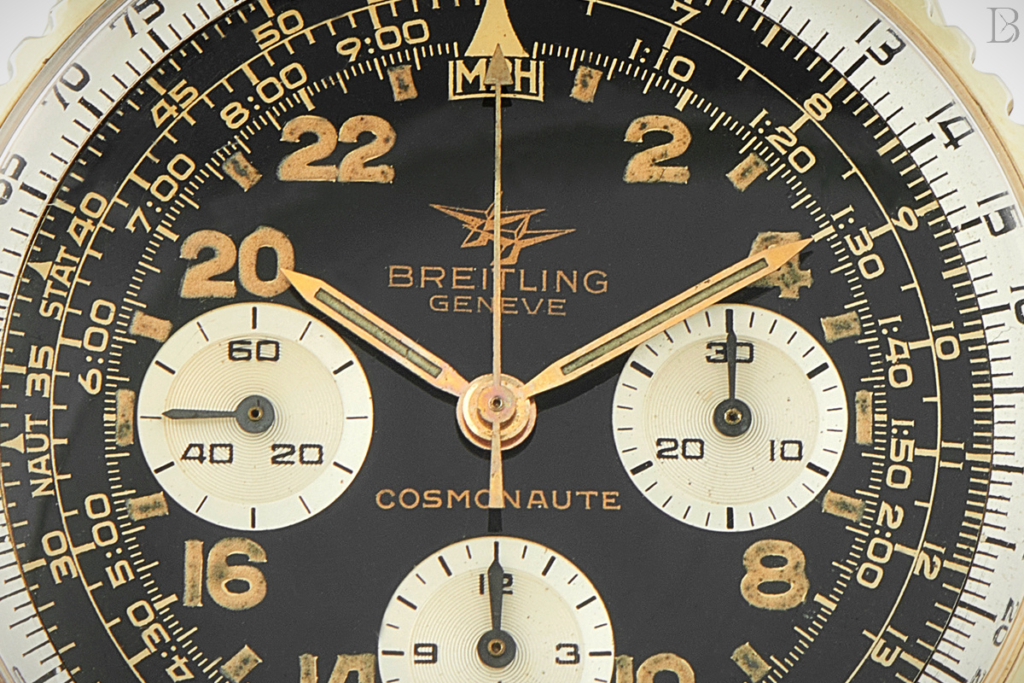
Every Breitling Cosmonaute (by definition) has a 24-hour configuration, and the knurled rotating slide rule bezel that the Navitimer is known for (here’s how to use it). All models are 41mm or larger. Let’s start with the original.
Scott Carpenter’s Prototype Breitling Navitimer Cosmonaute
Movement: Venus 178 (manual) | Width: 41mm | Logo: AOPA Wings
When you’re in space, you can’t judge by sunlight whether it’s AM or PM. So the 24-hour layout of the Navitimer Cosmonaute makes sense for spaceflight, and that’s what Carpenter wanted. When he unexpectedly contacted Breitling’s US distributor with this request, third-generation CEO Willy Breitling took it upon himself to personally oversee the development of a special 24‑hour Navitimer.
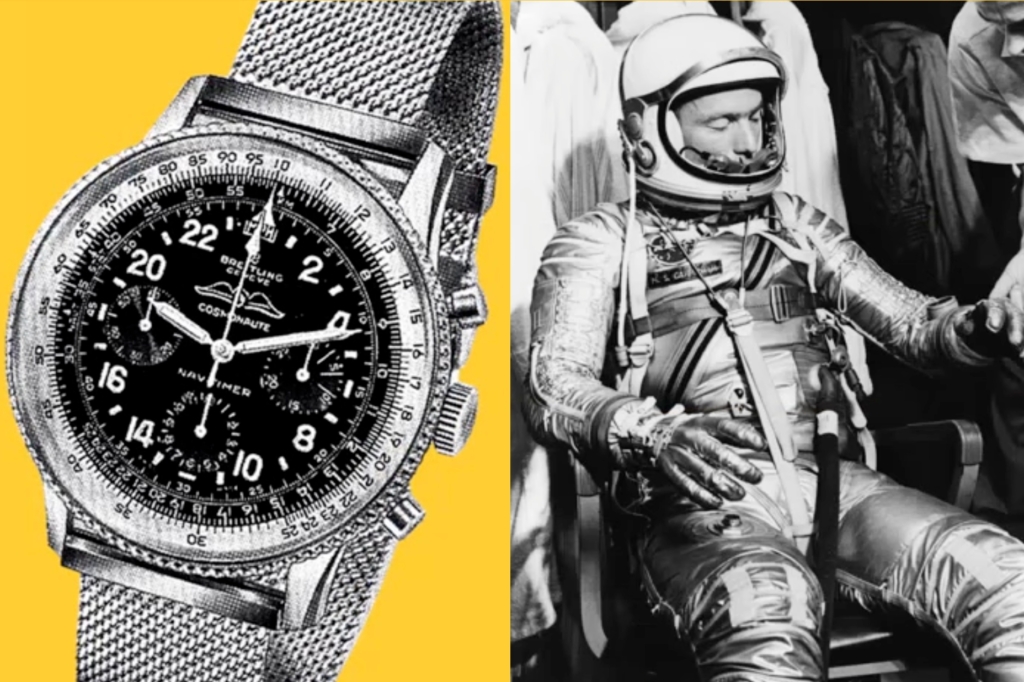
The base: a Breitling Navitimer 806, with its Venus 178 manual-wind chronograph movement modified so that its hour hand moves at half the normal speed, and a 24-hour dial to match. The rest of the watch was unchanged, aside from the bracelet.
To get it over his spacesuit, it is my assertion that Carpenter wore his Cosmonaute on a Speidel Twistoflex, a stretchy American-made bracelet that had debuted only a few years earlier based on a licensed German design. These clasp-less “hair puller” bracelets get almost universally ignored now, but I think they deserve some historical recognition, as they were the most popular replacement watch bracelet in the US for decades. Images of Carpenter from May 1962 show clearly, in my opinion, a Speidel Twistoflex on his wrist.
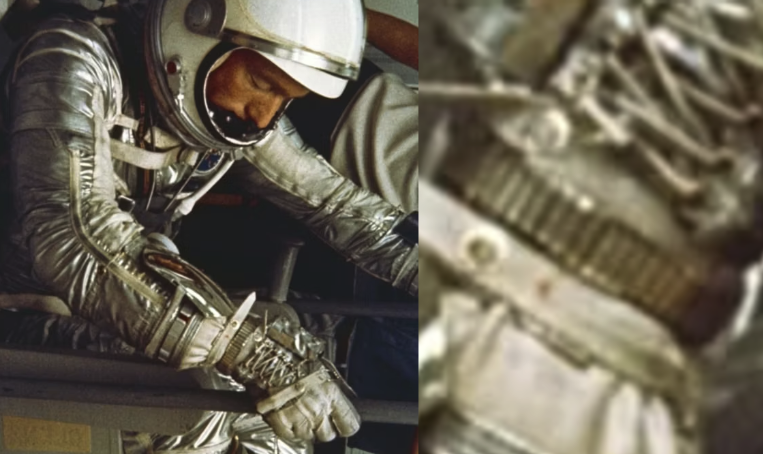
After completing his mission of orbiting the Earth three times, Carpenter landed in the ocean and, as the Navitimer is not a waterproof watch, his watch took on water while he waited to be recovered by a US Navy helicopter. Breitling gave Carpenter a new Cosmonaute, and the original (now extremely rusty) piece of history is still in the hands of Breitling.
The First Production Breitling Navitimer Cosmonaute: Ref. 809 (1962–1971)
Movement: Venus 178 or Valjoux 7736 (manual) | Width: 41mm | Logo: AOPA Wings or Twin Jets
The first production Breitling Navitimer Cosmonaute, ref. 809, was almost identical to Carpenter’s modified 806. The main difference: the tachymeter scale was replaced by a tens-of-minutes to hours:minutes converter, designed to measure elapsed mission time. So if you look at the “7” in the middle ring (to represent 70 minutes) you’ll see 1:10 in the innermost ring, for example.
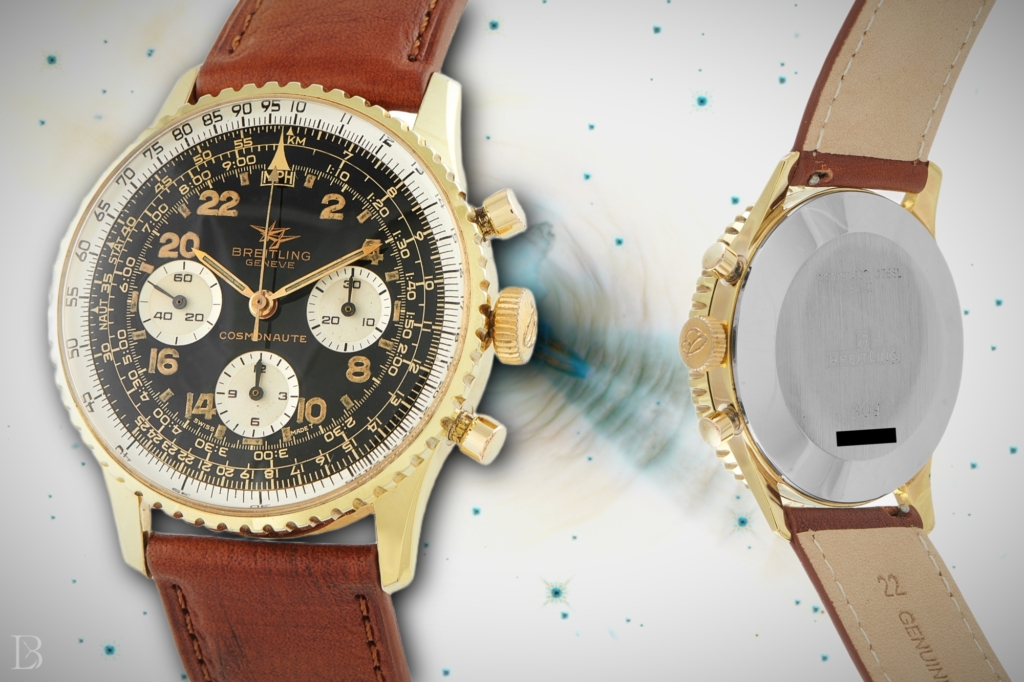
Inside the 809 is the same modified Venus 178, which is a well-respected column-wheel chronograph movement with 45 hours of power reserve. But Venus went out of business and was ultimately acquired by Valjoux by the late 1960s, so out of necessity Breitling switched to Valjoux 7736 movements for the end of the 809’s run. The Valjoux 7736 is a decent enough chronograph movement, but it’s cam-actuated and thus less “smooth” to engage and disengage than a column-wheel one.
The 809 was offered with either a gold-filled stainless steel case (thicker than mere gold plating), or a regular stainless steel case. Plus there are four known solid gold examples made for the King of Jordan.
Note that the earliest Cosmonautes feature the Aircraft Owners and Pilots Association logo, which is a shield with wings, instead of the Breitling logo. AOPA agreed to adopt the original Breitling Navitimer as their official watch, and their members were able to buy it in 1954 a year before the public could. So, there’s a long history between Breitling and AOPA. The AOPA logo on an 809 Cosmonaute usually means a Venus movement, while the “Twin Jets” logo that appeared in the mid-1960s usually indicates a Valjoux. 809-E and 809-36 are the reference numbers for the Valjoux type.
Some prefer the Twin Jets logo while others prefer the AOPA, but the Venus movement is generally favored. Note that some 809 dials lacked the “Navitimer” text, while others only had Navitimer text, etc. There are quite a few minor variations of these early Breitling Navitimer Cosmonaute dials.
As cool as it is, the original Navitimer Cosmonaute was not a huge commercial success, and the 809 didn’t last past the early 1970s.
Breitling Navitimer Cosmonaute 809 Specs
| Model Name | Navitimer Cosmonaute (First Generation) |
|---|---|
| Reference Number(s) | 809, 809-E, 809-36 |
| Case Materials | Stainless steel, gold-filled stainless steel, or solid 18k gold (rare, special order only) |
| Case Diameter | 41mm |
| Case Thickness | 13mm |
| Lug-to-Lug | 48mm |
| Movement Caliber | Venus 178 (1962–1968) / Valjoux 7736 (1968–1971) |
| Movement Type | Manual |
| Power Reserve | ~45 hours |
| Water Resistance | Not water resistant |
| Bracelet/Strap | Leather strap or steel mesh bracelet bracelet; 22mm lug width |
| Crystal | Plexiglass (acrylic), high-domed |
| Production Years | 1962-1971 |
| Typical Market Value (2026) | ~$8,500 |
“Fried Egg” Models (1968-1978)
Movement: Venus 178 (manual) or Calibre 11 (automatic) | Width: 48mm | Logo: Twin Jets
Breitling was part of a consortium of watchmakers (along with Heuer-Léonidas, Büren and Dubois-Dépraz) racing to develop the world’s first automatic chronograph movement in the late 1960s. The resulting Calibre 11 was launched successfully in May 1969, barely beaten to market by Seiko. The first Navitimer with the Calibre 11 (ref. 1806) was given a huge 48mm case made by EPSA (Ervin Piquerez SA), who famously made the “Master Compressor” case used by Jaeger-LeCoultre and others.
Collectors call it the “Fried Egg” or “Spiegelei” presumably because it resembles a big ol’ frying pan with two fried eggs in it. An equivalent Cosmonaute version of the Fried Egg, ref. 1809, was not far behind.
The 1809 features a left-hand crown, because that’s how Calibre 11 is laid out. But in 1968, before Calibre 11 was ready, Breitling released a manual-wind “Fried Egg” Cosmonaute (ref. 819, sometimes written as 0819) with the Venus 178 movement and a typical right-hand crown. Because the cases were apparently intended for the upcoming Calibre 11, the cases of 819 Cosmonautes have plugged holes on the left side of the case.
Breitling Cosmonautes with the Fried Egg case have two registers instead of three (no hour counter) although they do have a date window at 6 o’clock. They do not say Navitimer on the dial. In addition to leather straps they were offered on three-link steel bracelets that resemble a Rolex Oyster bracelet. The Breitling Cosmonaute Fried Egg Chrono-Matic (1809) has orange hands while the 819 has white hands, and the caseback of the 819 is also flatter because it has no automatic winding rotor.
Otherwise the two references are essentially identical. I believe the 819 was discontinued within a year or two of the 1809’s 1969 debut, and the 1809 was in turn discontinued in the late 1970s.
Breitling Cosmonaute “Fried Egg” Specs
| Model Name | Cosmonaute | Cosmonaute Chrono-Matic |
|---|---|---|
| Reference Number(s) | 819, 0819 | 1809 |
| Case Material | Stainless steel | Stainless steel |
| Case Width | 48 mm | 48 mm |
| Case Thickness | 13 mm | 15.3 mm |
| Case Lug-to-Lug | 55 mm | 55 mm |
| Movement Caliber | Venus 178 | Caliber 11 (Chrono-Matic) |
| Movement Type | Manual-wind | Automatic (micro-rotor, left-hand crown) |
| Power Reserve | ~42 hours | ~42 hours |
| Water Resistance | 30 m | 30 m |
| Bracelet/Strap | Leather strap or steel 3-link bracelet; 22mm lug width | Leather strap or steel 3-link bracelet; 22mm lug width |
| Years Produced | 1968-1971 | 1969-1978 |
| Typical Market Value (2026) | $4,600 | $4,750 |
Breitling as a whole was struggling by the late 1970s, as then-new quartz watches hurt the sales of mechanical chronographs particularly hard. Willy Breitling was also heirless and nearing the end of his life. Rather than getting absorbed by the conglomerate that would become the Swatch Group, he wanted Breitling to remain independent, and he found a buyer he liked in aviation enthusiast and Sicura owner Ernest Schneider.
Having run Sicura since 1960, Schneider had successfully embraced quartz watches once before, and after buying Breitling, he brought quartz movements to their lineup as well. But he also recognized the importance of mechanical chronographs to the brand, and the reborn Chronomat was a key success for them in 1984. One year later the Navitimer Cosmonaute would be relaunched.
More on Breitling:
| ➢ | A Timeline of Breitling Superocean Models |
| ➢ | The Best Entry-Level Breitling Watches |
| ➢ | The Best Breitling Watch |
| ➢ | 2025 Breitling Releases |
| ➢ | Who is Universal Genève and Why Did Breitling Buy Them? |

Lemania Era (1985–2001)
Movement: Breitling 12 (Lemania 1877 base, manual) | Width: 41.5 mm | Logo: Winged-B
The first Breitling Cosmonaute of the Schneider era, ref. 81600B (81600 is the equivalent regular Navitimer), got back to the model’s roots. It was practically a reissue of the 809, but just a tad larger at 41.5mm wide. It also sported the then-new winged-B Breitling logo. An optional seven-link bracelet gives it a much more “modern Breitling” look than the 809, although its mineral glass crystal maintains a vintage feel.
Inside the 81600B is the Breitling Caliber 12, which is a rebadged manual-wind Lemania 1877 chronograph movement. The 81600B was offered with a stainless steel, two-tone, solid gold, or gold-plated case.
Breitling’s model number convention changed around 1991, at which point the gold-plated Cosmonaute was dropped and the remaining models were renumbered to be the A12019 (steel), D12019 (two-tone) and K12019 (solid gold). Soon, sapphire crystals replaced the old mineral crystals as the 12020 models replaced the 12019s. This A12022, for instance, has a sapphire crystal:
Models ending in -21 or -23 are limited editions with sapphire casebacks. Otherwise, aside from the letters that denote the watch’s material, the different model numbers of the Breitling Cosmonaute Lemania era just refer to different dial styles (D12022 has a white dial while D12020 has black for example).
Lemania-Era Breitling Cosmonaute Specs
| Model Name | Navitimer Cosmonaute |
|---|---|
| Reference Number(s) | 81600B, A12019, A12020, A12021, A12022, A12322, A12023, D12020, D12021, D12022, D12322, D12023, K12019, K12020, K12022, K12322 |
| Case Material | A prefix: Stainless steel D prefix: Two-tone K prefix: Solid gold (81600 offered in all three, plus gold-plated) |
| Case Width | 41.5 mm |
| Case Thickness | 13 mm |
| Case Lug-to-Lug | 48 mm |
| Movement Caliber | Breitling Caliber 12 (Lemania 1877) |
| Movement Type | Manual-wind |
| Power Reserve | ~42 hours |
| Water Resistance | 30 m |
| Crystal | 81600, A12019, K12019: Mineral glass Others: Sapphire |
| Caseback | A12021, D12021, A12023, D12023: Sapphire caseback Others: Solid caseback |
| Bracelet/Strap | Leather strap or steel 3-link bracelet; 22mm lug width |
| Years Produced | 1985-2001 |
| Typical Market Value (2026) | $4,200 (Steel, add $600 for bracelet) $3,800 (Two-tone, add $2,000 for bracelet) $15,500 (Gold) |
ETA Automatic Era (2002–2011)
Movement: Breitling 22 (ETA 2892-A2 + module, automatic) | Width: 41.5 mm | Logo: Winged-B
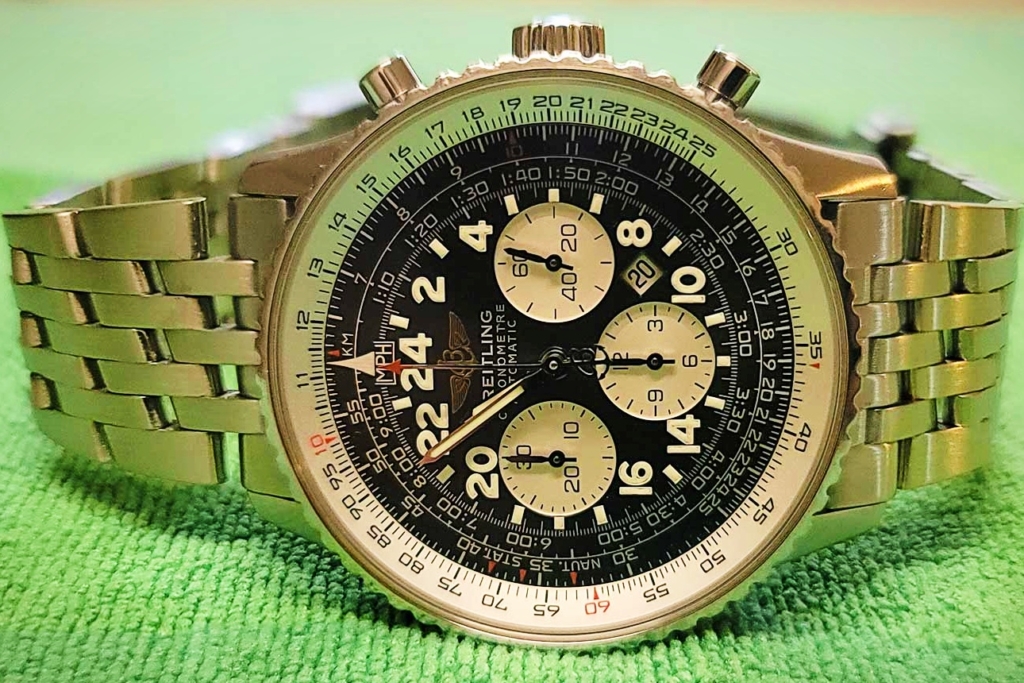
In 2002, the fourth-generation Breitling Cosmonaute was born, featuring an ETA 2892-A2-based Breitling caliber 22 movement. Visually it hardly changed from the Lemania era, but it added three key features: automatic winding, a date window at 4:30, and flyback chronograph functionality. It’s the only flyback generation of Cosmonautes (meaning you can restart the chronograph without stopping it).
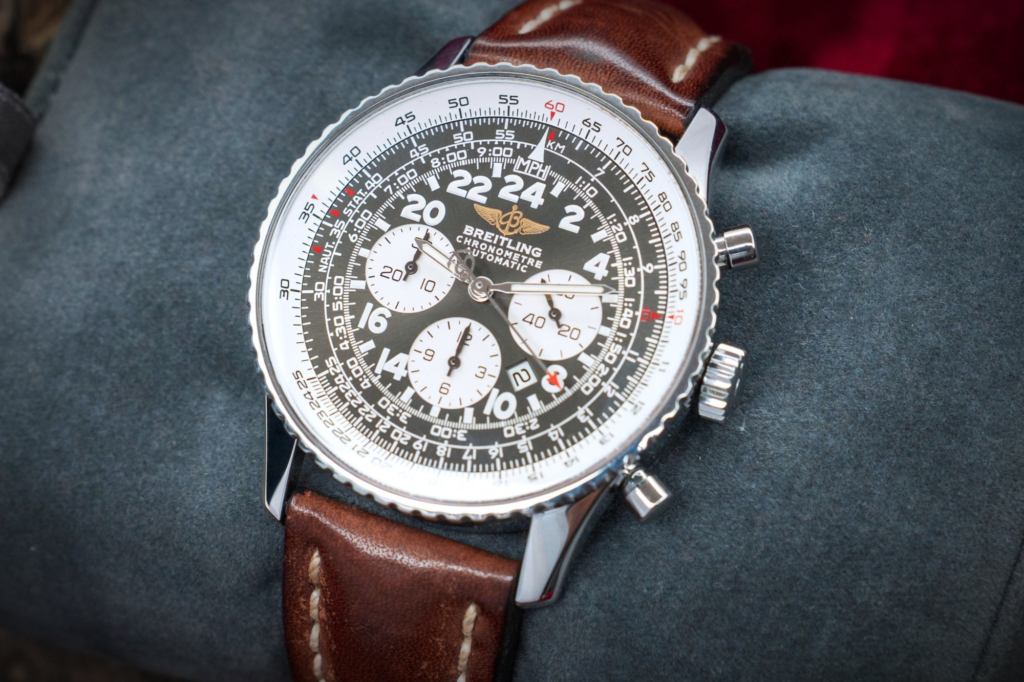
The space needed for the rotor of the automatic movement increased the thickness from 13mm to 14.4mm. And metal bracelets became much more common in the ETA era of the Breitling Cosmonaute.
A particularly desirable version is the “Porco Rosso” Japan-only limited edition, named for the renowned 1992 animated film by Studio Ghibli. The watch was released in 2001 to commemorate the opening of the Ghibli Museum, and features a depiction of Porco Rosso flying his plane at the top of the dial. 300 were made.
Aside from special editions like that, ETA-based Cosmonautes tend to sell for similar prices as their Lemania-based predecessors.
ETA-Era Breitling Cosmonaute Specs
| Model Name | Navitimer Cosmonaute |
|---|---|
| Reference Number(s) | A22322, D22322, K22322 |
| Case Material | A prefix: Stainless steel D prefix: Two-tone K prefix: Solid gold |
| Case Width | 41.5 mm |
| Case Thickness | 14.4 mm |
| Case Lug-to-Lug | 48 mm |
| Movement Caliber | Breitling Caliber 22 (ETA 2892-A2 + module) |
| Movement Type | Automatic |
| Power Reserve | ~42 hours |
| Water Resistance | 30 m |
| Crystal | Sapphire |
| Caseback | Solid |
| Bracelet/Strap | Leather strap or metal bracelet; 22mm lug width |
| Years Produced | 1985-2001 |
| Typical Market Value (2026) | $4,000 (Steel, add $600 for bracelet) $3,600 (Two-tone, add $2,000 for bracelet) $15,000 (Gold) |
43mm B02 Era (2012–2013)
Movement: B02 (in-house manual ) | Width: 43 mm | Logo: Winged-B
The first Breitling Navitimer Cosmonaute with an in-house movement appeared in 2012 to commemorate the 50th anniversary of Carpenter’s famous spaceflight. Its manual-wind B02 movement is based on the now-familiar and beloved automatic B01 caliber that launched in 2009. The date remains at 4:30, this time in a typeface with serifs, and overall these early B02 Breitling Cosmonautes look similar to the ETA-based ones, just enlarged to 43mm and with an applied silver-tone logo.
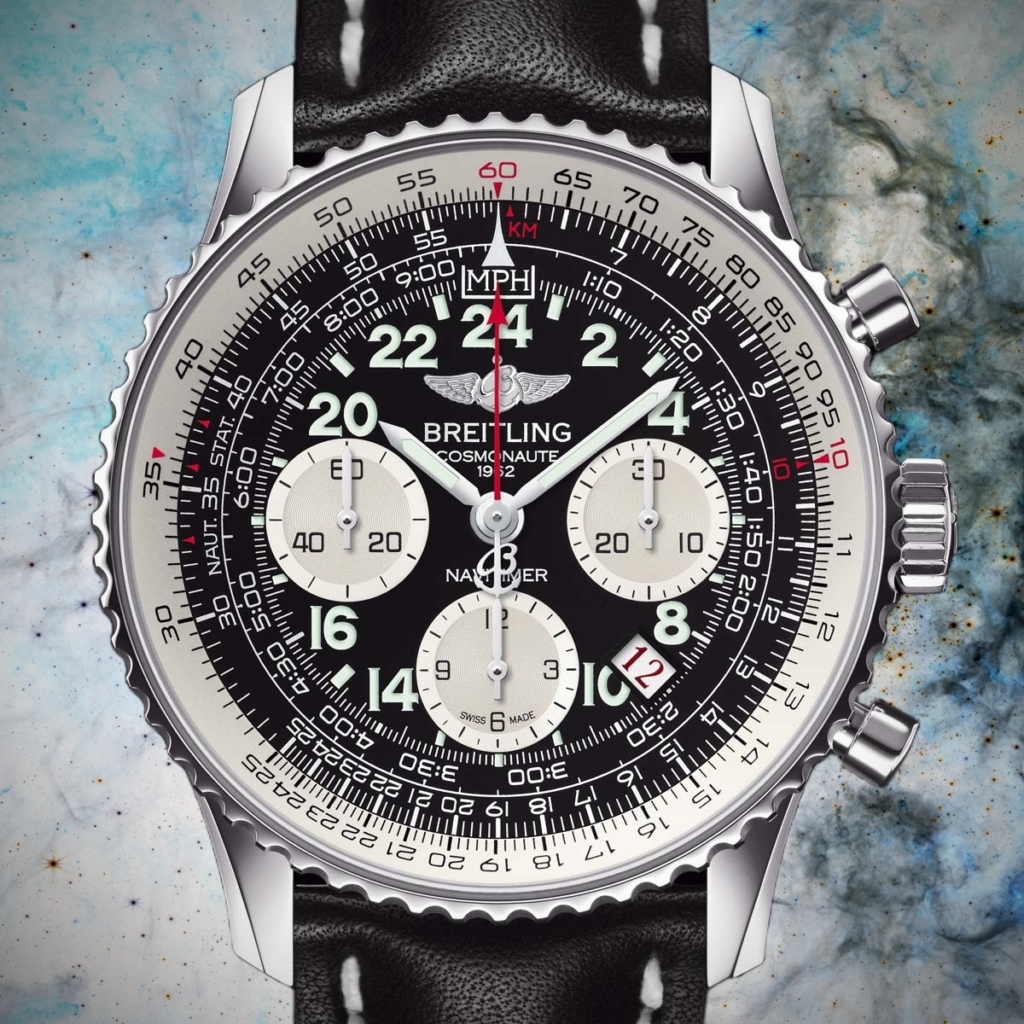
Only 1,962 examples were made in regular stainless steel, and 1,000 examples of a limited “Blacksteel” model (PVD-coated stainless steel) came in 2013. They all have solid casebacks. Breitling didn’t release another Cosmonaute for about nine years after that.
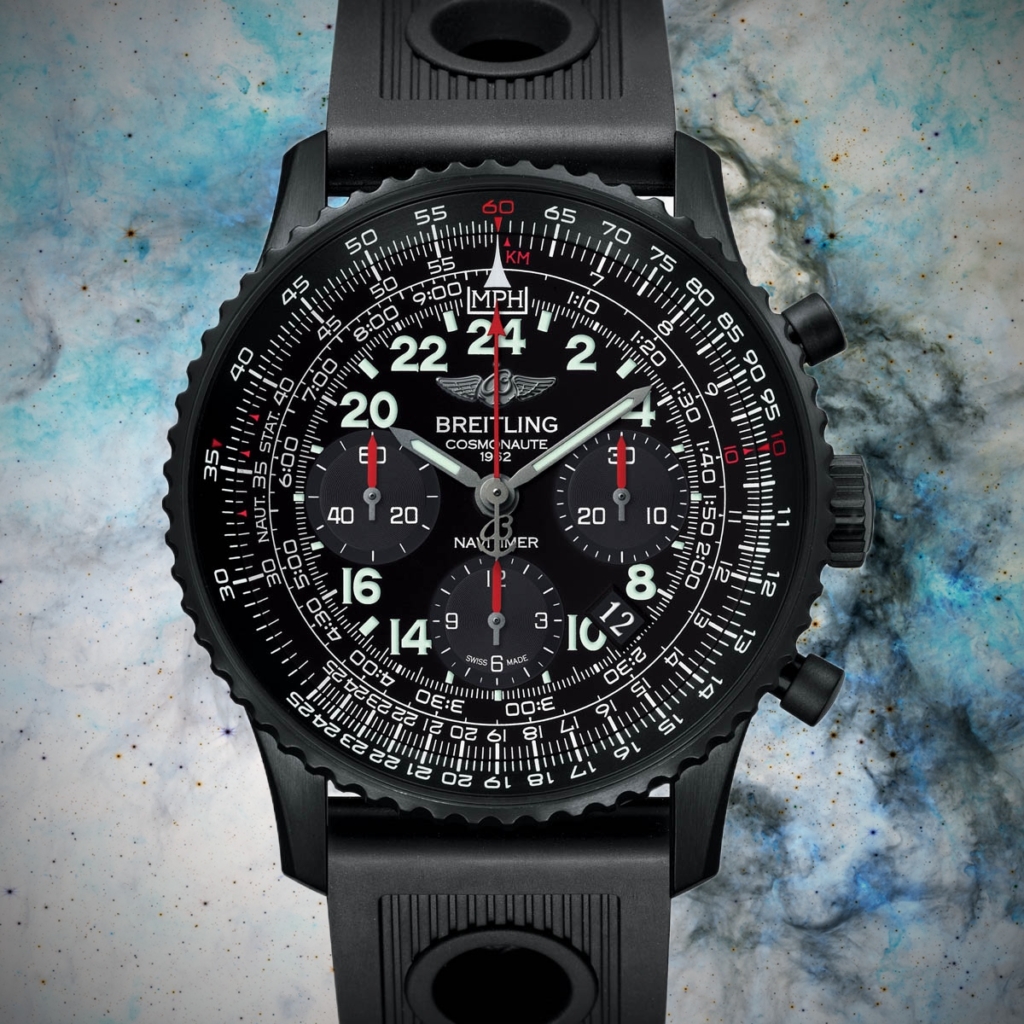
43mm Breitling Navitimer Cosmonaute Specs
| Specification | AB0210 / MB0210 Cosmonaute 02 (2012–2023) |
|---|---|
| Model Name | Navitimer Cosmonaute 02 |
| Reference Numbers | AB0210, MB0210 |
| Case Material | AB: Stainless steel MB: Blacksteel |
| Case Width | 43 mm |
| Case Thickness | 13.9 mm |
| Case Lug-to-Lug | ~50 mm |
| Movement Caliber | Breitling Caliber 02 (in-house, manual-wind) |
| Movement Type | Manual-wind |
| Power Reserve | ~70 hours |
| Water Resistance | 30 m |
| Crystal | Sapphire (AR-coated) |
| Caseback | Solid |
| Bracelet/Strap | Leather strap or rubber strap; 22mm lug width |
| Years Produced | 2012–2023 |
| Typical Market Value (USD) | $5,500–$6,500 (AB0210, steel) $7,000–$8,500 (MB0210, Blacksteel LE) |
41mm B02/B12 Era (2022–present)
B02 (in-house, manual) or B12 (in-house, automatic) | Width: 41 mm | Logo: AOPA Wings
In 2022, the sixth (and current) generation of the Breitling Navitimer Cosmonaute brought the size back down to the traditional 41mm width. The traditional AOPA logo is back, and 6 o’clock dates and exhibition casebacks are now standard.
The sixth-generation Breitling Cosmonaute dropped the innermost ring of text that was used to convert tens of minutes to hours:minutes, which I think was a good choice–the slide rule makes the dial plenty busy already.
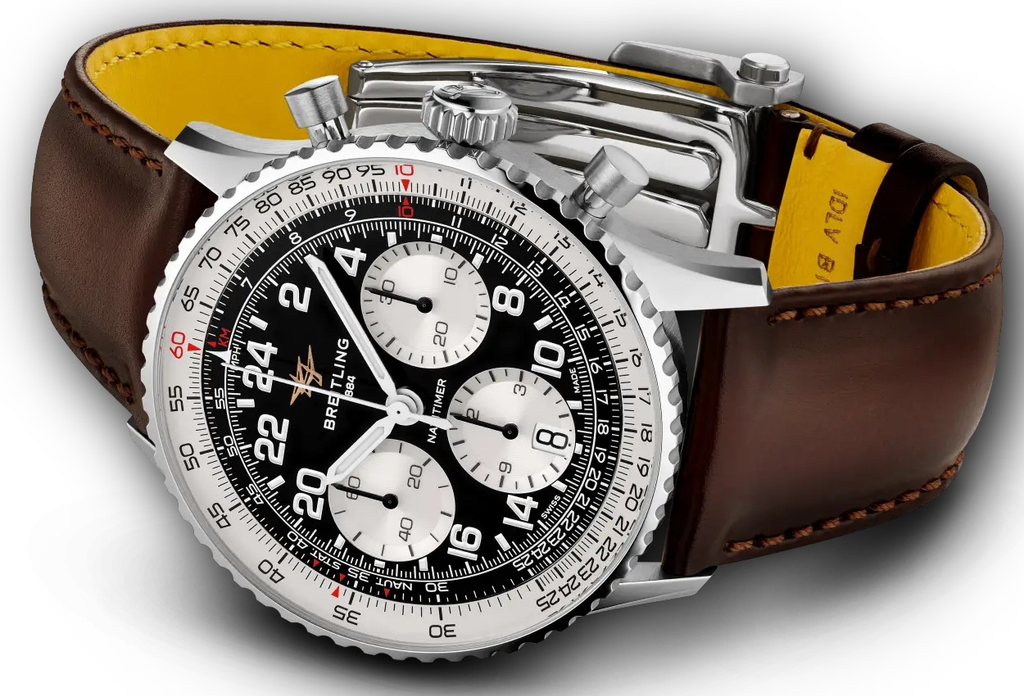
Breitling has only released a few versions, all limited editions except for one. The regular-production steel model starts at $10,600 (a $2,700 premium over a comparable Navitimer 41 with a 12-hour dial).
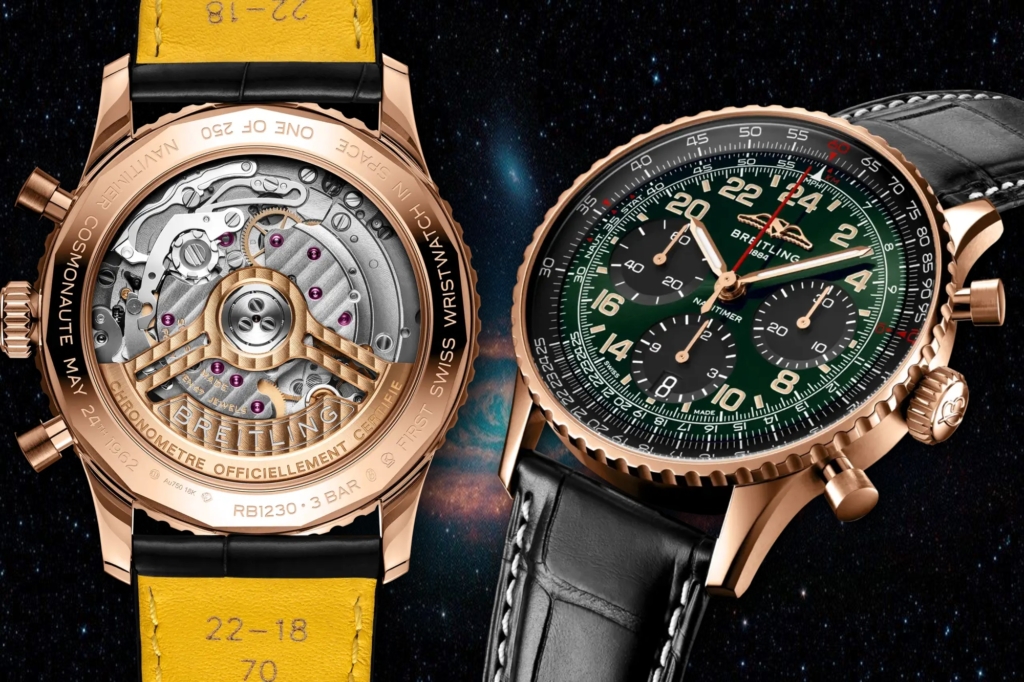
The $25,000 rose gold model comes with a green dial and an automatic B12 movement, while the other sixth-gen Cosmonautes keep the manual-wind B02.
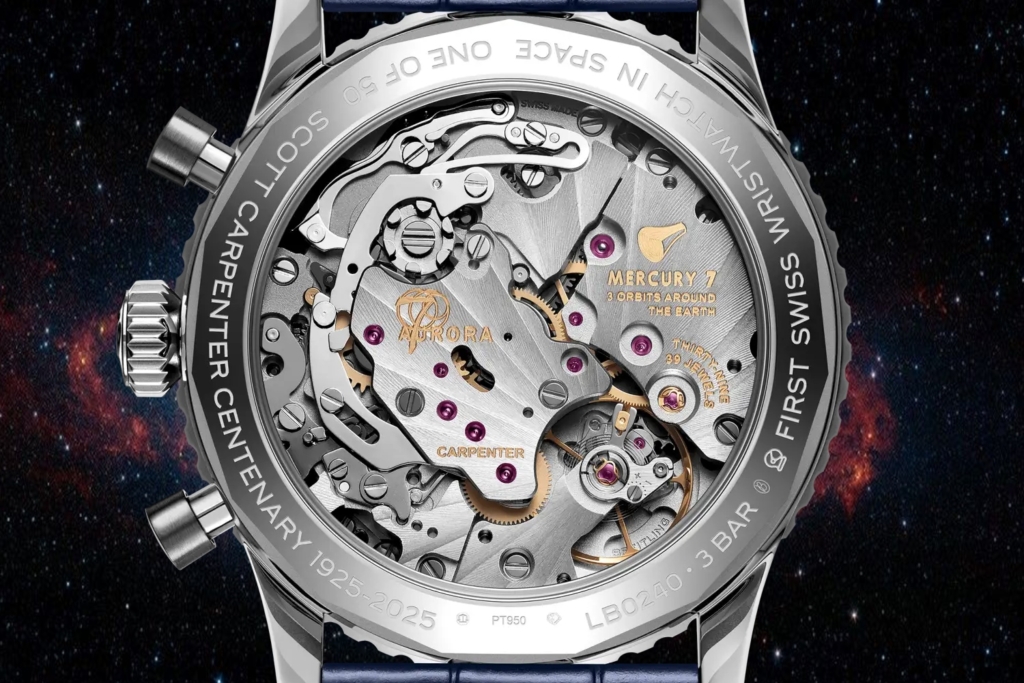
The solid platinum blue-dial “Scott Carpenter Centenary Edition,” which came as one of Breitling’s 2025 releases to celebrate what would be Carpenter’s 100th birthday, retails for $43,700.
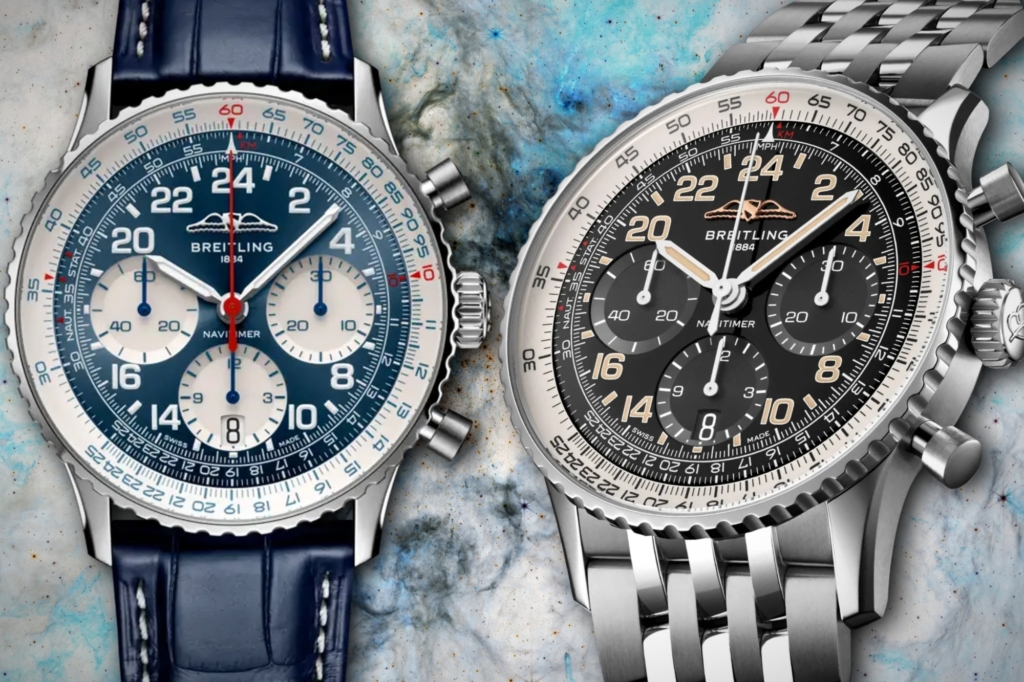
A stainless steel version with a black dial and platinum bezel, meanwhile, last sold for $12,650. There was also a Japan-only version of that, featuring a grey dial with a black outer ring and subdials. And in April 2026, a fully stainless steel version with a “galaxy-blue” meteorite dial was worn in space by the entire Artemis II crew alongside their NASA-qualified 2nd-generation Omega Speedmaster X-33 watches.
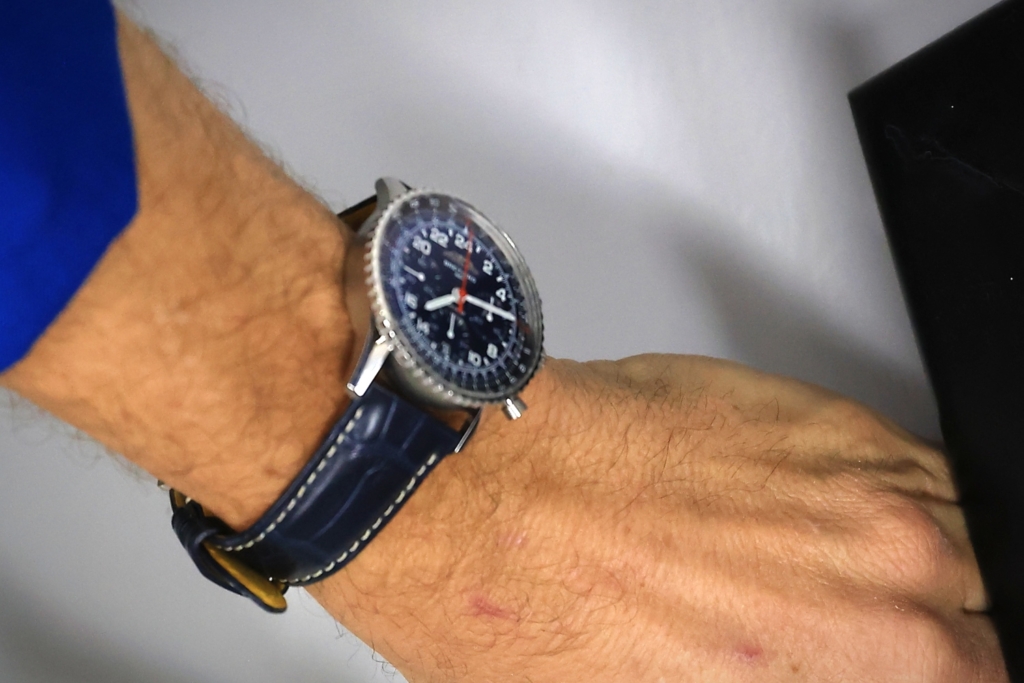
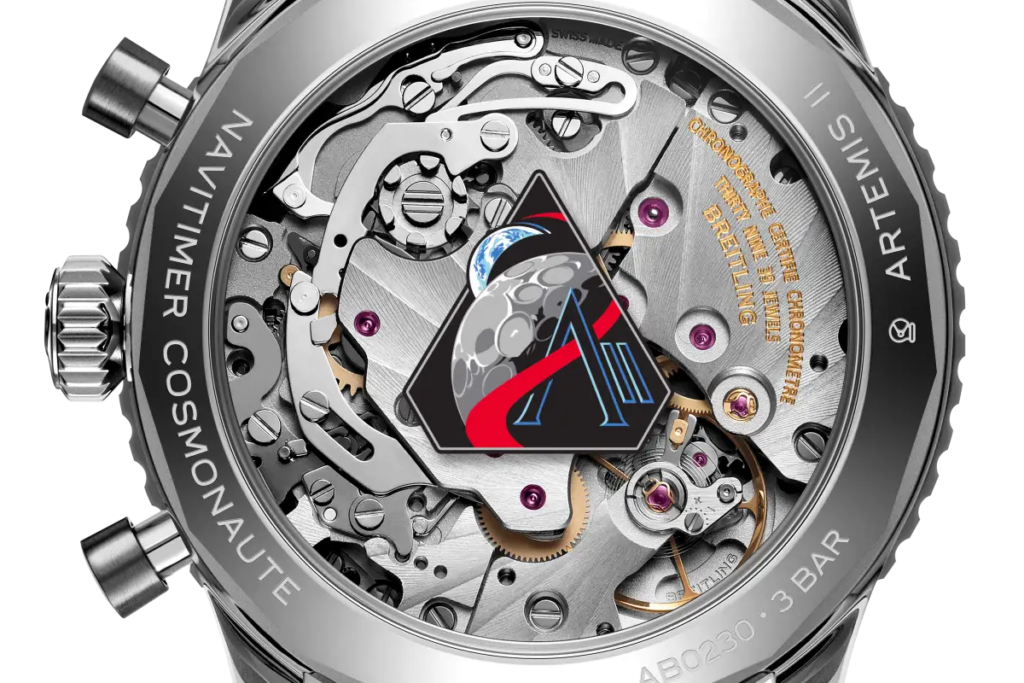
The Artemis II edition, limited to 450 pieces with a list price of $11,900, has the crew’s mission patch visible through the exhibition caseback.
All modern Cosmonautes have folding clasps. Let’s break down all the specs now:
6th-Generation Breitling Cosmonaute Specs
| Specification | AB0230 | PB0230 | RB1230 | LB0240 | AB0230 |
|---|---|---|---|---|---|
| Model Name | Navitimer B02 Chronograph 41 Cosmonaute | Navitimer B02 Chronograph 41 Cosmonaute | Navitimer B12 Chronograph 41 Cosmonaute | Navitimer B02 Chronograph 41 Cosmonaute Scott Carpenter Centenary | Navitimer B02 Chronograph 41 Cosmonaute ARTEMIS II |
| Full reference number(s) | AB0230211B1X1 | PB02301A1B1P1 PB02301A1B1A1 PB02302A1B1A1 (Japan-only) | RB12302A1L1P1 | LB0240211C1P1 | AB02307A1C1P1 |
| Case Material | Stainless steel | Stainless steel with platinum bezel | 18k red gold | Platinum | Stainless steel |
| Case Width | 41 mm | 41 mm | 41 mm | 41 mm | 41 mm |
| Case Thickness | 13 mm | 13 mm | 13.6 mm | 13 mm | 13 mm |
| Movement Caliber | Breitling B02 (Manual) | Breitling B02 (Manual) | Breitling B12 (Automatic) | Breitling B02 (Manual) | Breitling B02 (Manual) |
| Power Reserve | Approx. 70 hrs | Approx. 70 hrs | Approx. 70 hrs | Approx. 70 hrs | Approx. 70 hrs |
| Water Resistance | 30 m | 30 m | 30 m | 30 m | 30 m |
| Bracelet/Strap | Brown calfskin leather strap | P1 at end: Alligator leather strap A1 at end: Stainless steel bracelet | Alligator leather strap | Blue alligator leather strap | Blue alligator leather strap |
| Lug Width | 22 mm | 22 mm | 22 mm | 22 mm | 22 mm |
| Limited Edition | No | PB02301: 362 pieces total PB02302: 200 pieces | 250 pieces | 50 pieces | 450 pieces |
| Release Date | October 2026 | May 2022 | March 2024 | May 2025 | April 2026 |
| MSRP (2026 or most recent) | $10,600 | $12,150 (strap) $12,650 (bracelet) | $25,000 | $43,700 | $11,800 |
Breitling has only made one regular-production Cosmonaute model in the past 15 years, seemingly preferring to release limited editions instead. So, clearly they view it as a special model. Longtime Breitling fan Jerry Seinfeld thinks it’s special too, and NASA’s recent Cosmonaute-equipped trip to the moon will probably convince some new fans as well.


Leave a Reply